

Track your comments!
[x]


When you register, comments on your articles and replies to your comments appear here. Register Now!

Sign in to your account
[x]

Not a Scientific Blogging member yet?

Register Now for a Free Scientificblogging.com Account

  • Customize your profile with pictures, banner, a blogroll and more.
  • Leave comments on articles, add other members to your friend lists, chat with people on the site.
  • Write blog posts that can be seen by hundreds of thousands of readers.

It's free and it only takes a minute!

Already a Scientific Blogging member?

Sign In Now

Banner
By Randy Borum | May 15th 2009 08:43 AM | 16 comments | Print | E-mail | Track Comments
.

More Social/Behavioral Science & Security articles

All

About Randy Borum

Dr. Randy Borum is Professor in the College of Behavioral and Community Sciences at the University of South Florida, where he holds a joint appointment the College of Public Health.

He recently... Full Bio

Are there common structures or patterns to violent extremist ideologies, even when the content of the beliefs is dramatically different? 

Social and political scientists have explored elements of this question for decades using a variety of different methods.  And the method does seem to matter.  Several years ago, I tried to identify such overarching ideological patterns – not as a social science theory – but just as teaching tool for state and local law enforcement personnel, to help make the point that understanding extremists is not only about knowing what  they purport think or believe (or inferring motive from such statements), but knowing how those ideologies develop and facilitate (or inhibit) violent action. 

My overly simplistic rendering suggested four main ideological structures, which I summarized with the acronym PATH:

  • Polarized:  The essence of which is an us vs them mindset, or what some would regard as in-group – out-group conflict.


  • Absolutist:  The beliefs are regarded as truth in the absolute sense, sometimes supported by sacred authority.  This squelches questioning, critical thinking, and dissent.  It also adds moral authority to framing us vs. them as a competition between good and bad (or evil).


  • Threat-Oriented:  External threat causes in-groups to cohere.  Good leaders know this intuitively, if not from reading social psychological research.  They persistently remind adherents that the “us” is at risk from the “them.”  Because the “us” is seen as being good or right in the absolute sense, this works not only to promote internal cohesion but external opposition. 


  • Hateful:  Hate energizes violent action.  It allows principled opposition to impel
    direct action.  It also facilitates various mechanisms of moral disengagement – such as dehumanization – which erode the social and psychological barriers to engaging in violence that
    one believes is “justified” (an important point, since many more people endorse the justification for extremist violence than actually commit such acts).
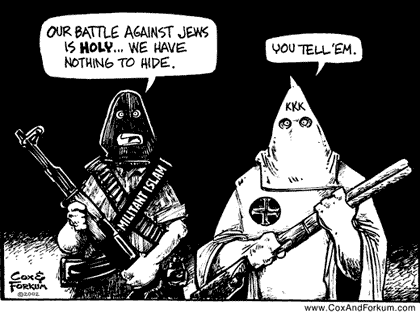


Admittedly unscientific, this PATH model represented how I came to view common ideological structures across extremists groups, whose beliefs differed radically from one another.

Gerard Saucier – a social psychologist at University of Oregon – and his international team of colleagues sought to investigate this same question on larger scale. The results of their study are reported in the May,
2009 issue of Perspectives in Psychological Science

They began with a rationally-derived “working model of the major components of the militant-extremist mind-set,” then collected books, printed and web-based material from militant-extremist individuals or groups to see how often certain themes appeared.  They wanted a broad range of groups, so they deliberately chose at least one from each of seven world regions.  “To qualify, a group had to have been active within the last 150 years, had to fit the definition of militant extremism, and also had to have had a record of actual violence involving the death of multiple persons outside the group. A qualifying group also had to have sufficient written documentary evidence (i.e., original statements) that would clearly indicate its mind-set.”

Saucier (the senior author) scanned these extremist documents looking for the presence of themes, then judged which themes were present in multiple statements “when, in Saucier's judgment, a reasonable
person hearing the set of statements would acknowledge them to be making the same essential point."  It is not clear from the described methodology, whether a coding scheme was used or whether any check was done on the inter-rater reliability of theme identification

The authors identified 16 themes “based on fairly obvious correspondences that emerged in repeated reviews of the extracted statements. Each of these 16 themes was found to occur in three or more groups.”

Accordingly, the “Key themes characterizing a militant-extremist mind-set” were identified as follows: 


  1. The necessity of unconventional and extreme measures.


  2. Use of tactics that function to absolve one of responsibility for the bad consequences of the violence one is advocating or carrying out.


  3.  Prominent mixtures of military terminology into areas of discourse where it is otherwise rarely
    found.


  4. Perception that the ability of the group to reach its rightful position is being tragically obstructed


  5. Glorifying the past, in reference to one's group.


  6. Utopianizing. There is frequently reference to concepts of a future paradise, or at least "the promise of a long and glorious future"


  7. Catastrophizing. There is a perception that great calamities either have occurred, are occurring, or will occur.


  8. Anticipation of supernatural intervention: Miraculous powers attributed to one's side, miraculous events coming to help one's side, or commands coming from supernatural entities.


  9. A felt imperative to annihilate (exterminate, crush, destroy) evil and/or purify the world entirely from evil.


  10. Glorification of dying for the cause.


  11. Duty and obligation to kill, or to make offensive war.


  12. Machiavellianism in service of the "sacred." This theme involves the belief that those with the right (i.e., true) beliefs and values are entitled to use immoral ends if necessary to assure the
    success of their cause.


  13. An elevation of intolerance, vengeance, and warlikeness into virtues (or nearly so), including, in some cases, the ascribing of such militant dispositions to supernatural entities.


  14. Dehumanizing or demonizing of opponents.


  15. The modern world as a disaster. Among militant extremists, there is commonly a perception that modernity, including the consumer society and even instances of successful economic progress, is actually a disaster for humanity.


  16. Civil government as illegitimate.


They suggest that militant-extremist groups use these thematic elements to craft a “narrative” frame for their ideologies.  Drawing on these 16 themes, they offer the following of how they might cohere in a narrative:

“We (i.e., our group, however defined) have a glorious past, but modernity has been disastrous, bringing on a great catastrophe in which we are tragically obstructed from reaching our rightful place, obstructed by an illegitimate civil government and/or by an enemy so evil that it does not even deserve to be called human. This intolerable situation calls for vengeance. Extreme measures are required;
indeed, any means will be justified for realizing our sacred end. We must think in military terms to annihilate this evil and purify the world of it. It is a duty to kill the perpetrators of evil, and we cannot be blamed for carrying out this violence. Those who sacrifice themselves in our cause will attain glory,
and supernatural powers should come to our aid in this struggle. In the end, we will bring our people to a new world that is a paradise.”


ResearchBlogging.orgSaucier, G., Akers, L., Shen-Miller, S., Knežević, G.,&Stankov, L. (2009). Patterns of Thinking in Militant Extremism Perspectives on Psychological Science, 4 (3), 256-271 DOI: 10.1111/j.1745-6924.2009.01123.x

Comments

Zionism to a tee

Hank's picture
Any ideology, actually.   That's the whole point of the article.   You can find these same common factors in the KKK, militant Islam, right-wing death groups, left-wing communist dictatorships, etc.   That's what makes them extremist instead of doing things like writing articles to make their cases.

Riane Eisler discussed this in her books. Basically, you've got the big four: authoritarianism, rigid male dominance, socially accepted violence, and the belief that all of these things are normal or even 'moral'. Go read 'The Chalice and the Blade', you'll see it's all there.

Gerhard Adam's picture
I think another point that needs to be included (or at least more specifically be acknowledged) is the role of fear and hopelessness.  While they may fit into some of the existing categories, there is a certain sense from the "external threat" perspective that causes a fear reaction in people, but if they feel correspondingly helpless, there will be a tendency to desire retaliation.

While there is no question that some of the leaders may well be focussed on hate and manipulation, there are also a significant number of recruits that respond because they feel hopeless that anything will ever change, so it becomes easier to "sacrifice for the cause".

In addition, I find it interesting that many of the definitions associated with PATH could be assigned to the "talking heads" on radio and television since they seem intent on emphasizing the discontent and rallying individuals around their respective "liberal" or "conservative" teams.

rborum's picture
First - Thanks to all who took time to read the post.  I was not sure how much interest there might be in social science on a forum that seems (perhaps by my misjudgment) oriented toward physical/life sciences.  But I have been grateful for those of you who have been receptive.

Gerhard -

Accurate observation about the PATH factors.  They may (or may not) be common structural elements across differing militant- extremist ideologies, but they are not necessarily unique or specific to those groups.  Each is based on a more general social scientific principle, and in that sense these elements may be seen simply as tools or devices, used to influence beliefs and action.

What I think may be critical moving forward is to better understand not just what makes extemists different from non-extremists, but among the extremists (including those who may believe that violence is justified), what causes some to act and others only to believe or support.

Randy

Gerhard Adam's picture
"...what causes some to act and others only to believe or support."

If I might throw in my two cents, I suspect that the driving force is something I would call "immersion".  Basically it is a form of propagandizing whereby the individual is surrounded by others (whether it be families, coworkers, etc.) that share a common view that they perpetually reinforce to each other.

Such a group may be related to any of the social groups to which people belong, but invariably it involves reinforcing existing beliefs or ideas and perpetuating the feeling of hopelessness that I mentioned earlier. 

It is no coincidence that in examining the political rhetoric in this country (the U.S.), that we seem polarized into "red" and "blue" states, because invariably people tend to watch programs and listen to individuals that reinforce their existing beliefs and ideas rather than to engage in critical thinking.  If there are no counter forces to mitigate against such exposure it would eventually consume your life by dominating your thinking.   In this country,  there are many factors that can mitigate against such exposure since we are also inundated with consumer pressures and entertainment that can act as a sort of "safety valve" so that our entire existence isn't focused around our ideology.

In situations where there is no release, it isn't difficult to image that invariably an individual may come to feel that there literally is no alternative and their involvement in extremist violence is all but inevitable. 

antunes's picture
First, let me say-- great article! Right up with with Mackay's 'Madness of Crowds' or Underhill's 'Why We Buy' in terms of putting complex social constructs into a scarily easy to understand cookbook recipe for controlling people.

That said, I also think it's a very timely article. I've noticed that scientists and science writers like us have, in the past, had a good role in defining society, but the recent advances in our culture have led to a cultural catastrophe of ignorance and anti-intellectualism, in which we no longer can fulfil our vital role. Obstructed by the unconstitutional operations of the government and the actions of corporate media, we need to take a stand against these jackals of oppressive idioicy. This may require extreme measures, but we should be willing to accept that and accept that, indeed, any means is justified because we must save society as a whole. As an army of the elite, we are best able to annihilate these evil forces which keep humanity downtrodden and purify the world of ignorance, in fact, it is our duty to do this, no matter what extreme force is required. Sacrifices will be required, tenure may be lost, but we shall remember those who fall in the line of duty, and rewards will be due to all who serve Glorious Leader Hank in our crusade. The tide of human culture and humanity's undeterable will to be free will be on our side, as will the zeitgeist of progress, and in the end, we will bring ourselves and all of humanity to a new golden age. So now is the time for scientific bloggers to rise up, cast off our shackles, and free the world! Now is our time to rule again, to lead humanity to the light! So say we all! So say we all!

Hank's picture
You had me thinking you were serious until I saw 'zeitgeist' - serious people don't use that word.   We actually had a motion to ban it on the site (along with schadenfreude) but those pesky freedom of speech types that run around here said that would be bad.   

Other hidden cultural litanies newer people may not be aware of ... when someone here writes, or quotes someone, saying something like "It has long been known" or "Much additional work will be required" I secretly link to this article.   If I see a press release claiming scientists were 'baffled' or 'stunned' and we write something on it I link to this one and, more recently, whenever anyone mentions 'gold' I link to the video in the comment of this one.

Inside jokes by the elite are true zeitgeist.  And a hint of my classically romantic intellect.

antunes's picture
Hank writes:
You had me thinking you were serious until I saw 'zeitgeist


Wait, the sentence before that with "to all who serve Glorious Leader Hank" didn't strike you as odd?  Now I'm worried!


Hank's picture
No way.   I am putting that in my bio!   It's cooler than anything Mao ever had, though Eisenhower had my all-time favorite during WW2 (along with coveted and rare 5 stars as a General) - "Supreme Commander of the Allied Powers".  It's hard to top that.

jtwitten's picture
Freedom of speech makes it easier to spot the idiots.

Stellare's picture
Excellent comment - and ideas! Supreme! I'm all for world dominance - by scientists. :-)) And what the heck - let Hank be our glorious leader. He's easy to manipulate anyhow. Hahaha

rborum's picture

Thanks for those links.   Wonderful reminders about the need for clarity in science writing. 


kstone's picture
Great summary and important topic. 

Enjoyed the comments and here's my 2 cents from a practical standpoint. White nationalists and other hate groups are violent in their language, promote division and advocate acts of real violence. And yet, most people remain blithely unaware of their existence. If you look at the hate group map maintained by the Southern Poverty Law Center you'll see that virtually every state has one or even dozens of extremist groups that are operating just beneath the surface. And their numbers are growing. 

The SPLC is the premiere hate group, targeting anyone who publicly diverges from multicultural orthodoxy. They also have near-official imprimatur, with Mark Potok or one of his underlings quoted in virtually every article dealing with "civil rights" or "hate" (both politically bastardized and ultimately meaningless terms, IMHO). They also don't seem to lack for funding.

"Violent in their language"? Apparently you've missed Hispanic irredentists call for the expulsion and/or extermination of Whites in North America. "Advocate acts of real violence"? Try listening to some rap.

Just my two cents.

One of the most interesting and disturbing aspects of this excellent post was the extent to which both the PATH model and Saucier's report tended to characterize effective mobilizers of violence rather than, say, terrorists or criminals. What we are talking about is the massaging of culture to accommodate and even condone violence. It is fascinating stuff. Thanks so much for posting about it, Randy, and inspiring me to post about it as well. I'd love to see what you guys think of my test game.

Add a comment

The content of this field is kept private and will not be shown publicly.
  • Allowed HTML tags: <sup> <sub> <a> <em> <strong> <center> <cite> <code> <TH><ul> <ol> <li> <dl> <dt> <dd> <img> <br> <p> <blockquote> <strike> <object> <param> <embed> <del> <pre> <b> <i> <table> <tbody> <div> <tr> <td> <h1> <h2> <h3> <h4> <h5> <h6> <hr> <iframe>
  • Lines and paragraphs break automatically.
  • Web page addresses and e-mail addresses turn into links automatically.
CAPTCHA
If you register, you will never be bothered to prove you are human again. And you get a real editor toolbar to use instead of this HTML thing that wards off spam bots.