

Track your comments!
[x]


When you register, comments on your articles and replies to your comments appear here. Register Now!

Sign in to your account
[x]

Not a Scientific Blogging member yet?

Register Now for a Free Scientificblogging.com Account

  • Customize your profile with pictures, banner, a blogroll and more.
  • Leave comments on articles, add other members to your friend lists, chat with people on the site.
  • Write blog posts that can be seen by hundreds of thousands of readers.

It's free and it only takes a minute!

Already a Scientific Blogging member?

Sign In Now

Banner
By Hank Campbell | July 19th 2009 06:15 PM | 2 comments | Print | E-mail | Track Comments
.

More Science 2.0 articles

All

About Hank Campbell

A wise man once said Darwin had the greatest idea anyone ever had. Others may prefer Newton or Archimedes.

Probably no one ever said a website was the greatest idea anyone ever had, but a website... Full Bio

Was there an impact on Jupiter or is that new dark spot just a  temporary anomaly?

Anthony Wesley, who hails from Canberra, Australia, grabbed this shot of a new dark spot near the south pole of Jupiter.   The great thing about astronomy is it's one of the last areas in science where 'amateurs' can still do great things before Big Science gets to it.

Nancy Atkinson at Universe Today says it's similar to the marks left by Comet P/Shoemaker-Levy 9 15 years back while Phil Plait at Discover says it's likely just weather.

Moon shadow?  Nope, wrong place and wrong size, says Wesley.   
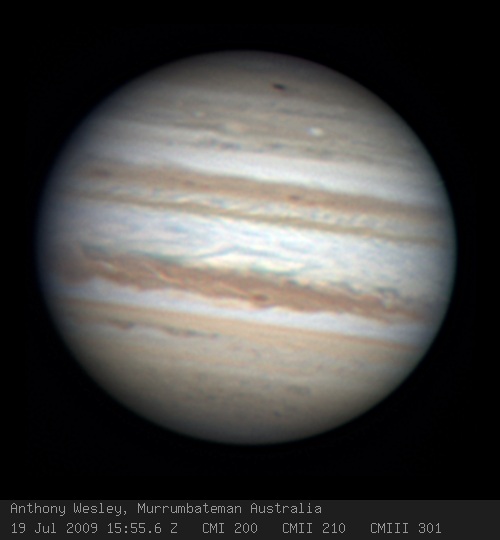
Anthony Wesley Murrumbateman Australia dark spot on Jupiter
Preliminary image showing a black mark in Jupiters South Polar Region (SPR) which is almost certainly the result of a large impact - either an asteroid or comet - similar to the Shoemaker-Levy 9 impacts in 1994.  Image captured by Anthony Wesley on 19th July 2009 at 1554UTC from Murrumbateman Australia

What say you?   We'll find out more in the next day or two but kudos to Wesley for being there first with his swanky new 14.5" Newtonian.

See it yourself soon:

2009 Jul 20 02:00 ( 216°)
2009 Jul 20 11:56 ( 216°)
2009 Jul 20 21:52 ( 216°)
2009 Jul 21 07:47 ( 216°)
2009 Jul 21 17:43 ( 216°)

For even more times when this dark spot on Jupiter will be visible, see Mike Salway's blog.

For JPL's analysis of what it was, see the next post Dark Spot On Jupiter: New Impact 15 Years After The Last One.

Comments

LauraHult's picture
Hank, the spot certainly is reminiscent of the Shoemaker-Levy 9 impacts, and may even have a bit of a "ring" around it too.  I wouldn't be surprised at all if we missed an impact.  Accretion happens!

Hank's picture
Someone who actually gets paid to do this seems to finally be taking a look.   From InfraRed Telescope Facility in Hawaii Twittypages:
“This has all the hallmarks of SL-9 in 1994 (15 years to the day!). High altitude particulates, looks nothing like weather phenom.” –@LeighFletcher

Though we sort of already knew that.

And ...
The phone is ringing off the hook: New Scientist, Science, Nature.... Jupiter still draws in the crowds!

Yes, they are eating our contrails, as usual.  Or whatever contrails are in space.

Add a comment

The content of this field is kept private and will not be shown publicly.
  • Allowed HTML tags: <sup> <sub> <a> <em> <strong> <center> <cite> <code> <TH><ul> <ol> <li> <dl> <dt> <dd> <img> <br> <p> <blockquote> <strike> <object> <param> <embed> <del> <pre> <b> <i> <table> <tbody> <div> <tr> <td> <h1> <h2> <h3> <h4> <h5> <h6> <hr> <iframe>
  • Lines and paragraphs break automatically.
  • Web page addresses and e-mail addresses turn into links automatically.
CAPTCHA
If you register, you will never be bothered to prove you are human again. And you get a real editor toolbar to use instead of this HTML thing that wards off spam bots.