




Finding Molecules On Second Life
As I've recently commented, there has been media interest in the use of the virtual online world Second Life for chemistry. We also recently demonstrated on Drexel Island that it was possible to visualize molecular docking using the molecular rezzer developed by Andrew Lang.
Nature Island also hosts several common molecules, including buckyballs. As more people start to experiment with representing chemicals and chemistry research in Second Life it would be nice if such examples were discovered by a simple Google search.
All that really needs to be done to accomplish this is to co-locate molecular descriptors with corresponding SLURLs (Second Life URLs) on the same web page. When clicked, the SLURL will automatically start Second Life and teleport the user to the location where the molecule can be found. If the user does not have Second Life, a page pops up explaining how to set up a free account and download the software. This could be a good way to introduce the mainstream chemical community to new modalities of communicating science.
As for descriptors, I am suggesting that we use InChIs and common names at the very least. Google does a fairly good job of finding molecules by InChI.
I created a wiki,
http://secondlifemolecules.wikispaces.com/
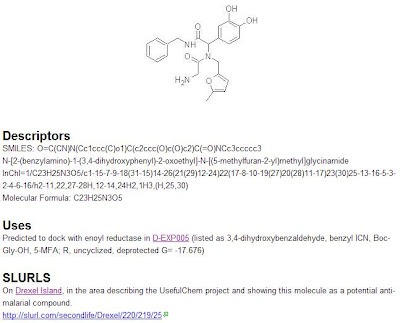
and seeded it with a molecule from our malaria research that I've used in several places and with caffeine, which is displayed on Nature Island. I invite anyone to contribute to the wiki and add information that could be useful. (The indexing on Google can take a few days for a new wiki)
There are several other ways of creating this index and I think the more redundancy the better. For example, we could make Second Life a "supplier" on ChemSpider. It might also be possible for Andrew's molecule rezzer to note the location of a molecule when it gets created in Second Life and automatically send off an email to a Blogger account to create a post.



Comments