



Wile E. Coyote has nothing on this guy.
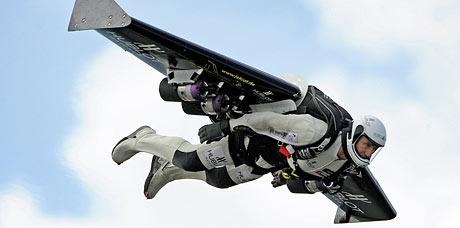
Yves Rossy, aka Jet Man, zoomed into the record books this morning, flying across the English Channel strapped to a single jet-powered wing, with only a helmet and flight suit for protection.
The 22-mile (35-kilometer) France-to-England journey took 13 minutes. Bad weather had twice postponed the event this week. But this morning—with clear blue skies and a nice tailwind—turned out to be an ideal flight day for the Swiss airline pilot.
Around 2 p.m., local time, Rossy leaped from a plane abound 8,200 feet (2,500 meters) above a beach near Calais. Within seconds he had opened his wing, fired up his four miniature jet turbines, and pointed his nose toward Britain.
Cruising at speeds of over 125 miles (200 kilometers) an hour, Rossy steered by just moving his head and back. After a smooth crossing—followed by a few celebratory loops—Rossy opened his parachute system and floated down to a green field not far from the White Cliffs of Dover.
To Infinity And Beyond!
"With that crossing I showed it is possible to fly a little bit like a bird. I am full of hope there will be many in the near future," Rossy said after landing, according to Britain's Guardian newspaper. The full story of the flight will be broadcast Friday night at 8 p.m. ET/PT on the U.S. National Geographic Channel. (The Channel is partly owned by the National Geographic Society, which owns National Geographic News.)
NOT Yves Rossy
Failure No Option
Failure was not an option, as the Channel is one of the world's busiest shipping lanes, and Rossy's jet wing is not designed for landing on water. Speaking earlier this week, NASA aeronautical engineer Tom Benson said, "He will be wearing a fireproof flight suit [and] 120 pounds [54 kilograms] of wings, fuel, engines, and parachutes, so staying afloat for any length of time could be difficult."
Markus Zipperer, an engineer with the German company JetCat, which helped build the machine, said, "The biggest challenge for him is to get into a stable flying configuration once he has left the plane."
Like many other aviation enthusiasts before him, Rossy—also known as Fusion Man—wanted to find a way for people to get as close as possible to flying like birds. He started working on the project about 15 years ago, building prototypes in his garage. He first created an inflatable wing that enabled him to glide, but Rossy was really after powered flight. With the help of JetCat and Swiss firm ACT Composites, Rossy built a prototype and began improving upon his jet-wing design.
Rossy is both the first person to build, and the first person successfully to fly, a jet engine-powered wing strapped to the back. His first flight occurred in November 2006, lasting nearly six minutes. While work with jet packs to propel humans dates back as far as World War II, his is the first one to have wings. A few weeks ago he carried out his longest flight yet, covering 22 miles (35 kilometers) in 12 minutes, but today's flight was the first time he tried to cross a major body of water.
The 49-year-old Swiss pilot will be following the route taken by French inventor Louis Blériot 99 years ago, when he became the first person to fly an airplane across the English Channel.
How the Jet Wing Is Made
In the version of the craft Rossy will use for the Channel crossing, the wing's jet engines are linked by digital processing equipment. "If one engine fails, the digital signal ensures that its opposite pair is shut down in half a millisecond," JetCat's Zipperer said. "Otherwise his wing would go into a flat spin."
At 5 inches (13 centimeters) across, Jet Man's turbines are much smaller than conventional jet engines, although the mini-turbines use the same type of fuel. "We use very fast motors and have developed special parts to ensure that the jet fuel is vaporized and burned completely," Zipperer said.
The craft is constructed from three main materials: carbon fiber to provide a lightweight but strong wing, glass fiber to mold it into an aerodynamic shape, and Kevlar to protect Rossy, should an engine explode.
"The turbines run at a very high revolution per minute. If there was a fracture, there is a danger that metal parts would leave the engine and hit Rossy," Zipperer said. "The Kevlar encases the engines and acts like a bulletproof vest."
Video from a previous flight over the Swiss Alps
In flight, Rossy uses his shoulders, head, and arms to steer the wing. To land, he has to deploy a series of parachutes while at a height of at least 1,800 feet (550 meters). The first parachute is a small one that reduces Jet Man's speed. The next is a large one that stops him from going forward and enables him and his wing to float safely to the ground. This dual parachute system prevents a sudden halt.
"On one of the previous prototypes, Rossy used only one parachute," Alain Ray of ACT Composites said. "Afterward he said, Never again."
More info on Jet Man:
"Jet Man" Crosses English Channel Like a Human Rocket


Comments