




The first Bose-Einstein condensates were generated in 1995 by Eric A. Cornell, Scientific Blogging featured columnist Carl E. Wieman and Wolfgang Ketterle, who received the Nobel Prize in Physics for their work only six years later. Since then, these unique gas clouds, the coldest objects humans ever created, have become a global research object.
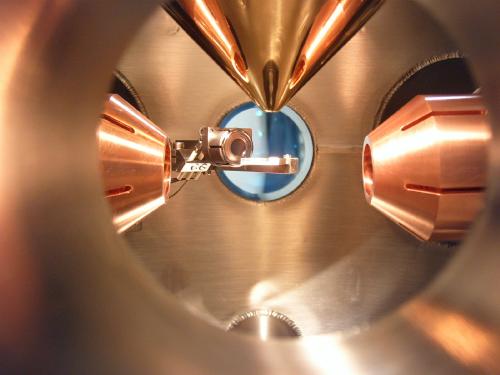
Inside the QUANTUM high-resolution scanning electron microscope.
Physicists working with Dr Herwig Ott in the study group for quantum, atomic and neutron physics (QUANTUM) at Mainz University have now developed a new technology that can be used to plot the individual atoms in a Bose-Einstein condensate. In addition, the spatial resolution achieved during plotting far exceeds any previous methods used. The research results of the Emmy Noether Independent Junior Research Group, sponsored by the German Research Foundation (DFG), were published in the professional journal Nature Physics under the title of "High-resolution scanning electron microscopy of an ultracold quantum gas.".
This breakthrough was possible due to the use of a high-resolution scanning electron microscope that makes use of a very fine electron beam to scan the ultracold atomic cloud, thus rendering even the smallest structures visible.
"The transfer of this technology to ultracold gases was a technical risk," reports Dr Herwig Ott, head of the Emmy Noether Junior Research Group, "as two different techniques had to be combined." Moreover, atoms and molecules move completely freely and ran-domly in gases unlike they do in solids. Another advantage of this highly advanced microscopy process is the better spatial resolution compared with optical processes where the resolution capacity is limited by the wavelength of the light used.
"With a resolution of 150 nm, we are able to view these quantum objects with an accuracy that is 10 times higher than has been possible to date," explains Ott.
As electron microscopy made previously unknown parts of our world visible to the viewer, so the technology developed in Mainz has opened up unique possibilities for investigating the microscopic structure of quantum gases. The physicists in Mainz have already reached their first major milestone: They managed to make the structure of a so-called optical lattice visible. Optical lattices are interference patterns comprised of laser beams, which are shone onto the atomic cloud and force their periodic structure onto it.
This results in the creation of crystal-like formations. The interesting aspect is that the movement of the atoms in an optical lattice within a quantum gas is similar to the behavior of electrons in solid bodies. Quantum gases are thus able to simulate the physical properties of solid bodies and can therefore also contribute to answering outstanding questions in solid-state physics.
Article: Tatjana Gericke, Peter Würtz, Daniel Reitz, Tim Langen&Herwig Ott,'High-resolution scanning electron microscopy of an ultracold quantum gas', Nature Physics Published online: 19 October 2008 | doi:10.1038/nphys1102


Comments