




But this story is more than the typical tale of direct competition: according to new genetic research published in PLoS One, black rats carried a pathogen that exterminated two endemic species, Rattus macleari and R. nativitatis. This study is the first to demonstrate extinction in a mammal because of disease, supporting the hypothesis proposed a decade ago that "hyperdisease conditions"—unusually rapid mortality from which a species never recovers—can lead to extinction.
Black rats were introduced to Christmas Island via the S.S. Hindustan in 1899. A parasitologist noted a few years later that fleas on these rats carried a pathogenic protozoan related to the same organism that causes sleeping sickness in humans. The black rats were well adapted to this protozoan, known as Trypanosoma lewisi, but quite clearly, R. macleari and R. nativitatis were not. The native species were soon seen staggering around on footpaths, evidently very ill, and by 1908 it was clear to biologists on the island that both were extinct. Extinction of island-bound mammals is not uncommon: more than 80% of the mammals that have gone extinct in the last 500 years hailed from islands.
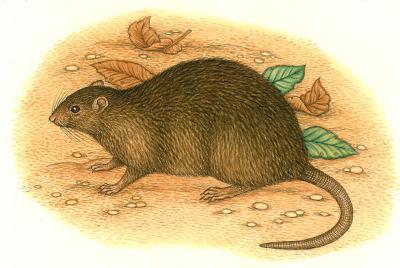
Rattus nativitatis went extinct on Christmas Island by 1908. Photo Credit: P. Wynne/patriciawynne.com
"This study puts into play pathogenic organisms as mediators of extinction," says Alex D. Greenwood of the Biological Sciences Department at Old Dominion University in Norfolk, Virginia, and the Division of Vertebrate Zoology at the American Museum of Natural History. "Our study is the first to correlate a pathogen with an extinction event in mammals, although we know about disease-associated extinction in snails and disease-associated population declines in amphibians."
Although the parasitologist's findings have occasionally been cited in the specialist literature, scientists have been unable to agree that disease—rather than hybridization or competition between rat species—was the actual culprit. Greenwood and colleagues used ancient DNA procedures to determine if a rat-specific trypanosome could be detected in Museum samples and if trypanosomiasis could have caused the extinction of these species.
The team collected samples from 21 specimens (virtually all extant) to see if the infectious agent existed in the population before and after contact with black rats. None of the three pre-contact samples were infected with the protozoan, but six of the 18 post-contact samples were infected. This suggests a very high rate of infection. Results were confirmed by sending a subset of the samples to a laboratory at the University of Copenhagen in Denmark for independent testing.
Finally, the group investigated the possibility of hybridization by testing for the distinctive genomes of the native rats in black rat species, but no evidence of this was found.
"This is not a case of humans over-hunting—I don't think anyone was that hungry," says Ross MacPhee, a Curator of Vertebrate Zoology at the American Museum of Natural History who proposed "hyperdisease conditions" as a mediator of extinction in 1997. "Within nine years of contact, these abundant, endemic species were evidently completely knocked out by an introduced disease—nothing else was around at the time that could have done the job. This study puts something else on the table as a reason for extinction."
The results of this study contrast with most scientists' view of the effect of pathogens on species. Most pathogens are self-limiting either because the disease burns itself out as the number of new hosts reduces, or because resistant individuals increase proportionally as susceptible individuals die out. Yet at least one mammalian species, the Tasmanian devil, shows every sign of undergoing a very severe collapse due to disease right now (in this case, from an apparently infectious form of cancer). At least a quarter of the total population has died out within the past decade, and some biologists predict the Tasmanian devil's extinction within a few years if the cancer continues to spread.
Another famous Australian mammal, the Tasmanian tiger, or thylacine, is also thought to have suffered severe decline around 1910 because of disease, although the culprit has never been identified and interpretation of its final collapse is complicated by population decline due to bounty hunting.
"This study should get people to think about the spread of pathogen pollution," says Greenwood. "Pathogen pollution is the introduction of animal or plant diseases into a new environment. This pollution could affect many species that are in decline or in small numbers, ranging from accidental to active introduction like the building of Pleistocene Park in Russia or the repopulation of species for conservation purposes."



Comments