




A supermassive black hole exists in the center of Messier 87 and gigantic plasma flows shoot out from the vicinity of the black hole at close to light speed. Scientists have now observed, simultaneously in gamma and radio frequencies, this active galactic core region and in doing so discovered that the elementary particles are accelerated to extremely high energy levels in closest proximity to the black hole.
Messier 87 is a giant elliptical radio galaxy in our immediate cosmic vicinity, just 55 million light years away. In its center, it hosts a super-massive black hole, about six thousand million times more massive than our own Sun. In a "jet", a giant outflow from the central engine of this galaxy, charged particles (electrons and protons) may be accelerated to velocities close to the speed of light. Inevitable witnesses and messengers of these acceleration processes are very-high-energy gamma rays, photons a thousand billion times more energetic than optical light. They are produced when the accelerated particles interact with their environment.
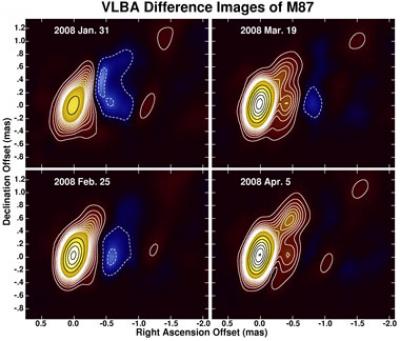
Series of radio difference images (with respect to the temporal average image) of the innermost part of M87 shows a substantial brightening of the innermost core region in spring 2008, which coincides with the period of increased very high energy gamma-ray emission. Credit: Image: MAGIC/HESS/VERITAS/VLBA-Team
High-energy gamma rays constitute the highest energy electromagnetic radiation observable, and are generated by the most violent cosmic objects such as supernovae, active galactic nuclei, and gamma ray bursts. They allow us to study a realm of extreme physical conditions, far beyond what can be studied in laboratories here on Earth.
First indications for very-high energy gamma radiation from Messier 87 were found as early as 1998 with the HEGRA telescopes, which was the predecessor experiment of H.E.S.S. and MAGIC. This detection could be confirmed with the H.E.S.S. telescopes in 2006. These observations also revealed a fast variability of the gamma-ray flux within few days, as seen again in the 2008 campaign. This implies that the extension of the gamma-ray source must be exceptionally compact, and is located presumably in the immediate vicinity of the supermassive black hole in Messier 87.
In early 2008, the three world-leading instruments sensitive to gamma rays in this energy domain, H.E.S.S., MAGIC and VERITAS, jointly observed Messier 87 from January to May 2008, collecting 120 hours' worth of data. During this campaign, Messier 87 underwent two major outbursts of gamma-ray emission. Simultaneous high resolution radio observations of the activity of Messier 87 using the VLBA, a system of ratio telescopes spanning the United States, indicate a persistent increase of the radio flux from the innermost "core" of Messier 87, which is associated with the immediate vicinity of the central black hole. The collaboration of observatories sensitive to the lowest (radio) and highest (gamma-ray) parts of the electromagnetic spectrum made it possible for the first time to pin down the location of activity during the gamma-ray outbursts and thus the site of the particle accelerator in Messier 87.
The Major Atmospheric Gamma-ray Imaging Cherenkov (MAGIC) telescope on the Canary island of La Palma and the telescopes of the High Energy Stereoscopic System (H.E.S.S.) in Namibia are latest-generation air-shower Cherenkov telescopes. With their 17-m (MAGIC) and 4 x 13-m (H.E.S.S.) diameter mirrors and ultrafast electronics, they record the flashes of dim blue light (Cherenkov light) from the cascades of subatomic particles that arise when very-high-energy gamma-ray photons interact high in the atmosphere.
The H.E.S.S. team consists of more than 150 scientists from Germany, France, the UK, Poland, the Czech Republic, Ireland, Austria, Sweden, Armenia, South Africa and Namibia. The H.E.S.S. telescope array is in operation since 2004, and its first data have already resulted in a number of important discoveries, including the first astronomical image of a supernova shock wave at the highest gamma-ray energies and the first map of the galactic disk at very-high-energy cosmic rays.
MAGIC was built and is operated by about 150 researchers from Germany, Italy, Spain, Switzerland, Poland, Finland, Croatia, Bulgaria and the United States. Operational since 2004, MAGIC has, among other important results, so far discovered the most distant source of very-high-energy gamma rays more than five billion light years away from us, as well as gamma rays from a fast rotating neutron star, the Crab pulsar.
For the future, both teams are continuing their successful collaboration in the European project Cherenkov Telescope Array (CTA). This next-generation gamma-ray observatory will consist of roughly a hundred telescopes, leading to a significant improvement in sensitivity by a factor 10 compared to the current generation of instruments.
Article: V. A. Acciari et al., Radio Imaging of the Very-High-Energy Gamma-Ray Emission Region in the Central Engine of a Radio Galaxy, Science Express, July 2, 2009



Comments