




John Weinman led a team of researchers from King's College London who aimed to update a similar survey carried out almost forty years ago. He said, "We thought that the improvements in education seen since then, coupled with an increased media focus on medical and health related topics, and growing access to the internet as a source of medical information, might have led to an increase in patients' anatomical knowledge. As it turns out, there has been no significant improvement in the intervening years".
The 722 people who took part in the study were shown pictures of the human body (male or female) with certain areas shaded out and were asked which of the shaded areas was the location of a given organ. Although 85.9% of people could identify the location of the intestines and 80.7% knew where the bladder could be found, only 46.5% of people correctly identified the heart and 68.6% misidentified the position of the lungs. Overall, approximately half of the answers were correct. There was no significant difference between men and women, although women did perform better when a female body image was used.
The researchers are concerned about the potential problems these findings reveal in doctor-patient communication, with possible adverse effects on diagnosis and treatment outcomes. According to Weinman, "Recent evidence has shown that when doctors' and patients' vocabulary are matched, significant gains are found in patients' overall satisfaction with the consultation as well as rapport, communication comfort and compliance intent".
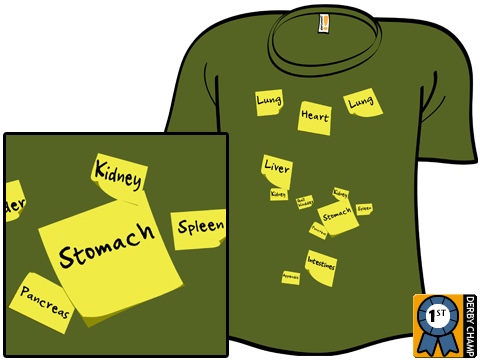
If you don't know your basic anatomy, here is a t-shirt that can help.
Article: 'How accurate is patients' anatomical knowledge : a cross-sectional, questionnaire study of six patient groups and a general public sample', John Weinman, Gibran Yusuf, Robert Berks, Sam Rayner and Keith J Petrie, BMC Family Practice (in press)


Comments