




Galaxy Zoo users volunteer their spare time to help classify galaxies in an online image bank. When they came across a number of objects that stuck out because of their small size and bright green color, they dubbed them the Green Peas. Employing the help of the volunteers to further analyze these strange new objects, the astronomers discovered that the Green Peas are small, compact galaxies forming stars at an incredibly high rate.
"These are among the most extremely active star-forming galaxies we've ever found," said Carolin Cardamone, an astronomy graduate student at Yale and lead author of the paper, to be published in an upcoming issue of the Monthly Notices of the Royal Astronomical Society.
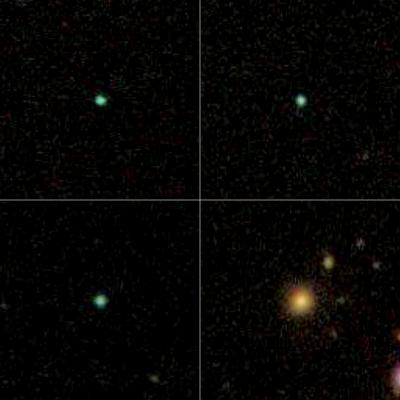
The Green Peas stuck out because of their small size and green color compared to the more common galaxies -- such as the one on the bottom right -- that Galaxy Zoo users were used to seeing. Credit: Carolin Cardamone and Sloan Digital Sky Survey
Of the one million galaxies that make up Galaxy Zoo's image bank, the team found only 250 Green Peas. "No one person could have done this on their own," Cardamone said. "Even if we had managed to look through 10,000 of these images, we would have only come across a few Green Peas and wouldn't have recognized them as a unique class of galaxies."
The galaxies, which are between 1.5 billion and 5 billion light years away, are 10 times smaller than our own Milky Way galaxy and 100 times less massive. But surprisingly, given their small size, they are forming stars 10 times faster than the Milky Way.
"They're growing at an incredible rate," said Kevin Schawinski, a postdoctoral associate at Yale and one of Galaxy Zoo's founders. "These galaxies would have been normal in the early universe, but we just don't see such active galaxies today. Understanding the Green Peas may tell us something about how stars were formed in the early universe and how galaxies evolve."
The Galaxy Zoo volunteers who discovered the Green Peas—and who call themselves the "Peas Corps" and the "Peas Brigade"—began discussing the strange objects in the online forum. (The original forum thread was called "Give peas a chance.")
Cardamone asked the volunteers—many of whom had no previous astronomy background or experience—to refine the sample of objects they detected in order to determine which were bona fide Green Peas and which were not, based on their colors. By analyzing their light, Cardamone determined how much star formation is taking place within the galaxies.
"This is a genuine citizen science project, where the users were directly involved in the analysis," Schawinski said, adding that 10 Galaxy Zoo volunteers are acknowledged in the paper as having made a particularly significant contribution. "It's a great example of how a new way of doing science produced a result that wouldn't have been possible otherwise."
The Galaxy Zoo project was launched in 2007 by a team of astronomers in the U.K and U.S., including Schawinski. To date, 230,000 volunteers from all over the world have helped classify one million images of galaxies taken by the Sloan Digital Sky Survey. Galaxy Zoo 2, which launched in February 2009, lets users more fully analyze 250,000 of the brightest galaxies.
Other authors of the paper include Marc Sarzi (University of Hertfordshire); Steven Bamford (University of Nottingham); Nicola Bennert (University of California, Santa Barbara); C. M. Urry (Yale University); Chris Lintott (University of Oxford); William Keel (University of Alabama); John Parejko (Drexel University); Robert Nichol and Daniel Thomas (University of Portsmouth); Dan Andreescu (LinkLab); M. Jordan Raddick, Alex Szalay and Jan VandenBerg (Johns Hopkins University); Anze Slosar (Lawrence Berkeley National Lab).
Citation: arxiv.org/abs/0907.4155



Comments