

Track your comments!
[x]


When you register, comments on your articles and replies to your comments appear here. Register Now!

Sign in to your account
[x]

Not a Scientific Blogging member yet?

Register Now for a Free Scientificblogging.com Account

  • Customize your profile with pictures, banner, a blogroll and more.
  • Leave comments on articles, add other members to your friend lists, chat with people on the site.
  • Write blog posts that can be seen by hundreds of thousands of readers.

It's free and it only takes a minute!

Already a Scientific Blogging member?

Sign In Now

Banner
By News Staff | May 19th 2009 01:00 AM | 9 comments | Print | E-mail | Track Comments
A new type of air-fuelled battery called the STAIR (St Andrews Air) cell could give up to ten times the energy storage of designs currently available, meaning a new generation of batteries for electric cars, mobile phones and laptops.

The new design has the potential to improve the performance of portable electronic products and give a major boost to the renewable energy industry. The batteries will enable a constant electrical output from sources such as wind or solar, which stop generating when the weather changes or night falls.

Improved capacity is thanks to the addition of a component that uses oxygen drawn from the air during discharge, replacing one chemical constituent used in rechargeable batteries today. Not having to carry the chemicals around in the battery offers more energy for the same size battery. Reducing the size and weight of batteries with the necessary charge capacity has been a long-running battle for developers of electric cars.
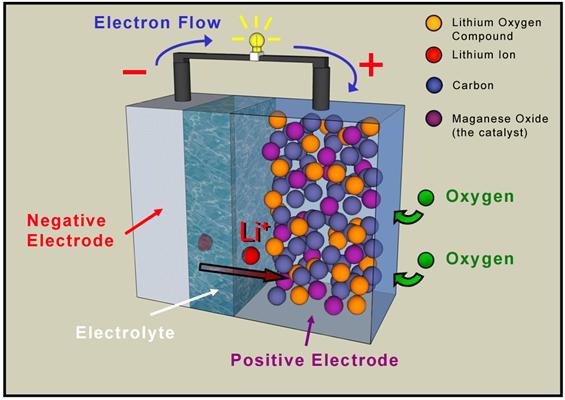
STAIR St Andrews Air cell air battery
Diagram of the STAIR (St Andrews Air) cell. Oxygen drawn from the air reacts within the porous carbon to release the electrical charge in this lithium-air battery.  Credit: University of St Andrews

The STAIR cell should be cheaper than today’s rechargeables too. The new component is made of porous carbon, which is far less expensive than the lithium cobalt oxide it replaces.

This four-year research project, which reaches its halfway mark in July, builds on the discovery at the university that the carbon component’s interaction with air can be repeated, creating a cycle of charge and discharge. Subsequent work has more than tripled the capacity to store charge in the STAIR cell.

Principal investigator on the project, Professor Peter Bruce of the Chemistry Department at the University of St Andrews, says: “Our target is to get a five to ten fold increase in storage capacity, which is beyond the horizon of current lithium batteries. Our results so far are very encouraging and have far exceeded our expectations.”

“The key is to use oxygen in the air as a re-agent, rather than carry the necessary chemicals around inside the battery,” says Bruce.

The oxygen, which will be drawn in through a surface of the battery exposed to air, reacts within the pores of the carbon to discharge the battery. “Not only is this part of the process free, the carbon component is much cheaper than current technology,” says Bruce. He estimates that it will be at least five years before the STAIR cell is commercially available.

The project is focused on understanding more about how the chemical reaction of the battery works and investigating how to improve it. The research team is also working towards making a STAIR cell prototype suited, in the first instance, for small applications, such as mobile phones or MP3 players.

The research work, funded by the Engineering and Physical Sciences Research Council (EPSRC), is being led by researchers at the University of St Andrews with partners at Strathclyde and Newcastle.

Comments

So if this thing catches on, we won't have to worry about rising carbon dioxide levels in the atmosphere anymore?
Just have to worry about dropping oxygen levels. Oops, sorry population, we didn't think of that.

From the write up, I assume this is not a closed system, as in a constant supply of oxygen is required.

It doesn't "use up" oxygen. When the battery is discharged, oxygen bounds with the lithium inside, and is released into the air again on charging.

Yes, yes, yes
perfect for e-cars or laptops
but the price?

Did you read?

"The STAIR cell should be cheaper than today’s rechargeables too. The new component is made of porous carbon, which is far less expensive than the lithium cobalt oxide it replaces."

**Reducing the size and weight of batteries with the necessary charge capacity has been a long-running battle for developers of electric cars.**

Of course, yet you still have the issue of what generation source for the electricity.
Solar / wind / hydro = good, Coal / nuclear = bad

The key is in reducing the weight of automobile bodies, and recently I saw a carbon polymer
shell on PBS that does exactly that. Super light and cannot even be dented by a sledgehammer.
-- found a cool site; Balkingpoints ; incredible satellite view of earth

why nuclear = bad ??

Hi Anonymous,
The biggest negative aspects about nuclear power are:
1) The limited availibility (approx. 40 - 50 yrs); certainly not sustainable
2) No one worldwide has yet come up with an adequate and acceptable solution for the disposal of nuclear wastes
3) Nuclear power is only as safe as those fools tampering with it
Ever hear of that proverb: "Fools rush in where Angels fear to tread"?
Regards,
Geronimo

1) much much more, suggest more knowledge
2) suggest more knowledge too
3) ??
think you mix religion with ...

Hi Anonymous,
Nope, i'm definitely not mixing up anything. I may be many things, but definitely neither a fool nor religious. That proverb fits, intransitively seen, for many things also for fools.

Regards,
Geronimo

Add a comment

The content of this field is kept private and will not be shown publicly.
  • Allowed HTML tags: <sup> <sub> <a> <em> <strong> <center> <cite> <code> <TH><ul> <ol> <li> <dl> <dt> <dd> <img> <br> <p> <blockquote> <strike> <object> <param> <embed> <del> <pre> <b> <i> <table> <tbody> <div> <tr> <td> <h1> <h2> <h3> <h4> <h5> <h6> <hr> <iframe>
  • Lines and paragraphs break automatically.
  • Web page addresses and e-mail addresses turn into links automatically.
CAPTCHA
If you register, you will never be bothered to prove you are human again. And you get a real editor toolbar to use instead of this HTML thing that wards off spam bots.