
Track your comments!
[x]


When you register, comments on your articles and replies to your comments appear here. Register Now!

Sign in to your account
[x]

Not a Scientific Blogging member yet?

Register Now for a Free Scientificblogging.com Account

  • Customize your profile with pictures, banner, a blogroll and more.
  • Leave comments on articles, add other members to your friend lists, chat with people on the site.
  • Write blog posts that can be seen by hundreds of thousands of readers.

It's free and it only takes a minute!

Already a Scientific Blogging member?

Sign In Now

Banner
By T. Ryan Gregory | May 10th 2008 01:34 PM | 5 comments | Print | E-mail | Track Comments

More Genomicron articles

All

About T. Ryan Gregory

I am an evolutionary biologist specializing in genome size evolution at the University of Guelph in Guelph, Ontario, Canada. My scientific interests include evolution, genomes, and biodiversity


... Full Bio

Those of you who have been reading Genomicron for some time will have seen most of these already, but it seems worthwhile reviewing them here at the new blog. The game is simple: identify what is wrong with these figures which have been published in science magazines or scientific journals.

(To view larger images, right-click and select "view image" in Firefox -- you're on your own in other browsers).


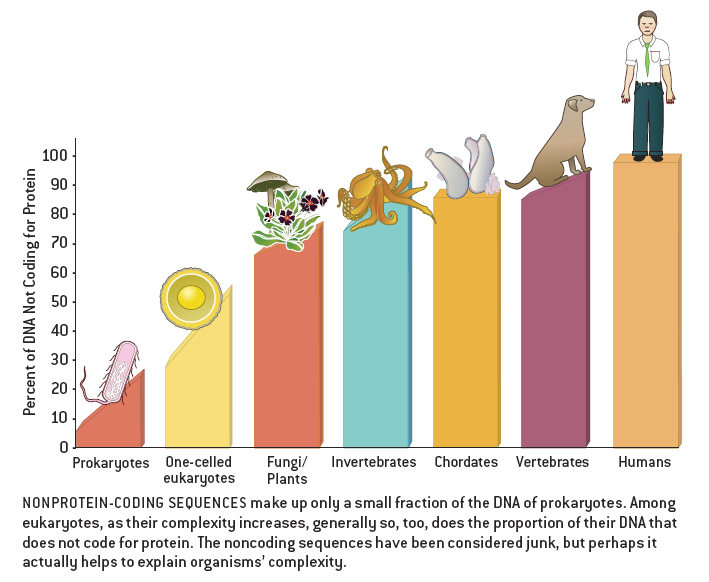
1) The infamous "dog's ass plot":
 

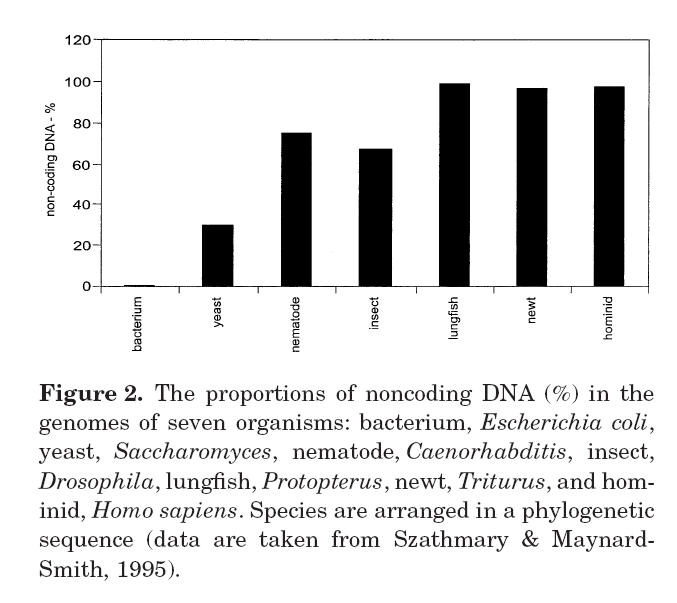
2) More non-coding sequences:
 

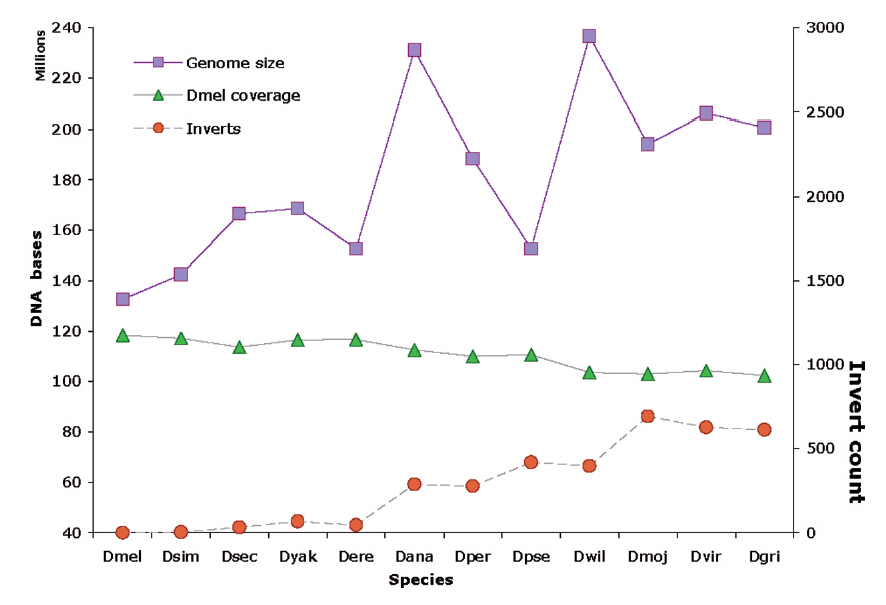
3) Fly genomes:
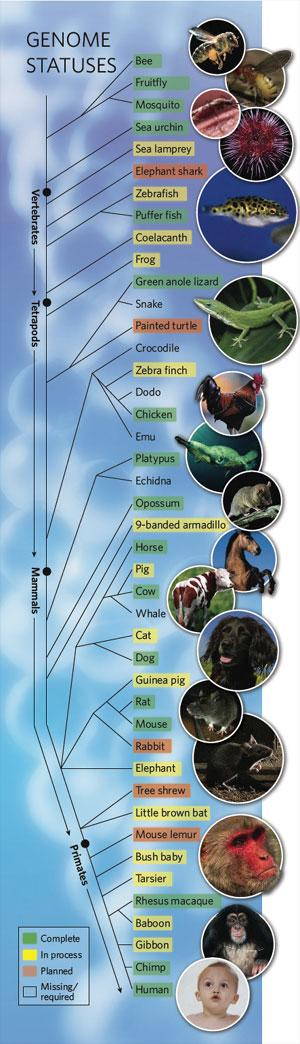
4) Sequencing data:
 

Sources:

Brown, S. 2008. Top billing for platypus at end of evolution tree. Nature 453: 138.

Gilbert, D.G. 2007. DroSpeGe: rapid access database for new Drosophila species genomes. Nucleic Acids Research 35 (Database Issue): D480-D485.

Mattick, J.S. 2004. The hidden genetic program of complex organisms. Scientific American Oct: 60-67.

Stebbing, A.R.D. 2006. Genetic parsimony: a factor in the evolution of complexity, order and emergence. Biological Journal of the Linnean Society 88: 295-308.



Comments

Problems with 1:
- The claim is that there's some function (thus adding to the complexity) of these non-coding sequences when it's actually the case most are really without function
- The sample selected is made to justify the desired hierarchy. Different groups be selected to represent the exact opposite trend.
- The groups selected are not really comparable (chordates vs. humans)

BTW, commenting is much easier now.

1. You covered this one. Cherry-picking data and an irrational exclusion of humans from all other vertebrates.

2. Horribly painful captioning, although that was probably not your first thought! They should have put the species names in parentheses or something more readable. The species are listed as a "phylogenetic sequence", which sounds to me like a linear route of descent. Hmm. The "phylogenetic sequence" should be just as accurate if we swap the yeast to the far right, since fungi and animals are sister groups. The species are ordered in a way that's supposed to show an evolutionary progression from lower to higher, which, of course, is an imaginary distinction. Since only one species is shown for each I wouldn't be surprised if more cherry-picking is going on.

3. Usually when you have a line graph that means there is some sort of logical progression from one point on the X-axis to the next. You can show percent completion of a reaction at different temperatures with a line graph, but percent alkylation at each site in a DNA strand should be shown with bars. This is a collection of individual species. This should be a bar graph.

4. Ow. Need I say more? Apparently the lepidosaurs diverged from the amniotes before the archosaurs did, and archosaurs and synapsids are sister groups. That's just the beginning of the problems with this chart. For instance, I see now that evolution has culminated with the human species, the evolutionary process can cease.

T Ryan Gregory's picture
Tres bien!

I would add for #1 that the sloping bars imply a range, but the actual range in genome size (and thus amount of non-coding sequence) for vertebrates extends to about 40x larger than humans. There are many invertebrate, plant, and unicellular eukaryote genomes much bigger than humans' also.

For #4 - Every node can be rotated. Every node can be rotated. Every node...

T Ryan Gregory's picture
Nimravid -- send me an email (there is a contact form available here)

T Ryan Gregory's picture
Got the email but I don't think my reply made it.

Add a comment

The content of this field is kept private and will not be shown publicly.
  • Allowed HTML tags: <sup> <sub> <a> <em> <strong> <center> <cite> <code> <TH><ul> <ol> <li> <dl> <dt> <dd> <img> <br> <p> <blockquote> <strike> <object> <param> <embed> <del> <pre> <b> <i> <table> <tbody> <div> <tr> <td> <h1> <h2> <h3> <h4> <h5> <h6> <hr> <iframe>
  • Lines and paragraphs break automatically.
  • Web page addresses and e-mail addresses turn into links automatically.
CAPTCHA
If you register, you will never be bothered to prove you are human again.
Image CAPTCHA
Copy the characters (respecting upper/lower case) from the image.