Track your comments!
[x]


When you register, comments on your articles and replies to your comments appear here. Register Now!

Sign in to your account
[x]

Not a Scientific Blogging member yet?

Register Now for a Free Scientificblogging.com Account

  • Customize your profile with pictures, banner, a blogroll and more.
  • Leave comments on articles, add other members to your friend lists, chat with people on the site.
  • Write blog posts that can be seen by hundreds of thousands of readers.

It's free and it only takes a minute!

Already a Scientific Blogging member?

Sign In Now

Banner
By Hayley Mann | April 28th 2009 09:25 PM | 12 comments | Print | E-mail | Track Comments
.

More The Alternate Allele articles

All

About Hayley Mann

In 2006, I graduated from UC Davis with a degree in Genetics and Anthropology. I've had the privilege of working for various laboratories conducting research in different areas of interest including... Full Bio

If you haven't heard of swine flu - Influenza A H1N1 - by now... well, you have unless you can't read, which means you aren't on this website.   Reading too many popular media articles may have led you to believe there's an epidemic on your doorstep.   Fortunately, it's just an epidemic of hysteria.  The number of reported swine flu cases (no deaths edit - okay, one death, still not worth a panic) in the US is 1/1000th of the regular flu deaths that occur each year.  Although a H1N1 vaccine is a few months off and would undoubtedly cure your hysteria, perhaps in the mean time learning more about thine swine flu enemy will lessen your inner fears of the microbial unknown.

Aside from wondering if you’re going to die soon, I’m almost positive the second and third questions on your mind are; what are the molecular mechanisms that make Influenza A so nasty?  And then maybe, how the heck did Wilbur the pig, a distantly related creature, manage to spread his cooties to humans?

Influenza A infects approximately 10% of the population in the US each year and causes approximately 35,000 deaths annually.  That's arguably a good year considering Influenza A also makes a recurring appearance every 10 to 15 years as a highly virulent form that is responsible for epidemics.

So what is it about Influenza A that makes it a top candidate for pandemics?  The primary answer lies in its genomic layout.

Influenza A is a RNA virus and in general, RNA viruses have a very high rate of mutation, a short generation time and yield a high production of virions after replication in the host’s cells.  However, influenza A’s most advantageous feature is its segmented genome which consists of eight different linear RNA strands.  These strands can combine with each other and create novel genotypes—an important mechanism for extremely rapid adaptation to new hosts.

The major advantage conferred by a segmented genome comes into play during coinfection which is when a cell becomes infected by two different viral strains at the same time.  During coinfection, different segments of each virion can recombine, thus creating a new viral strain emergence that is sometimes even more detrimental than the original parent viral strains.  Furthermore, viral strains from different species can also recombine with each other.

When two different species’ influenza strains (for example pig and human) recombine, the novel viral strain that emerges potentially has a better chance of evading the immune system and persisting in the host organism than the pre-existing viral strains.  In other words, the host organism’s immune system doesn’t have antibodies for viruses indigenous to other species and thanks to the original virus that is indigenous to the host, molecular features necessary for “optimal” host infection are retained.

The emergence of a viral strain that is capable of evading the host's immune system as well as transmits and replicates effectively, is precisely the recipe for a potential pandemic.

Every 10 to 15 years, influenza undergoes a dramatic genetic change (antigenic shift) which as described, is responsible for epidemics/pandemics.  In between epidemics, minor influenza genetic changes occur (antigenic drift).  These minor changes are relatively predictable and clinicians are able to develop effective flu vaccines every year.  However, highly virulent duel-specie strains are a challenge to quarantine.  Due to the sudden and drastic antigenic shifts that are observed in rare/novel hybrid viral strains, making vaccine predictions are no longer possible and pre-designed flu shots are ineffective.
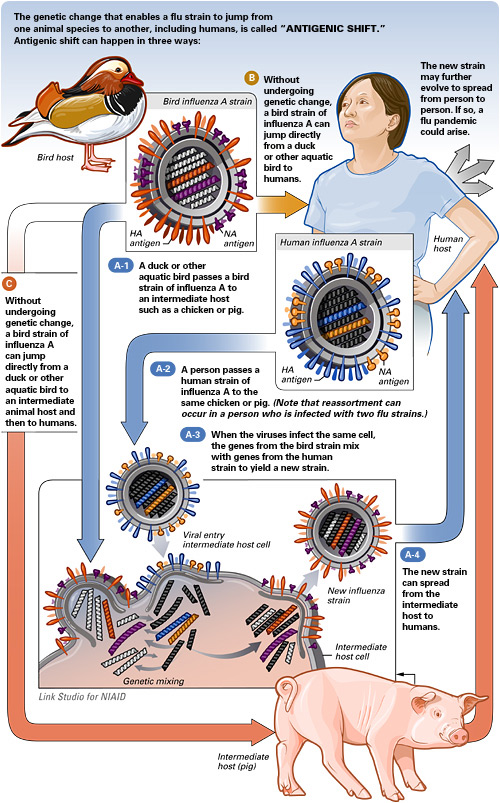
antigenic shift
Credit: National Institute of Allergy and Infectious Diseases (NIAID)

Another reason as to why researchers are unable to predict epidemics is that they are unclear as to what key mechanisms are required for viral emergence.  The truth is that there really aren’t a lot of observable trends to base predictions off of and there isn't a way to determine how susceptible a potential host is for a given virus.

Evolution, for example, seems as if it would be one of the mechanisms required for cross-species transmission.  In order to successfully infect a new host, the virus must be able to effectively replicate in the host’s cells.  Such a task is met with multiple barriers including host cell entry via receptor binding which requires genetic compatibility.  Overcoming all of these hurdles means there must be a corresponding change in the virion's genetic makeup.

Avian influenza viruses replicate in the gastrointestinal tract while human influenza viruses replicate in the respiratory tract—as conveyed by their differential genetic makeup.  What researchers don’t know is if viruses that jump the species barrier are already compatible with the new host or if they evolve compatibility after the fact.  Needless to say, evolutionary adaptation to new hosts is a poorly understood process.

Although we know that hybrid influenza viruses are a serious risk, evolutionary changes are not always required for viral emergence in a new host.  In the case of the 1918 human influenza epidemic, it is believed that the virus contained eight avian RNA strands.  It was also just determined that Influenza A H1N1 is a combination of two pig Influenza viruses.  Therefore, cross-species transmissions do not always require antigenic shifts in order to adapt to their new host.

Intuition seemingly breaks down when studying cross-species transmission.  It’s logical to assume that the more closely related to a species we are, the more likely it is we will contract viruses from them.  Indeed the majority of viruses that humans contract are mammalian in origin, but we have also contracted viruses from birds.  HIV is an example of a virus contracted from a closely related species, however, even though we’re most closely related to chimpanzees, our exposure to them is limited.  On a global scale, humans are more exposed to rodents which are responsible for a large number of emerged viruses in humans.

Another factor to take into consideration is that more closely related species share the same/similar alleles and other innate immune antibodies, meaning some organisms have pre-immunity to closely related organism viruses.  This is in contrast to more distantly related species where less immune system components are similar.

Overall, phylogenetic relationships may not be a crucial factor in cross-species transmission but rather, the occurrence of residing in close proximity to other animals.  Also, domesticated animals sometimes act as transitionary viral carriers.  SARS emergence for example, originated in bats, but humans contracted the virus from civet cats.

Not knowing factors that determine whether or not a virus will result in a pandemic is a major problem in public health.  We realize that it is a very real possibility for a new and rapidly spreading virus to potentially reach numbers to where quarantine is no longer a viable strategy—hence the root cause of mass hysteria.  Clearly we must take advised precautions in such times, but epidemics are and have always been inherently part of the human condition and is sometimes out of our control, which if anything, accepting reality can have a calming effect.

References:

Holmes, E. C., Drummond, A. J. (2007).  The evolutionary genetics of emergence. CTMI 315:51-66.

Parrish, C. R., Holmes, E. C., Morens, D. M., et al. (2008).  Cross-species virus transmission and the emergence of new epidemic diseases.  Microlobiology and Molecular Biology Reviews 72:457-470.

Slonczewski, J. L., Foster, J. W., Gillen, K. M. Microbiology: An evolving science. (2009). W. W. Norton&Company, Inc. New York, NY.

Comments

Woo! Thanks for all of that. You answered the questions I had, as well as others that I hadn't even thought about yet!

I'm curious, but ignorant of the details about the different strains, so I apologize if this is a dumb question:
Would the people in NY who've gotten the more benign type of the flu develop antibodies to the more virulent strains we're seeing in Mexico?

Alternate Allele's picture
Pre-immunity depends on pre-exposure to a pathogen.  I am unsure about the particular strain in NY, but my best guess would be that it's unrelated to one in Mexico except for that they're both Influenza. 

Overall, just a very minor difference in genetics between strains is sufficient enough to evade immune system defenses (which is why we need a new flu shot every year).  My best guess is that the people in NY have not developed antibodies to the virulent strain and would still be susceptable to the epidemic. 

I think it's more or less safe to assume that if a population is exposed to a virus then they would be less susceptable to the introduction of new closely related viruses, in other words, statistically speaking, there would be less fatalities/infections.  But this scenario occurance depends on different vriables at play.

So hypothetically speaking, depending on how many New Yorkers were exposed, you might see that as a population, less deaths may occur since perhaps they've had some recent exposure to Influenza, but as mentioned, it depends on how closely related the strains are.

It's more than likely that the two strains aren't related though and in the case of Influenza, minor differences are sufficient to surpass the immune system. 

However, if there was a pandemic we would definitely see that some populations would suffer less than others (we even observe this pattern with HIV).  These outlier populations/individuals are signifcant in research.

Thank you, that makes perfect sense.
While I'm not happy to learn that I am susceptable to catching multiple variants of pig cooties, I also think it's important that people who are exposed to the NY strain not consider themselves "safe" from this more virulent strain, if it does happen to run amuck for longer than it should.

"But this virus, technically called 2009 H1N1, is a hybrid of swine, avian and human strains, and no vaccine has been developed for it." http://www.cnn.com/2009/HEALTH/04/30/swine.flu.outbreak/index.html
I am a student of Chemistry/Medicinal chemistry at the University at Buffalo, and I think we have alot more than a standard Influenza A on our hands. The virus infected patient zero less than 1 month ago, while death toll is nearly 200. This number is obviously not yet comparable to the seasonal flu annual death count, but the virus is currently in its early stages of proliferation and development. Already the virus has reached many european nations and is starting to show up in parts of Asia. In such a short time mass emergence has occurred; and this virus is obviously as we know beginning to build resistance by genetic accumulation. This media induced hysteria is resulting in hasteful usage of anti-virals which will do nothing dig our own graves. I for one am very suspicious of the proclaimed origin of this virus, given the fact that there is no consistency in WHO numbers, title, or even the very nature of the antigen. How do you iterpret the ambiguities of this premature 'Pandemic'?

-Tony

Alternate Allele's picture
You're right, we do have a non-standard Influenza A strain on our hands.  But it's not like it's some super-mutant where a vaccine cannot be devleoped.  Vaccine development takes time, hence the delay.  Also, the virus can't be building "resistance" if we haven't even administered vaccines yet.  But yes, the virus is mutating, but not necessarily at a faster rate than "normal."

There is no reason to be suspicious as to the origins of the virus.  I read that it's believed to be two pig Influenza viruses.  Even if it's a combination of human, avian and piggy it still doesn't make it "suspicious."  A vaccine can still be developed.

I don't think there are any ambiguities associated with this potential pandemic, but rather, scientific unknowns and media inconsistencies.  Sicence has a learning curve, and the media is probably trying to make as many conclusions as possible despite the lack of information.  As time continues we'll learn more and the scientific community will be consistent in their data.  Undoubtedly, the virus will continue to spread... but as for true pandemic status, that remains to be seen, but none the less, that's reality and it's out of our control.  Overall, thus far, there is nothing out of the ordinary occurring, a highly virulent Influenza strain emergences every 10-15 years.

(By the way, if experts I requested interviews with respond to me I'm going to write something on the sociology of epidemics and address why people are freaking out over this!!!  Stay tuned...)

Hank's picture
"But this virus, technically called 2009 H1N1, is a hybrid of swine, avian and human strains, and no vaccine has been developed for it." 

He needs to stop getting his science from Twitter.  Or CNN.  Same thing.

Well put Hayley, the media is exactly the reason why so many are falling victim to panic and hysteria; that was my point entirely. I was simply pointing out the a few of the 'facts' that the media spits out, such as CNN and Twitter, which clearly are contradictory to every other source. Obviously, it is the intent of these sources to simply keep viewers engaged rather than calm. I guess 'suspicious' was a poor word choice, I was simply pointing out the ridiculous. Clearly, if we are capable of developing new Influenza vaccines at will the synthesis of a swine/ wherever it origin lies vaccine would not be an impossible task. What I was getting at, rather poorly for which I apologize, is that the instilled fear will cause the public to begin demanding vaccine and any form of antivirals which would be devastating. I'm well aware that this virus is not in any sort of conditions that would facilitate accelerate mutation and accumulation of resistance. However, my point was that the public is on edge and may result to aggressive/ violent demand for vaccination no matter the supply. Which is not far off from the people of Mexico City crowding hospitals filled with infected patients protesting the supply of surgical masks; ironic huh. But as I pointed out previously, incomplete vaccination could give rise to a highly resistant strain. I apologize if no one was able to pick up on my irony in my previous comment.

-Tony

Hayley:
A very well written/cogent article.

As to "I'm going to write something on the sociology of epidemics and address why people are freaking out over this!!!"...this is probably more attributable to instant media coverage than anything else.

Until the epidemiologists track the vectors of infection for all of the cases we will not know if we are looking at parallel or singular strains. IMHO, the lack of perceived virulence in this country may have more to do with access to hygenic living environments here and in Western Euope than in Mexico. Also--we may be in the very early stages of a pathogen propogation in a population--which usually shows very low mortatlity.

For the "mouth breathers" you may want to write an article about the critical-mass/tipping-point of resistance building in a population. E.g., early infectees are likely to be infected with a mixture of old and new strains and these infectees will have antibodies to the "old" strain--while the new strain will survive. As the new strain propogates through the population, all of the "old-related" and non-virulent strains are naturally killed off--leaving only virulent new-strain bugs.

I am sure that you have some text on the tipping point histogram/statistics.
I tossed mine long ago.
:-)

Thanks--and keep up the good work!
JCC
BS '75
MS '80
Microbiology

"Clearly we must take advised precautions in such times, but epidemics are and have always been inherently part of the human condition and is sometimes out of our control, which if anything, accepting reality can have a calming effect."

You use wording several times that takes the statistical approach while trying to talk to individuals. "don't worry, little chance of you being one of the many dead people". Yes death is part of life :-) I think everyone knows that. Just because statistically it doesn't happen often, does not mean that the whole world should go back to watching Rock-em' Sock-em' Robots just yet.

It's just as important that the fool on the bus next to you knows that this isn't a time to be sneezing all over ppl as it is that you know what RNA is. The amount of people that continue to go to work etc with flu is disgusting, inconsiderate. A little hysteria has it's place, I'll be thankful if a fearful moron saves my life by deciding not to go out while sick.

Yeah, it's real easy to smugly talk about Swine Flu as if it were someone else's problem...but just wait till the dying starts.

I find it intolerable that our government has repeatedly suggested and ingrained in simpler minds that hand-washing (of no effect against an airborne virus), masks (completely ineffective when they become moist), and the 2 flu vaccines (Untried, untested, and contain Squalene) are the only means of staying safe during this period.

Oxygen Therapy is a proven method of denying the Swine Flu virus access to your body on a cellular level. This is not just my opinion. Doctors in Omaha, Nebraska who recently cured a little girl of Swine Flu also attest to it...as do many, many others.

Gerhard Adam's picture
...but just wait till the dying starts.

With the proposed therapies, it's a wonder it hasn't started for more varied reasons already.

Add a comment

The content of this field is kept private and will not be shown publicly.
  • Allowed HTML tags: <sup> <sub> <a> <em> <strong> <center> <cite> <code> <TH><ul> <ol> <li> <dl> <dt> <dd> <img> <br> <p> <blockquote> <strike> <object> <param> <embed> <del> <pre> <b> <i> <table> <tbody> <div> <tr> <td> <h1> <h2> <h3> <h4> <h5> <h6> <hr> <iframe>
  • Lines and paragraphs break automatically.
  • Web page addresses and e-mail addresses turn into links automatically.
CAPTCHA
If you register, you will never be bothered to prove you are human again. And you get a real editor toolbar to use instead of this HTML thing that wards off spam bots.