Track your comments!
[x]


When you register, comments on your articles and replies to your comments appear here. Register Now!

Sign in to your account
[x]

Not a Scientific Blogging member yet?

Register Now for a Free Scientificblogging.com Account

  • Customize your profile with pictures, banner, a blogroll and more.
  • Leave comments on articles, add other members to your friend lists, chat with people on the site.
  • Write blog posts that can be seen by hundreds of thousands of readers.

It's free and it only takes a minute!

Already a Scientific Blogging member?

Sign In Now

Banner
By Danna Staaf | September 9th 2009 08:11 AM | 2 comments | Print | E-mail | Track Comments
.

More Squid A Day articles

All

About Danna Staaf

Cephalopods have been rocking my world since I was in grade school. Now I'm a graduate student at Stanford University's Hopkins Marine Station, where I study the development and dispersal of Humboldt... Full Bio

The Cephalopod International Advisory Council is convening in Vigo, Spain even as I write. Yes, I wish desperately that I were there right now! At least I can follow along by wistfully reading the abstract book, which they were kind enough to post.

Let's start at the very beginning . . . wait, the very beginning lists "restaurants nearby to the congress" and now I am imagining tortilla española auténtica and salivating . . . so let's not start at the beginning. Let's skip ahead to the symposium opening and the first invited talk:

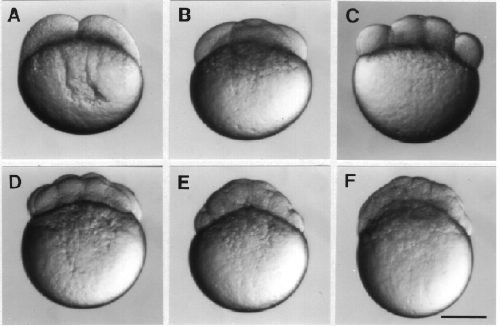
Cephalopod embryology: a review, by Sigurd von Boletzky. That would have been something to see! Cephalopod embryos fascinate me. See, cephalopods lay yolky eggs (like chickens), which are kind of a nightmare for straight-up classical embryology. The classical embryologist wants to watch one big cell divide into two smaller cells, two into four, so forth and so on, and draw diagrams of the whole thing. But yolk doesn't like to divide. A very yolky egg doesn't split into two smaller cells, each with some yolk. No, the yolk sits heavily at the bottom while the top goes through an "incomplete division," followed by a whole lot more incomplete divisions. That big old yolk sac never divides, and you end up with a very cellular embryo hanging onto a completely acellular yolk sac. Very cool, but harder to study.

Consequently, we don't know nearly as much about yolky cephalopod embryos as we do about some of the nice yolk-free embryos, like sea urchins. But von Boletzky probably knows more than anyone, and I'd love to know what he knows.

Comments

Jeff Sherry's picture
D. Staaf, I was wondering if all cephalopods follow the same model of incomplete division?

Danna Staaf's picture
I am pretty sure that they do! Nautilus is the only plausible exception, because it's so weird and different in general, but I've checked the literature and they appear to have big yolky eggs too.

Add a comment

The content of this field is kept private and will not be shown publicly.
  • Allowed HTML tags: <sup> <sub> <a> <em> <strong> <center> <cite> <code> <TH><ul> <ol> <li> <dl> <dt> <dd> <img> <br> <p> <blockquote> <strike> <object> <param> <embed> <del> <pre> <b> <i> <table> <tbody> <div> <tr> <td> <h1> <h2> <h3> <h4> <h5> <h6> <hr> <iframe>
  • Lines and paragraphs break automatically.
  • Web page addresses and e-mail addresses turn into links automatically.
CAPTCHA
If you register, you will never be bothered to prove you are human again. And you get a real editor toolbar to use instead of this HTML thing that wards off spam bots.