
Track your comments!
[x]


When you register, comments on your articles and replies to your comments appear here. Register Now!

Sign in to your account
[x]

Not a Scientific Blogging member yet?

Register Now for a Free Scientificblogging.com Account

  • Customize your profile with pictures, banner, a blogroll and more.
  • Leave comments on articles, add other members to your friend lists, chat with people on the site.
  • Write blog posts that can be seen by hundreds of thousands of readers.

It's free and it only takes a minute!

Already a Scientific Blogging member?

Sign In Now

Banner
By George Cooper | July 4th 2008 04:18 PM | 14 comments | Print | E-mail | Track Comments
.

More Solar Fun of the Heliochromologist articles

All

About George Cooper

Amateur astronomer, B.S. M.E., self-acclaimed heliochromologist.... Full Bio

Continuing from the prior article...

“The Sun Ain’t Yeller”, cries the heliochromologist.  Undaunted by tradition, dogma, or tens of thousands of erroneous magazine and textbook images of our Sun, heliochromology, a colorful heterodox, is winning the day because the Sun is what it is, color and all, regardless of other’s puerile incognizance.  The answer is not a vague, subjective one, but an objective one, as sure as red apples are red.  Heliochromology is our path to enlightenment that will bring resolve to this color conundrum -- a subtle polemic that has been dormant to all of astronomy for hundreds, nay thousands, nay nay, tens of thousands of years, perhaps since mankind first discovered the Sun and its daily color metamorphosis.  We know not who the sagacious sapien may have been who indubitably made the first astronomical discovery of all time – the Sun.  Yet, dare none to ask its color?  Who knows what color lurks hidden behind the blaze of Sun? The heliochromologist knows!


The Sun is certainly a worthy topic of study, one with a dynamic and powerful past. Our star has no equal as an observable object and it is even an object of great worship.  Consider Ra the Egyptian god.  “Ra Ra shish cum bah” – where do you think that mantra comes from?  Even today our host star is worshipped, especially during the spring equinox when thousands stretch along miles of beach and soak in excesses of radiation, possibly proportionate to their beverage consumption.  Yet, ask them the color of their god and they only offer wild guesses, more often than not yellow is their response.


So, as other worthy scientists have been marching ahead including astronomers, solar physicists, helioseismologists, nuclear physicists, and others, let us now join our color paladins, heliochromologists, as they enter the tail of this triumphant science parade and learn of their brooming efforts that has helped make a cleaner and more colorful path for all. [/corn]


Why ain’t the Sun yeller?  There are two strong elements that come together to reject any yellow argument:  the Sun’s color we observe here, under appropriate attenuation, and the colors that were scattered away by our atmosphere (extinctions).  This simple finding was not expected initially but was realized after much stumbling along my amateur way.


A number of attempts were made in trial and error fashion to help get a handle on what might and might not advance this color quest.  The following are most of the examples:


1)      The SAD -  Solar Attenuation Device consisting of a black painted paper plate with a pencil glued to its center.  A 0.5 mm slot was made in the plate that allowed me to observe the Sun with a 99.9% attenuation while the plate was spun by a cordless drill.  [It costs about 15 cents to make as all parts were used.  Perhaps it is the worlds cheapest scientific instrument.]  The Sun was still too bright to determine its color, as seen terrestrially.


2)      Random orientations of quality 3 inch convex lenses and prisms were tried but produced little toward any progress.  Worse, it did manage to catch my blue jeans on fire.  [When a restaurant hostess now asks me if I smoke, I say “No, except when I’m on fire.”]


3)      Invention of the asterochromograph.  This device uses a simple, calibrated mask that alters the Sun’s spectrum that has been dispersed by a prism -- one with five place accuracy of refractive index – to obtain the matching energy for each wavelength of that of the AM0 spectral irradiance data found from space observations. 


asterochromograph


 This adjusted spectrum is then scrambled and homogenized into a small dime-sized spot to allow us to simply see the color of any object with known spectral irradiance data.  This spot’s color accuracy can be easily verified with a simple spectrometer.  The original prototype was made and mounted onto my 8” SCT to provide Solar tracking.  

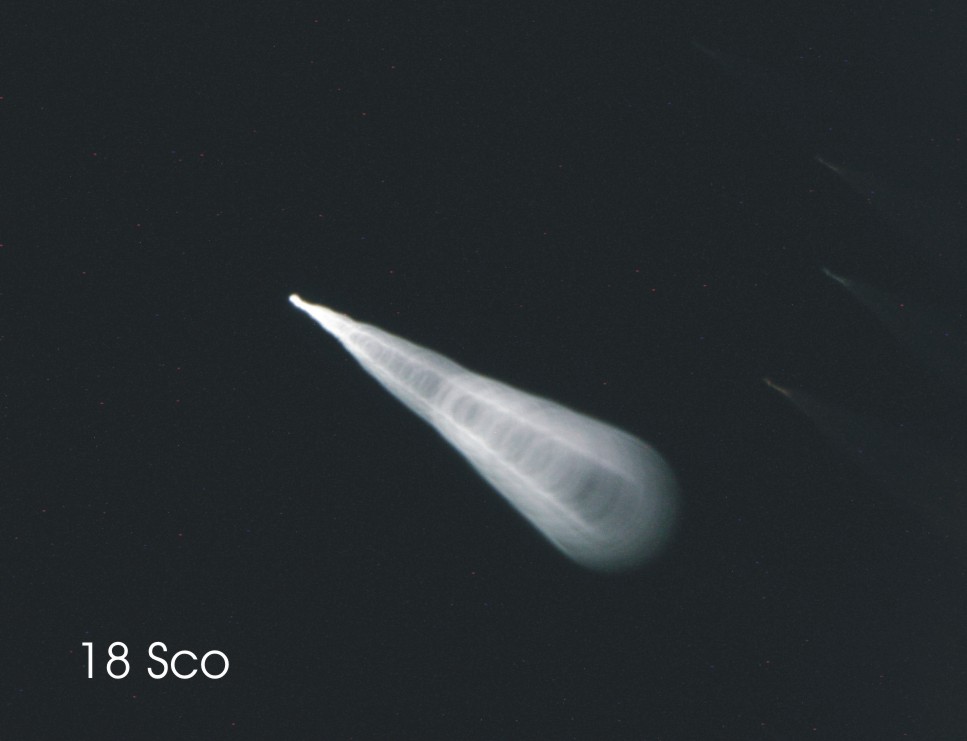
4)      Taking advantage of Kitt Peak’s great AOP (Advanced Observing Program) for the public, I did an all-nighter with their technician Roy Lorenz.  [What a fun time, an event I recommend to everyone.]  Roy was very helpful and patient as he helped me obtain images of solar twins.  The following image is of 18 Sco and uses a astrophoto technique known as progressive defocusing. 


18 Sco


Taking the image progressively out of focus while altering the tracking rate allows the color of a celestial object to be revealed.  Stefan Seip is a photographer who has produced beautiful images using this technique. Here is one of his images.


5)      Using various computer color programs we can determine color given the known spectral irradiance data.  Of the few that I found, none seemed to work.  One model can be found at this site, but claims the Sun is peachy pink!  Is our Sun a girl star???  [Actually, peach pinkish is the author's color descripton, but I’m in this for the fun, as well as, truth.]


6)      Observing the simple objects such as clouds, the Moon, and other objects.  If the Sun were, say, green, wouldn’t the Moon look green?   Wouldn't clouds look green, too?  They all look white, don’t they?  Look at the color of this astronaut: 



Ed White


He not only looks white, he is white….Ed White!![He was the first US astronaut to walk in space.]  [I had the pleasure of meeting him and hearing his speech.  Every time he referred to his cockpit companion by saying “Jim and I”, people laughed, but I was too young to catch the pun (Gemini).]


7)      Finally, the best of all evidence:  The Solar image of the Sun from Kitt Peak taken by Roy Lorenz and Dr. Drew Potter.


Suns color


This last one came days after the all-nighter with Roy Lorenz, and while my wife slept in the Spartan astronomer’s dorm – that was also the night of our 25th wedding anniversary (thanks again Honey!).  The next day, after I had no sleep, I took her on the late morning tour through the McMath Pierce observatory, world’s largest Solar telescope.   Their main projection table had a small image about the size of a dime or nickle cast upon it.  This intrigued me and I asked what it was.  The person who was adjusting the tracking system said it was Venus.  Venus in broad daylight was impressive enough, but here was a reasonable nice disk of it, too.  He said you can do a lot when you have a f50 telescope.  Their other and smaller projection table had a nice, bright solar image upon it, though I saw no sunspots.  I was intrigued with the observatory more than I was cognitive of my original goal. On the way out of Tucson, and after some sleep, it finally hit me what I missed.  The color of the Sun was flooding down on me and I had overlooked every drop!  The Solar projection table had the proof that refuted any claim whatsoever that the Sun is yellow.   This, however, was  predicated on their telescope not using any filters.  I later confirmed with them that they were not using any filters, which could have easily altered their Solar image. 

Remember me saying that if we knew the color of the Sun seen terrestrially that we could add the colors back into this image in proportion to those scattered by our atmosphere.  This would be rather tricky except for the fact that the Sun’s image on the table was white -  all white, from limb to center.  This makes the non-yellow claim extremely strong.  Why is that?  Well, recall that our atmosphere scatters blue light far greater than any of the longer wavelength colors.  [Rayleigh Scattering describes this and shows that this scattering is inversely proportional to the fourth power of wavelength.  Blue is not quite half the wavelength of red, and it scatters blue photons about 8 or 9 times more than red photons, depending on which wavelengths of those colors you want to compare.  This scattering effect is why the sky appears blue.]  So, if we add primarily blues to a white object, could it ever cause it to become yellow?  Nope, not no way, not no how.  The Sun ain’t yeller, indeed.


But could it be a blushish-white star since we are adding blues to this white object?  I doubt it since the amount of blues, along with all the other colors in diminishing amounts, are not enough to cause us to see anything but white.  Part of this reasoning is supported by another eye phenomena known as color constancy.  Our brain likes to make light sources appear to be white.  Turn your car’s headlight on during a sunny day and notice how it appears yellow, but turn it on at night and our eyes see it as white. 


Since the Sun is alone in space no other light source will trick us in seeing anything other than a white star. Yet there is more evidence for a white Sun.


The Sun is a ball of gas and the layer that we see is the photosphere.  As we look into the central portion of the Sun’s disk we are able to see deeper into its atmosphere.  As we peer into deeper regions of the Sun, we are seeing hotter and hotter gases.  The Sun’s surface temperature is about 6,390K in the central zone.  As we look to the limb of the Sun, we see only the very top of the photosphere where the Sun is only 5,000K.


This temperature gradient is part of what is known as the center-to-limb variation (CLV).  It is important to us because if the Kitt Peak image is not yellow at the limb, at 5000K, then there is really no hope, once again, of the Sun ever appearing yellow.  [In 4 or 5 billion years, that will be a different story.]


But, what happens when we add those atmospheric blues into the hotter, central disk region.  Will this portion of the disk appear bluish white?  I don’t think so, but there is that possibility.  Color models do indicate that objects at this temperature should look blue.  Until someone goes up into space and uses some simple attenuator (a SAD, perhaps) we may never know.


Nevertheless, until that day, our Sun should be regarded as a white star as it illuminates the entire solar system.    Hopefully, artists will take it from here and will occasionally portray it in its true color.  Hopefully, also, they don’t always do this since I also like seeing a colorful Sun, just not all the time, please.


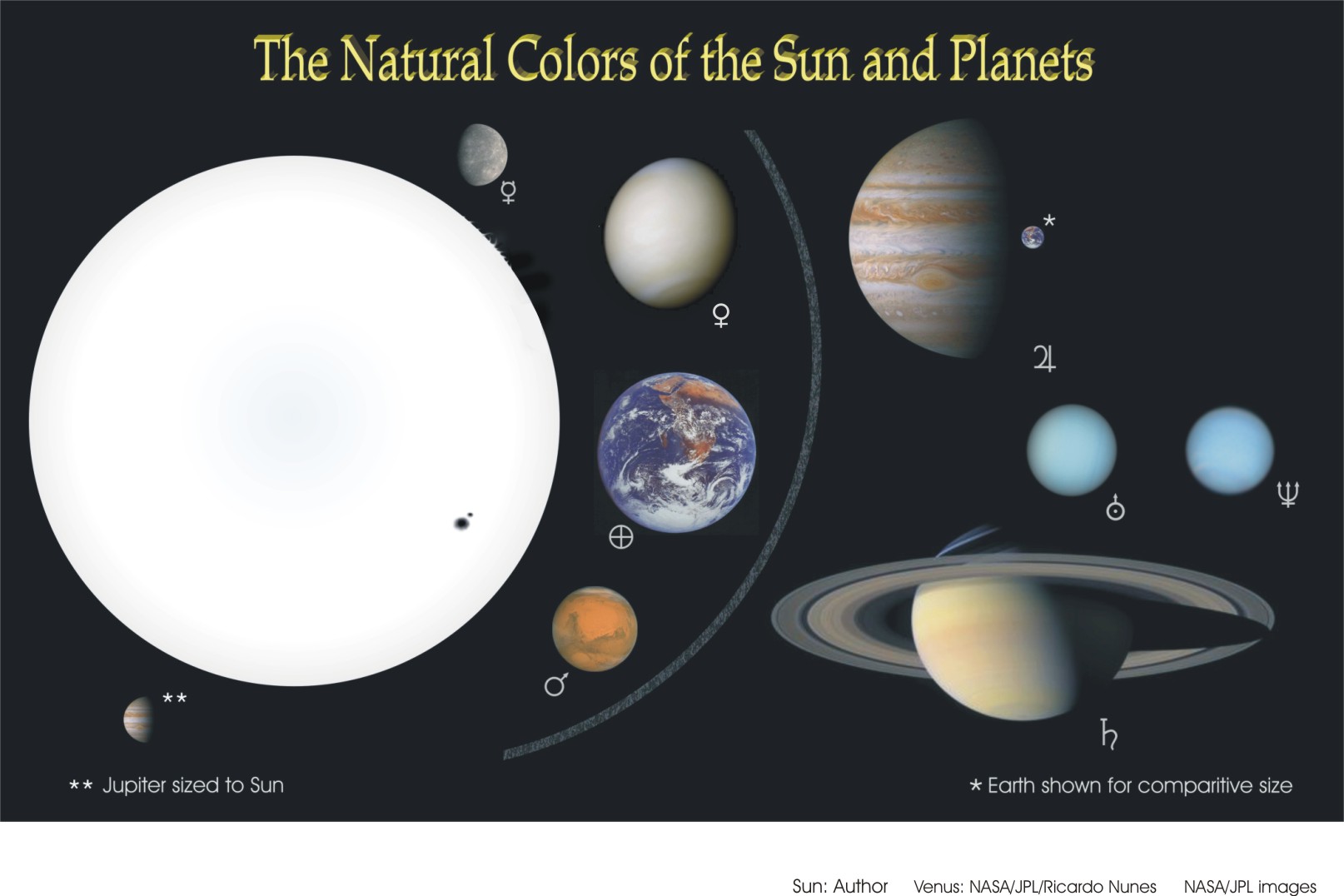
Allow me to leave you with a somewhat true color representation of our Solar system, for even the planets (especially Venus) are portrayed poorly by most others.]


System


Venus here courtesy of Ricardo Nunes; and the other planets courtesy of NASA/JPL


  BTW, the fun doesn't end here. Since the Sun is still classified as a yellow dwarf, yet it is really white, now what? Pluto was an easier correction. :)


[edit for grammar corrections]

Comments

Hfarmer's picture
double post oops
Hfarmer's picture
Interesting, very interesting, however there are some serious problems with your reasoning and conclusion.   First of all you never precisely defined what the color of a star was.  Since most objects do not emit blackbody radiation like the sun does.  In fact they are illuminated by the black body radiation of other objects.  So for most objects it can be said that the color of the object is defined by it's emission spectrum... the set of wavelengths that are emitted from it's surface under illumination.  Or equivalently the color of an object is white minus the frequencies it absorbs. Since stars emit so much visible radiation along almost all wavelength's  their emitted light will appear to be white.    Observe the dark lines in the absorbtion spectrum of our sun.  These are the wavelengths that are absorbed by the elements it is made of. It can be said then that the star's color is white minus those dark lines. Looking at this spectral data the sun emits the most consistently in the red and yellow.  This, not superstition, is why so many people when drawing the sun draw it red, orange, or yellow even when they depict high noon when more of the higher wavelength's your greens blues and violets will get through the atmosphere.  

Basically while 90% right you are 10% wrong.

However I like your simple approach to the problem.   Dont tase me bro
Helio George's picture
[Hmmmm, I lost my original reply to you.]
Hfarmer, you are correct that the color of a star is defined, though loosely, by its emission spectrum. However, it is not correct to claim a star’s color is white less its absorption wavelengths, no more than its color would be white plus its emission band colors.

The color of a light source, if seen at a proper intensity level, is determined by the combination of all the photons of all the wavelengths within the visible band of light, as well as, the spectral sensitivity our eye – brain (retinex) has.

To take any given spectral energy distribution and compute a net color seems beyond our abilities when it comes to certain stars, especially ones like the Sun which has a peak within the visible spectrum.

Looking at your illustrations, these are not actual spectrums of the Sun. The absorption lines are much too clean and the color distribution is wrong; yellow is a very narrow banded color.

Here is a very good, perhaps best, Solar spectrum. [Also taken from the McMath-Pierce telescope at Kitt Peak.] Notice the slight fuzz to the absorption bands and how narrow is the yellow band. This narrow band was mentioned in Part II of this article. [Go to the top of this article for the link.]

Thanks for your interest.

Thanks for the discussion. I think Hfarmer missed the point though. Absorption lines aren't visible to the human eye anyway so how is it relevant.

As you say the sun is certainly white as white is defined. Of course we're really talking about a black-body curve so it's not flat or uniform in wavelength.

This gets us to the definition of "white" itself. In our human case, "white" is biologically (and species-specifically) defined by what we've evolved to. For example, other species see farther below and above our "visible" spectrum and presumable if you asked a bumble-bee what "white" is you'd get a slightly different answer in a strictly physics wavelength sense. Evolution "found" it convenient to make our biological sense of every day illumination a flat, uniform response to the extent necessary for survival without being wasteful.

In our case we generally have our white defined by the aggregate of three (3) biological dye response curves (roughly Red, Green and Blue) in our eye. If you have a certain gene mutation there's an extra dye curve between Red and Green. Alone this doesn't fit the curve of the black body of the sun. So there must be an additional curve formed by neural nets, probably in the retina, that effectively combine the whole 3-dye curves responses to result in a "1 - blackbody" shape to a first order, ultimately resulting in the "flat response" that allows individual wavelengths to suddenly "have color" rather than the "all color" of white. Then again, that may be our brains fooling us again.

Helio George's picture
Jes, it seems logical that a flat distribution of colors would represent a white sensation in our brains. I favor this hypothesis, but evolution doesn't require it since it is only a passive process. Other animal have evolved with such different visual senses, though ours is superior to many of theirs, no doubt. [This is one reason I mentioned the white-tail deer.]

It might be more logical to have an evolved eye that sees an ultimate white as the actual photon flux distribution we see during midday. The photon flux I showed in the prior article (part II) is one seen from space, thus, an even steeper drop-off will be found for the blues and some greens as seen terrestrially due to the greater scattering effect for these colors.

This might mean the "most white" is one that has a much greater reduction in blues, perhaps even half that of the other colors.

Considering that only about 2% of our color cones are blue [receptors], that last idea is even more remarkable to suggest.

This all goes to show that it is no simple task to determine the Sun's color. If the Kitt Peak image had been yellow at all, then yellow would still have a chance of being its true color. Since no yellow was found, then the Sun can not be yellow (again, as seen in space at an appropriate attenuation level).

A while back, one astronomer rightly asked about the brightness of the KP projection since our eyes will tend to make bright light sources white, which I also mentioned in the article. Roy and Drew, once again, stepped in and, after I sent them a light meter, measured the surface brightness and found it to be well within our photopic comfortable zone.

rholley's picture
I read somewhere that the Garnet Star, so called from its appearance in binoculars or a small telescope, appears yellow in a large, 12 inch (?) instrument.

Another thing - what is brown? I've been playing with the colour picker on my favourite graphics application, and I get a respectable brown from Hue 40 Saturation 100% Value 60%. When I change the value to 100% I get orange. Yellow has a hue of 60, and when I reduce the value to 60%, the colour is more a dull green than anything else.

Robert H. Olley
Physics Department
University of Reading
England

Helio George's picture
A yellow Mu Cephi through binoculars may have more to do with the binoculars than the color of Mu Cephi. Mu Cephi, one of the largest known stars, is an M-class star and and should look orange or red. These stars are cool enough to have more complex molecules. TiO is one example that is common to many class M stars. TiO, to a much lesser extent, is also found in cooler regions of the Sun (ie sunspots). Perhaps the complex molecules give it a yellow look, but I doubt it.

Also, if Mu Cephi is near the horizon, you will get a redening effect caused by our atmosphere, which is why the white Sun looks yellow or orange. [Thus, even more reason for a non-yellow result. I seem to be anti-yellow these days. :)]

No blackbody distribution, as typically found in stars, will give you a brown color. However, the newer class of stars known as the T-class are about the coolest you can get and still be a star. At these lower temperatures weird things can happen. One T-class star, as I mentenioned in the article, is storong in red and somewhat strong in blue. That is not unusual except that it has almost no mid-range colors. Combining blue and red makes the star appear maroon or crimson, depending on which university you might be rooting for.

Hfarmer's picture
Well the by the definition you are using all stars would be white then. Their would be no red or blue giants. Which by observation there are. My definition is all about precise, quantitative and empirically defineable things. While on the certain level that you worked at you are right, on a more fundamental level you are wrong. Dont tase me bro
Helio George's picture
The Sun is blue! But let me 'splain...

First, Hfarmer, my view does not suggest all stars are white. It all depends on the relative strengths of all those photons entering the eye. Stars, like the Sun, that have a flat distribution, will appear as white. But, not all stars have flat distributions. [I tried to keep the article short, which limited the explanation needed. Sorry for the confusion. The blue thing is coming.]

For instance, consider the M-class "red" stars. Their surface temperatures are under 3500K. At 3500K the peak energy comes at a wavelength just beyond red, which means all the M-class stars will have energy peaks redder than red, if you will.

Since stars are nearly blackbody radiators, then the strong "reds" must be added to the slighly weaker "oranges", as well as, the weaker "yellows", etc. It is this combination of colorful flux that gives our brain the signal that, in this case, will yield a red or orangish-red color determination.

This same arguement will apply to the blue end, but the blue end is somewhat different. Recall that photon flux is the best model to use for light when our eyes and cameras are the instruments. Since "blue" photons have nearly twice the energy of the far "red" photons, it will take a larger blue-ended hump in the Planck distribution to give us as rich a blue appearance as we enjoy the richness of red in the M-class stars. As a result, blue stars are more blue-white, since the other colors are influencing us more so.

It is intersting that the spectral energy distribution (SED) that we see in a rich blue sky will approximately be matched with a 15 million deg. temperature; the SED slope in the visible spectrum is very steeply inclined to blue and beyond. [The peak is near 2 Angstroms.] This condition happens to exist in the core of the Sun.

Therefore, if we could safely see a properly attenuated view of the Sun's core, it would appear as a rich blue object. So, the Sun is blue, but only inside. :)

George

rholley's picture
Now, what colour is the Moon?

Look at these PICTURES.

Robert H. Olley
Physics Department
University of Reading
England

Helio George's picture
That is a great shot from EPOXI (its new name following the Deep Impact mission).

I don't trust, however, the color accuracy in this image, but I do trust the relative brightness between Earth and the Moon. The Earth's albedo is 0.37 (avg.) and the Moon's albedo is 0.12, or 1/3 the surface brightness of the Earth (given the same light source).

The Moon rocks seem to be gray, but there are varying color regions on the Moon. On one Apollo mission, they found on a crater's rim, IIRC, a very bright orange region.

The image of your link, nonetheless, is very remarkable. Have you seen the animated version?

Animated Lunar Transit

On page 112 of Sky & Telescope Observer's Guide Series "City Astronomy" (1994) by Robin Scagell are the words: "The Sun is actually pure white in color, with a slightly yellow limb. ... If the Sun appeared to us as yellow, we would never see an object by day as a white, for it would be the color of Sunlight -- yellow. ..."

The author has some more words about this but I don't see that they are needed for this point.

The argument by the author appears to remove the point about how very bright lights overwhelm our eyes and cause us to see white when the light isn't white. Another point is that I have attenuated the Suns light with a foil-like solar filter when looking directly at the sun with either my binoculars or telescope or reflected off the moon with a gray or polarising lunar filter with my apochromatic 4" refractor. In every case the Sun was always white. (The highly reflective portions of the moon would be white and other parts would be gray or even brown, but nothing yellow.)

I believe their are many errors in astonomy and cosmology. For some other big ones visit my homepage listed above.

I didn't see this science blog showing my website and since I referenced it here it is in the text http://home.pacbell.net/skeptica
Vince

Helio George's picture
Hi Vince,

Yes, there have been many assumptions made within astronomy that have been shown to be incorrect.  The Sun's color is an odd error by many since it is taken more as a subjective issue and not highly relevant to advancing science.  They have accurate data on the Sun's spectrum, mass, size, composition, temperatures, etc., and color accuracy just seems to have fallen through the little cracks.   Other stellar colors also could use some revision since red giants are more orange than red, and blue stars are never deep blue but bluish white instead.

Thanks for the 1994 S&T article.  It is rare to find any claims for a white Sun from back then.   The arguments stated that the Sun must be white because white paper looks white is not that great an argument, however.   If the Sun were a yellow star and sunlight were yellow, we would still see any white paper look white because the Sun would still be emitting all the other colors, too.   So the paper could be, say, a bluish-white paper as seen in white light, but would appear white in yellow sunlight.

When I glance at the Sun, I see a yellow rim around the Sun, though it is unclear why most people see this.  Regardless, the white Sun claim I make is on the basis of us seeing the Sun from space and appropriately attenuated to avoid the blinding affect you mention.  In this case, the limb region will still be white because there is essentially no yellow in the limb seen terrestrially  (see the Kitt Peak image).  Since our atmosphere removes more of the blue end of the spectrum, then if the Sun limb were indeed yellow, it would appear to us more prominently yellow (or yellow-orange) in imaging taken terrestrially.

You have an interesting site, btw.  I would recommend you give the www.bautforum.com forum a try as you will find many to discuss your views.

George


Add a comment

The content of this field is kept private and will not be shown publicly.
  • Allowed HTML tags: <sup> <sub> <a> <em> <strong> <center> <cite> <code> <TH><ul> <ol> <li> <dl> <dt> <dd> <img> <br> <p> <blockquote> <strike> <object> <param> <embed> <del> <pre> <b> <i> <table> <tbody> <div> <tr> <td> <h1> <h2> <h3> <h4> <h5> <h6> <hr> <iframe>
  • Lines and paragraphs break automatically.
  • Web page addresses and e-mail addresses turn into links automatically.
CAPTCHA
If you register, you will never be bothered to prove you are human again. And you get a real editor toolbar to use instead of this HTML thing that wards off spam bots.