
Track your comments!
[x]


When you register, comments on your articles and replies to your comments appear here. Register Now!

Sign in to your account
[x]

Not a Scientific Blogging member yet?

Register Now for a Free Scientificblogging.com Account

  • Customize your profile with pictures, banner, a blogroll and more.
  • Leave comments on articles, add other members to your friend lists, chat with people on the site.
  • Write blog posts that can be seen by hundreds of thousands of readers.

It's free and it only takes a minute!

Already a Scientific Blogging member?

Sign In Now

Banner
By Kimberly Crandell | July 2nd 2007 09:51 AM | 75 comments | Print | E-mail | Track Comments
.

More The Science of Motherhood articles

All

About Kimberly Crandell

I'm a mother of three, with an aeronautical engineering degree.  Although it's been a while since I've done any aircraft design, there are surprising applications of


... Full Bio

You can’t watch the news, turn on the radio, or open a newspaper these days without hearing about global warming. It seems our future is looking rather warmish, and many of our modern conveniences may be to blame.

I’m not disputing the fact, but at the same time I’ve never had it explained to me precisely and quantitatively how many of the choices I make each day are contributing to global warming. I mean, I understand the link between driving my car and carbon emissions. The family minivan spews carbon dioxide for goodness sake, so I clearly understand how running my daily errands in a gasoline-powered car can contribute to the problem.

But what about the rest of my daily routine… what impact does it have? If I roast a chicken in the crock-pot instead of my electric oven, does is make a difference? What if I grill instead? What is the impact of watering my lawn, or taking a hot shower? How do the decisions I make each and every day impact the environment in terms of energy consumption and greenhouse gas emissions? And what does it mean when we’re told that something produces 100 lbs of CO2 each year? Is that a lot?

I went in search of all of the facts and figures needed to quantify how the little things I do each day translate into fossil fuel usage. I love numbers, formulas, and equations… so I gathered as many as I could find. The effort was worthwhile, because it’s helped me to develop a picture of how many of my short-term decisions have long-term impacts.

If you’re interested in determining what many of the things you do each day relate to this global warming issue we’re hearing so much about… read on! Information is never a bad thing – and once you have it, you are at least armed with additional facts to consider as you go about your day.

APPLES TO APPLES

First, let’s talk units. Global warming is all about an increase in greenhouse gas emissions, which are “thickening” our atmosphere and preventing more and more solar heat from escaping. The greenhouse gas we hear the most about is carbon dioxide, because it is what we see the largest quantities of, and is what has been increasing so dramatically over the past 50 years. There are other greenhouse gases that are also on the rise, but initially we’ll concentrate on carbon dioxide.

As we go about our day, we do things that directly contribute to greenhouse gas emissions (like driving our cars), and indirectly contribute (like using electricity that is produced by burning fossil fuels, which generates carbon dioxide). To compare the impact of it all, we will look at everything in terms of the pounds of CO2 that are produced as a result of our activities and energy consumption.

GASOLINE

Let’s start with the most direct contributor first: automobile emissions. According to the EPA, a gallon of gasoline produces 19.4 pounds (or 8.8 kilograms) of CO2. (1) Gas This of course is an average, and takes into account the total number of cars on the road, the average fuel economy of these cars, and the total annual emmissions due to cars. Our personal cars may be a little more or a little less, but this gives us a general idea.

In our family, our minivan gets an average of 20 mpg. So for each individual mile we burn approximately 1/20th or 0.05 gallons. So, using the approximation above, that equates to 0.97 lbs of CO2 per mile… almost one pound per mile.

So those drizzily mornings when I drive my daughter the 5-mile round trip to drop her off at her middle school instead of letting her take the bus, I burn up about a quarter of a gallon of gas, and produce 4.85 pounds of CO2. In actuality, it is probably a little more, because cars are least efficient during the first few miles of the day while the engine is still cold. My car is probably just warming up to its peak efficiency just as I’m returning to the garage.

Hmmm… maybe it’s time to invest in an umbrella.

ELECTRICITY

When you receive your electrical bill each month, your usage is most likely presented in terms of kilowatt-hours (kWh). Gas A kilowatt-hour is a unit of energy equivalent to 1000 watts of electricity used for 1 hour. So for example, if you left a 100 watt light bulb on for one hour, you would use (100 watts) x (1 kW/1000 watts) x (1 hour) = 0.10 kWh.

The national average emissions factor for electricity is 1.37 pounds CO2 per kWh. (2) Again, this is an average. Different sources of electricity clearly produce different levels of emissions. Burning coal and natural gas are on the high end, while solar power and wind power are considered to be “green” or renewable sources that do not contribute to greenhouse emissions at all.

If you are interested in discovering specifically what sources are used for electricity in your area, your can contact your utility company and find out. In California, utility companies provide a Power Content Label (3) which gives a breakdown of what percentage of the power they supply comes from various energy resources. But for now, we’ll use the national average above.

So how do you determine how much energy you’re using, and therefore how much CO2 you are emitting, as you putter around your home each day? Well, most appliances come with an Energy Guide label that gives an estimation of what the energy use of that appliance is in terms of kWh per year. But if you really want to know specifically what’s going on in your home, you need to find out what the wattage of the appliances you use, and determine the number of hours per day that you use them.

Unlike lightbulbs, not everything is stamped with its wattage information. If you’re really a hands-on kind of person, you can still estimate it by finding the current draw (in amperes) and multiplying that by the voltage used by the appliance. Most appliances in the United States use 120 volts. Larger appliances, such as clothes dryers and electric stoves, use 240 volts. The amperes might be stamped on the unit in place of the wattage. If not, find a clamp-on ammeter—an electrician's tool that clamps around one of the two wires on the appliance — to measure the current flowing through it. You can obtain this type of ammeter in stores that sell electrical and electronic equipment. Take a reading while the device is running; this is the actual amount of current being used at that instant. (4)

If you don’t feel like getting down to that level of nitty-gritty, there are plenty of tables available that will provide an estimated wattage rating for major appliances. To help me answer the question about using my crock-pot instead of my oven to roast a chicken for example, I looked up the estimated wattage of the two appliances so I could compare.

According to my source (5), the wattage of an electric oven is approximately 4000 W, while a crock-pot uses approximately 250 W. So, I can roast a chicken for 2 hours in the oven, or for 5 hours in the crock-pot. Does it make a big difference? Let’s see:

Oven: (4000 W) x (1 kW/1000 W) x (2 hours) = 8 kWh
Crock-pot: (250 W) x (1 kW/1000 W) x (5 hours) = 1.25 kWh

Now, like many appliances, ovens and crock-pots aren’t “on” the entire time they are being used. They heat up to the temperature required, and then cycle on and off as many times as are needed to maintain that temperature. What percentage of time are they off? I actually don’t know, and it is dependent on many factors (including how many times you open the oven door or lift the lid of the crock-pot to check on your meal). But let’s assume over a period of time, our cooking appliances are actually on for 70% of the time. (This is a guess folks, completely off the top of my head. If anyone has any real figures on this – please let me know!)

Back to our chicken. If we reduce our calculations by 30%, we have comparative figures for our two appliances of:

Oven: 5.6 kWh at 1.37 pounds CO2 per kWh corresponds to 7.67 lbs of CO2
Crock-pot: 0.875 kWh at 1.37 pounds CO2 per kWh corresponds to 1.20 lbs of CO2

So, by roasting a chicken in the crock-pot, I can save approximately 4.7 kWh, and avoid corresponding emissions of approximately 6.4 lbs of CO2. Not to mention avoid heating up my kitchen by using the oven, which impacts another energy hungry beast in my house – the air conditioner. Nice!

COOKING WITH GAS

For those that would rather sauté their chicken on the stove, or throw it on the barbeque, there are conversion factors to calculate CO2 emissions from the use of natural gas and propane as well. Gas

If you get a bill each month for natural gas, most likely it is going to display your gas usage in terms of therms. One therm is equivalent to 100,000 BTU, and one therm of natural gas generates 11.7 pounds of CO2 (6). To determine your energy usage and corresponding emissions from using your gas stove, you first need to discover your stove’s BTU input rate. Most major gas appliances have a fuel rating plate attached to them that will tell you its hourly BTU input. But just as with electrical appliances, if you cannot find the specific information on your appliances, there are several tables available that can help you estimate the values.

The estimated energy usage for a gas stovetop is 9000 BTUs/hr (7). So if you decide to make a nice chicken sauté, a half-hour of cook time on the stove would equate to:

(9000 BTU/hr) x (.5 hr) x (1 therm/100,000 BTU) x (11.7 lbs CO2/therm) = 0.53 lbs CO2

What if you like to grill? During the summer months, there’s not much that can beat a great meal prepared on the BBQ. But what is the impact to using a propane-fueled grill? Well, the conversion factor for propane is 1 gallon of propane generates 11 pounds of CO2 (7). But to determine how quickly your grill burns through a gallon of propane, you will once again need to have an idea of what the BTU rating is for your particular grill.

Generally you will find that the BTU rating of most grills is approximately 10,000 BTU per the number of burners. So if you have a 4-burner grill, you’re looking at a grill in the neighborhood of 40,000 BTUs/hr. Now given the amount of technical data available on most grills (to compare against the neighbors’, of course), you may know exactly what the BTU rating is for your 6-burner-with-rotisserie-and-smoker stainless steel behemoth. But if the particulars have slipped your mind, you can use the 10,000 BTU/burner rule.

So to determine the propane used (and CO2 generated) when you throw some chicken on the grill, the last piece of information you will need to know is that each gallon of propane is equivalent to 91,502 BTU (8). Given that, what does the math tell us is the result of a half-hour of grilling on our Weber 4-burner?

(40,000 BTU/hr) x (0.5 hr) x (1 gal/91,502 BTU) x (11 lbs CO2/gal) = 2.40 lbs CO2

And what if you decide to use a charcoal grill instead of propane? A charcoal grill operated for an hour will emit approximately 11 pounds of carbon dioxide (9). And unlike a gas grill, it cannot be turned off once you pull your meat off. So although there are certainly flavor benefits to cooking over a smoky grill, if your concern this 4th of July is reducing your environmental impact, then propane is the way to go.

WATER

It’s easy to miss the link between water usage and carbon emissions. Water of course is not a source of greenhouse gas itself, but the electricity required to transport, treat, and distribute it certainly is!

According to the CEC (10), the typical energy use for urban drinking water supply is comprised of the following segments:
Conveyance: Average energy use – 100 kWh/MG
Treatment: Average energy use – 250 kWh/MG
Distribution: Average energy use – 1,150 kWh/MG

When you add it all together, on average it takes 1,450 kWh per Million Gallons (MG) to deliver clean water to our homes.

So how much water do we use during our typical daily activities? Well, let’s begin with our daily shower. Shower A conventional showerhead uses 3-5 gallons of water per minute. However, federal regulations mandate that new showerhead flow rates can’t exceed more than 2.5 gpm (at a water pressure of 80 psi). To determine the impact of the water used by each option, we’ll do the math for a ten-minute shower for both:

Conventional Showerhead (Avg. 4 gpm)
(4 gal/min) x (10 min) x (1 MG/ 1,000,000 gal) x (1450 kWh/MG) = 0.058 kWh
Low-Flow Showerhead (2.5 gpm)
(2.5 gal/min) x (10 min) x (1 MG/ 1,000,000 gal) x (1450 kWh/MG) = 0.036 kWh

Then using our previously discovered conversion to CO2 for electricity:

Conventional: (0.058 kWh) x (1.37 lb CO2/kWh) = 0.079 lbs CO2
Low-Flow: (0.036 kWh) x (1.37 lb CO2/kWh) = 0.049 lbs CO2

So one shower by itself doesn’t have a huge impact, regardless of the showerhead used. But not many of us out there are happy to stop at one shower for a lifetime. Let’s assume we take 6 showers a week (maybe we take Saturday off?), every week, each year.

Conventional: (0.079 lbs CO2) x (6 days/week) x (52 weeks/yr) = 24.65 lbs CO2/year
Low-Flow: (0.049 lbs CO2) x (6 days/week) x (52 weeks/yr) = 15.28 lbs CO2/year

And how many people are in your household (hopefully) taking showers on a regular basis? If you are a family of four, with each person taking the equivalent of 6 ten-minute showers per week:

Conventional: (24.65 lbs CO2/year) x 4 = 98.60 CO2/year
Low-Flow: (15.28 lbs CO2/year) x 4 = 61.12 CO2/year

What about other daily uses of water? Where we live, the lawn must be watered just about daily if we want our grass to remain anything close to green during the summer months. So how much water and electricity is being used each morning when we hear the sprinklers kick on, and what is the impact?

To determine the gallons of water that are used during your daily watering cycle, calculate the gallons per minute (gpm) used by each zone of your sprinkler system. Sprinkler To accomplish this, add up the gpm output of each sprinkler head in each zone. The data for each spinkler nozzle can be obtained from the manufacture, and many nozzles have the gpm figure stamped or molded right on them. Generally however, spray heads use about 0.75 gpm for ¼-circle, 1.5 gpm for ½-circle, and 3.0 gpm for full-circle heads. “Rotor” style heads use 2 to 5 gpm each, for most residential applications (11). After determining the gpm for each zone, multiply it by the time that zone is on each morning, and then add all the zones together to find out what your total water usage is for each watering cycle.

Here’s an example. Let’s say that after a quick look over your front and back lawns, you determined that you had the equivalent of 20 “full-circle” heads in your entire system. Also each of your zones is set to water for the same amount of time each morning, 12 minutes. Skipping a step or two, you can just multiply out the total gpm, and the resulting water usage, for the whole system.

(20 sprinklers) x (3.0 gpm/sprinkler) x (12 min/day) = 720 gallons/day

This equates to:
(720 gallons/day) x (1 MG/ 1,000,000 gal) x (1450 kWh/MG) = 1.044 kWh/day
(1.044 kWh/day) x (1.37 lb CO2/kWh) = 1.43 lb CO2/day

Assuming the sprinklers run 5 mornings a week through the 13 weeks of summer:
(1.43 lb CO2/day) x (5 days/week) x (13 weeks) = 92.95 lbs CO2

So in this case, just running the sprinklers through the summer uses almost the same amount of resources and has the same impact of a family of four showering for an entire year!

THE CARBON COMPONENT

All of our equations have helped us to quantify the amount of carbon dioxide that is emitted into the atmosphere as a result of the electricity, water, natural gas and gasoline that we use. But how much is too much? And what do these pounds of carbon dioxide mean in terms of something we can better understand?

Natural components or our earth’s ecosystem are doing their best to offset the carbon dioxide produced each year. The oceans, trees, plants, and soil have the natural ability to absorb carbon dioxide through photosynthesis – the process through which plants and trees convert water, sun, and carbon dioxide into fuel and nutrients, while producing oxygen as a byproduct. As efficient as these natural “carbon sinks” are however, they can no longer keep up with the accelerated rate that carbon dioxide is being released through the use and burning of fossil fuels.

Of the approximately 8 billion tons of carbon emitted each year, scientists believe about 30 percent is absorbed by the oceans, and about 30 percent is absorbed by terrestrial ecosystems, especially trees. The remaining 40 percent however, accumulates in the atmosphere (12). Ocean This percentage may be increasing though, as recent studies have discovered that some of our oceans are already saturated with carbon dioxide. Researchers say at least one large ocean, the Southern Ocean around Antarctica, is so loaded with CO2 that it's losing its ability to soak it up. The Southern Ocean alone accounts for 15 percent of the global carbon sink. The decline of Antarctica's Southern Ocean as a carbon sink may raise future CO2 levels and speed up global warming. Climate scientists have predicted this would happen. The trouble is that the changes appear to be happening some 40 years ahead of schedule (13).

So if over time, the oceans begin to max-out on their carbon absorption capabilities, our only remaining natural resource to counterbalance growing carbon dioxide emissions is plant life… especially trees. But how many trees does it take to absorb the CO2 that is being emitted as a result of our daily activities?

Different trees absorb CO2 at different rates. Douglas Fir As an example, let’s take one that we’re all familiar with (especially around Christmas time), the Douglas fir. Through photosynthesis, trees remove CO2 from the atmosphere and store the carbon within the components that make up wood tissue. An acre of Douglas fir trees stores approximately 1.4 metric tons of carbon each year (14). To equate this to pounds of CO2 removed from the atmosphere, we need to multiply this figure by the ratio of the molecular weight of carbon dioxide to that of carbon (44/12), and the ratio of pounds per metric tons (2203/1).

(1.4 MT C/acre) x (44 units CO2 / 12 units C) x (2203 lbs/MT) = 11,308.7 lbs CO2

Each year, an acre of Douglas fir trees can absorb 11,308.7 lbs of carbon dioxide.

But what about just one tree? Evergreen Not all of us have acres available to devote to a Christmas tree farm. However, for the beauty factor alone I love to have trees throughout my yard. Besides providing shade in the hot summer, can a tree planted in the suburbs make a difference in offsetting carbon emissions?

A medium growth coniferous (evergreen) tree, planted in an urban setting and allowed to grow for 10 years, sequesters 23.2 lbs of carbon (14). This estimate assumes the trees are planted when they are approximately 4.5 feet tall (the typical size of tree purchased in a 15-gallon container). Once again, we need to convert this estimate to pounds of CO2 removed from the atmosphere.

(23.2 lbs C) x (44 units CO2 / 12 units C) = 85.1 pounds of CO2

A medium growth evergreen tree, planted in an urban setting and allowed to grow for 10 years, absorbs approximately 85 pounds of carbon dioxide.

So every tree can make a difference, but clearly there is a vast difference in scale in terms of how quickly CO2 can be released into the atmosphere compared to how long it would take for that same amount to be absorbed naturally. For example, it would take a single tree 10 years to absorb the carbon dioxide emitted in less than 90 minutes by a typical car driving on the freeway.

For further illustration, here are some additional “weekly activities” and what they equate to after a month in terms of energy consumption, CO2 emissions, and equivalent fossil fuel use. Also included is the number of evergreen tree seedlings that would need to be planted (and left to grow for 10 years) to offset the resulting emissions.
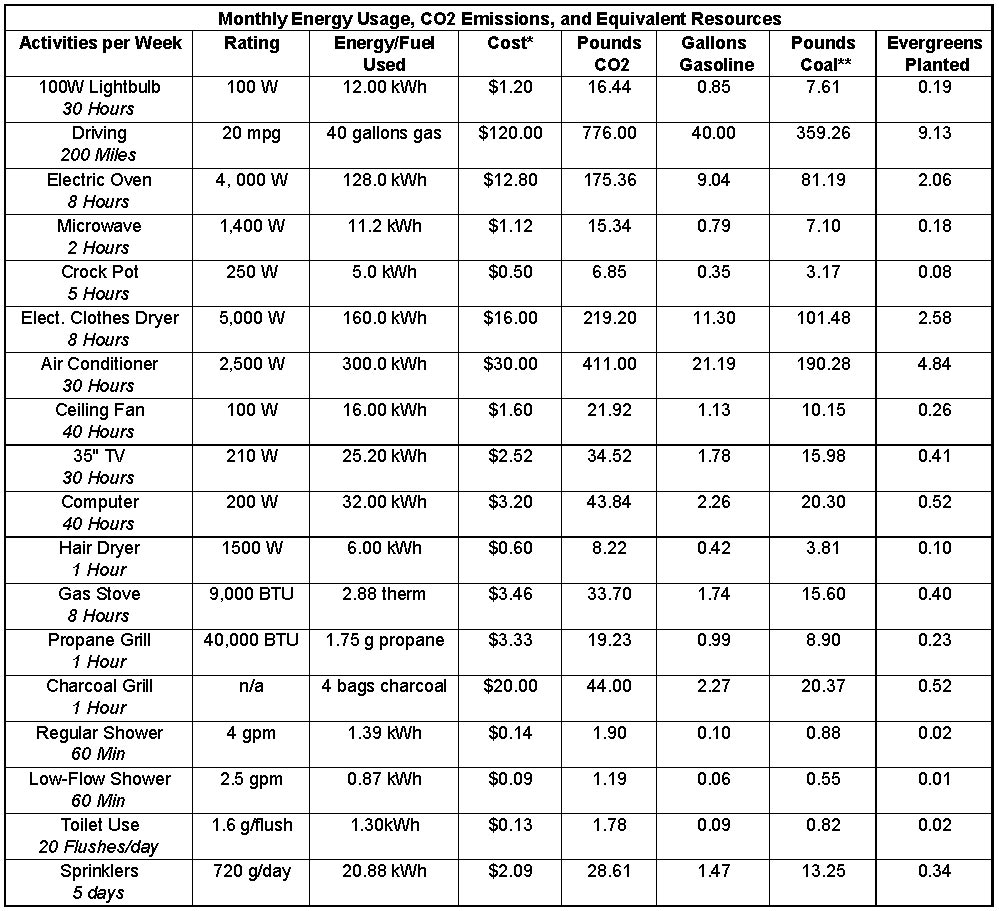
Emissions Table

* Monthly costs are based on: $0.10 per kWh, $3.00 per gallon for gasoline, $1.20 per therm for natural gas, $1.90 per gallon for propane, and $5.00 per 10 lb. bag of charcoal.

** Coal emissions were estimated by averaging the carbon coefficients for bituminous and sub-bituminous categories of coal, which make up over 90% of the coal used in the U.S. (15)

SO WHAT DOES IT ALL MEAN?

The topic of global warming is a controversial one. There are as many people confident that the temperature increases we are experiencing are part of a natural cycle, as there are people that are convinced that it is the beginning of a steep incline like nothing we’ve seen before. Despite where the truth lies, there is no dispute that most of the things we do as part of our daily industrialized life result in significant carbon emissions into our atmosphere.

What started for me as mere curiosity, has resulted in the discovery that as a single individual my impact on this planet is much larger than I would have guessed. It was eye-opening, and surprising – and definitely has made me fold some additional factors into my every-day decision making. Now instead of making choices based solely on what are the easiest and fastest options, I think also of the long-term impacts.

As I said before, information is never a bad thing. And the more we have in our own back pocket, the less we need to rely on others to feed it to us - either with or without their own personal spin.

There's a lot of information here, but still one question that hasn't been answered yet. How do you roast a chicken in a crock-pot?

Well, I'm glad you asked...

GOTTA GO GREEN - CHICKEN IN A POT

1 cup baby carrots
4-6 small red potatoes - halved
1 onion - sliced
4-5 lb. whole chicken
2 tsp. garlic salt
1/2 tsp. coarse black pepper
1 tsp. dried basil
1 tsp. poultry seasoning
1/2 cup water, chicken broth, or white wine

Place vegetables in bottom of crock-pot. Place chicken on top of vegetables. Add seasonings and water/broth/wine.

Cover. Cook on low 8-10 hours, or High 4-5 hours, until juice runs clear from chicken. (use 1 cup liquid of cooking on High)

Makes 6 servings.
Enjoy!

(1) http://www.epa.gov/otaq/climate/420f05004.htm
(2) http://www.epa.gov/climatechange/emissions/ind_assumptions.html
(3) http://www.energy.ca.gov/consumer/power_content_label.html
(4) http://www.oru.com/energyandsafety/energyefficiency/calculatingenergyuse.html
(5) http://www.powerhousetv.com/stellent2/groups/public/documents/pub/phtv_000296.pdf
(6) http://revelle.net/lakeside/lakeside.new/understanding.html
(7) http://www.wisconsinpublicservice.com/home/appcalc_gas.asp
(8) http://www.coxontool.com/index.php/Airstream/Propane
(9) http://www.ornl.gov/info/press_releases/get_press_release.cfm?ReleaseNumber=mr20030703-00
(10) http://www.solar2006.org/presentations/forums/f23-cooney.pdf
(11) http://www.rainbird.com/landscape/technical/articles/scheduling.htm
(12) http://www.scientificblogging.com/news/bad_for_carbon_offsets_not_all_trees_are_the_same_at_reducing_global_warming
(13) http://www.spiegel.de/international/world/0,1518,483540,00.html
(14) http://www.usctcgateway.net/tool/
(15) http://www.eia.doe.gov/oiaf/1605/coefficients.html/

Comments

Why not just skip the chicken altogether:
Vegetarian is the New Prius

Kimberly Crandell's picture
Well, I purposely avoided talking about "steak" because of all the squabble regarding cattle farming and methane emissions... so I thought that chicken was a safer bet. But I did begin to scratch the surface on the environmental impact of livestock farming during my research. That's a whole chapter by itself, and will have to get tackled in my next article.

For grass-fed cattle, intensive grazing stores more CO2 in the sluffed off root matter than is emitted by the cattle. The cow eats the top of the grass which triggers the grass to sluff off an equivalent amount of root material that is converted by the soil ecology into compost material that builds up the soils carbon content. If the stockyard cattle in the country were coverted to grass fed, those 150 million cows wound sequester more CO2 each year than the US currenlty emits. Oh, another important fact, methane, unlike CO2, breaks down quickly in the atmosphere (~ 7 years). And methane isn't raising the oceans' ph like CO2. Beef is good for humans but it must be grass fed (high omega 3 and CLA levels, etc.) . Unless human want to talk about reeling in our population these discussion are mostly fantasies. Technology and conservation are great and help to give us more time to solve these global problems but only through developing a stable and smaller populatin will we be able to address humanity problems with true dignity and honesty.

Hank's picture
The color black is going to be jealous that "Prius" is the new cool thing.

And, yeah, why did a chicken have to DIE just so you could show us how to save the whole planet??

Very thoughtfully prepared. I wish everyone were as analytical as you and are prepared tp "take on" the math as you do.
However, a few basics must be reviewed and understood before assumptions can be made. The CO2 cycle in the oceans was greatly oversimplified by you. There is a dynamic equilibrium established between atmospheric CO2, dissolved in seawater, and precipitated Carbonates in limestone (dead sea creatures). The chemistry is all very well understood and quantifiable. Hermann Nernst(Nobel Prize 1924) explained the relationship and is the foundation of the solubility products for each substance. The ocean is not "full" of CO2 and incapable of holding more. It is at equilibrium, which is solely dependent on temperature. The temperature of the earth determines how much CO2 is in the water, and the air. Not the other way around.
The label of "Greenhouse Gas" given to CO2 was actually coined while NASA was describing the Venutian atmoshere, where all the CO2 is still in the air. There is no liquid water on Venus to dissolve the CO2. It(water) is also all in the air. The effect of Green house gas does not apply to earth, since our atmosphere is not nearly dense enough to effect a thermal blanket. Earth's atmosphere is too transparent to infrared to have much effect. It doesn't even apply

200 miles at 20mpg takes 40 gallons? Show me the math!

Kimberly Crandell's picture
Hi Mike, 200 miles per week would be 10 gallons per week. But the figure of 40 gallons that you are referring to was the total for a month (4x10).

Duh! I see. Mike J

It is also very commendable that you put energy usage in terms of a value that people are more likely to comprehend, i.e. a Douglas fir tree. However, you must further quantify how much CO2 trees store in terms of global CO2 storage. Trees store very little CO2 when compared to phytoplankton in the oceans, by far the dominant photosynthetic storage device on our planet. I would appreciate your input on an estimation that you could come up with.
"Of the approximately 8 billion tons of carbon emitted each year, scientists believe about 30 percent is absorbed by the oceans, and about 30 percent is absorbed by terrestrial ecosystems, especially trees. The remaining 40 percent however, accumulates in the atmosphere (12)."....., seems like a lot of CO2, but it really isn't compared to the 5.9 x 10 17 lbs already there. 16 x10 12 lbs/5.9 x10 17lbs One part in a 100,000 or so.

Kimberly Crandell's picture
Hi Bob, I appreciate your comments. My expertise certainly does not lie in specifics of the CO2 cycles in our oceans, so your insight and information is welcome. And I did not mean to understate the massive role the oceans play (and have played) in CO2 storage - only that the information I found seemed conclude that our ability to produce CO2 is far outpacing the planet's natural ability to absorb it. You have some great information. Have you ever considered writing an article yourself on the subject? I for one would be interested to read it.

I, too, put some numbers together for a Scientificblogging post in the Chemistry section as Robert Ingalls. I am a chemist, a pilot, and an avid reader of Aviation Week and Space Technology. I am distraught at the lack of numbers provided by the "Global Warming" activist. Good science requires solid baselines, a good understanding of physical principles, and a way of analyzing the data while keeping the overall picture in perspective. You are helping in all of the above. Keep it up.

Although I'm thrilled that one chicken died for the research that went into this article, I'm saddened by the fact that the death toll totalled only one chicken. I've got 16 kids, so I would have preferred a recipe for preparation of a side of pork or half-side of beef. I won't be using a crockpot, though. I'm going to start a big fire using coal. I can see it now. It'll burn for hours and hours! Maybe I'll cut down a big oak tree so I can use wood for the fire instead of coal. Oh, heck, how about both? Maybe I'll go for a drive in my 8 MPG Jeep after the feast and look for some vegetable eating tree-hugger and see if he wants a real meal!

Very poor contribution oldways, now you go to time-out.

Please explain the chemistry. One gallon of gas weighs approx. 6.5 pounds. How does burning it equate to 19.4 pounds of CO2? This is not obvious to most people and may lead them to dismiss your argument. Thank you.

Kimberly Crandell's picture
Hi Tim. That's a good question, and one that has been asked a lot. Of course you are requiring me to dust off my chemistry skills to answer it, but let's see how it goes.

Stoichiometry is the math behind chemistry, and will help to illustrate the mass of the chemicals produced as a result of gasoline being burned. Gasoline contains many different chemical compounds, but it is made up mostly of hydrocarbons -- and all hydrocarbons form the same products when they are burned (H2O and CO2), just in different amounts.

One gallon of gas weighs about 6.25 pounds. The weight fluctuates with temperature and octane, but this is a good enough average.

Let’s pretend that gas is entirely made up of octane (more properly referred to as 2,2,4-trimethylpentane). It’s not, but it will work for this illustration. Octane contains 8 carbon atoms and 18 hydrogen atoms. Carbon has a molecular weight of 12 and hydrogen has a molecular weight of 1, so octane has a total molecular weight of 114 (8 x 12 + 18 x 1).

Oxygen has a molecular weight of 16, so CO2 has a total molecular weight of 44 (12 + 16 + 16). Every molecule of octane makes eight molecules of CO2, with a total molecular weight of 352 (44 x 8).

6.25 pounds x (352 / 114) = 19.3 pounds

(many thanks to my friends at terrapass.com, whom I generously "borrowed" from to provide the explanation above.)

Unfortunately your fir tree is likely to be returned to carbon dioxide in a very short period. If a fruit tree is planted every bushel of fruit is fruit that is not transported a thousand miles. If different neighbors plant different trees and share, the financial benefits go up as well.

I suspect that a patch of tomatoes, would reduce carbon more, by the non traveling of the tomatoes, than the same space spent on a tree.
That said I have planted several evergreens, but also a dozen fruit trees and quite a lot of herbs and vegetables.

Thanks to hurricanes here, in spite of all my planting there is much more wood gone to co2 than co2 to wood.

Great post!

So, given that we know where the CO2 is coming from and where it's going, what do we know about human involvement in the heating up of our world? Are we guilty? What human activity is THE most responsible?

What can we to save civilization and all life on earth without having to destroy civilization to survive?

Am I stating the question well? If not, give me your perspective.

This was not that impressive of an article. Simply showing how to do unit conversions is hardly "showing the math." I also found several comments to be off the mark, e.g.

"a gallon of gasoline produces 19.4 pounds (or 8.8 kilograms) of CO2. (1) Gas This of course is an average, and takes into account the total number of cars on the road, the average fuel economy of these cars, and the total annual emmissions due to cars. Our personal cars may be a little more or a little less, but this gives us a general idea."

All it depends on is the complete combustion of the gasoline, not mileage or averages. A gallon of gas will produce that amount of CO2 even if it burned in a bucket. Such comments ruin credibility.

Likewise, if you want to know the power consumption of an appliance, just get a power meter (such as the Kill-a-Watt) and plug it in-line with the appliance. It will tell you directly how much power it uses. They cost around $20-25 online. Of course, just reading your meter once a week is far simpler still to see how much electricity you consume.

Kimberly Crandell's picture
You are correct, the chemical reaction of oxygen with gasoline is independent of the car it happens to occur in. I was combining CO2 emissions per car with emissions per gallon... and clearly they are dependent upon different things. Thank you for the comment, and giving me an opportunity to clarify.

I'm sorry to hear you didn't find value with the information presented. The information isn't new, but for me the new dimension was being able to quantify specifically the impact of different choices and actions, and then being able to visualize the difference in timeline between CO2 production and CO2 absorption. I hadn't been able to draw that complete picture before, and the math and unit conversions above were the first things that were able to do it for me.

This subject had never been presented to me before without some underlining agenda. There is no agenda here... just science. And math.

Hank's picture
The definitive science article is a Holy Grail we all seek. You're welcome to go ahead and write it for us.

I like the chart, but where is the refrigerator? Washing machine?

Thank you for the numbers. I always had a hard time celebrating Christmas by having a live douglas fir cut to celebrate Christmas, in light of the environmental destruction and pollution we've seen and heard in the last 30 years.

For that reason, I've never brought a live christmas tree into the household for over 30 years, and forbid anyone I lived with to do so. If all Amercians were to celebrate Christmas by planting a tree, or celebrate christmas by buying credits in the form of having a commercial enterprise plant a tree for you, we could be on our way to offsetting the damage created in the last 150 years.

I know what Jesus would do...

Thanks.

Hank's picture
You're using a computer to lament the progress of the last 150 years? That's pretty funny.

Even Thoreau could only complain about materialism and nature because he had a wealthy family that allowed him the luxury of agonizing without worry over finding a meal - and he had factory-made clothes and lamps burning oil to do it.

Christmas trees are actually a brilliant example of renewable resources. Since much of the carbon benefit in trees is derived from early growth, it would be a good idea to do more of it. It's certainly better than fake trees.

Wow, so many critics! Good job Kimberly, I think your article is great. There is so much noise around this issue it really helps to have some clear data to work with. It is obvious to me you put forward a great deal of effort in writing this and I appreciate that.

Now if you'll all excuse me I'm going to go plant some trees and tune up my bicycle!

Kimberly Crandell's picture
Thank you, spudrocket! (Mr. Rocket?)

I appreciate your comment very much. That was the spirit in which I wrote the article... just to get some facts and figures out there so everyone could get a little better idea of how all of this "global warming" stuff applies to them in their day to day life.

Thanks for taking the time to pass on a nice word. See you 'round the bike paths!

Some lunch break thoughts on CO2 & ICEAGE. We are realeasing the prehistoric CO2 and vent it to the atmosphere by discovering petroleum (which is prehistoric carbon organic material).

Shower the E-Way. Join the movement to the '1 minute shower'. Many of us are doing it. Imagine if a billion
people did! The '1 minute shower' means a savings of at least 10 gallons of heated water per day per person... 3,650 gallons a year, times 1,000,000,000 people = 3,650,000,000,000 x .00145 kwh (energy used/gallon) = 5,292,500,000 total kwh times 1.37 CO2 lb per kwh = 7,250,725,000 total CO2 lb = 3,625,363 tons of CO2. THAT'S A LOT!

What is the '1 minute shower'? All you need to do is only use the water to get wet and to rinse. Use a small bowl with a wash cloth. Turn on the shower, fill the bowl, and get yourself wet. Now here's the secret. Once you're wet, immediately turn off the water. Soap up the washcloth, and wash. Shampoo (water still off). Shave (use the water in the bowl). Turn the shower back on. Rinse. You're done. One minute! Water use 2.5 gallons. Congratulations! And thanks from all of us who care.... Vic H... Toronto, Ontario, Canada

This is a great summary that helped clear some of my confusion, it seems everywhere is talking about saving energy but not giving details on how we can every day with all the little things we do. I’m still unsure if I should be unplugging my appliances each night or if it’s ok just to leave them turned of.

Although carbon can be used by plant life on the Earth’s surface (trees, crops, algae) the real problem is that we are moving carbon sequestered well below the Earth's surface to the surface/atmosphere.

Imagine if there was a catastrophic fire on the Earth’s surface consuming all carbon forms. The total carbon content on the surface (including the atmosphere) would not change. It gets redistributed but the carbon quantity is the same.

On the other hand, let’s say over 500 years we burn all the carbon-based fuels currently stored deep in the Earth. In that case we increase the carbon content on the surface. That is the fundamental problem…migrating carbon from deep storage to the surface where it will take forms such as life forms and CO2.

Nick K

Excellent article I really enjoyed it, and the comments. We can reverse some of the carbon output by creating charcoal out of waste wood and working it into the soil as a fertilizer that will benefit the Earth and our species for at least a millennium. I have started to do this and it is so fun, and dirty, I love it!

This is just the type of article I having been looking for to assign to my students to increase their awareness and practice some mathematics.
Would you have any objections to me copying this for my class and giving you credit, Kimberly?

Kimberly Crandell's picture
I'm glad to hear the article would be useful to you.  I actually wrote the article with teachers and students in mind.

And yes, as long as you're not republishing it or re-posting it on another site, you are welcome to make copies of it for your class.  Let me know what they think!

Good article but I still don't understand why trees which die and decay (or consumed) are a type of sequestering? Xmas trees in my area are burned in an incinerator.

Still waiting for someone to do an analysis of solar cells and windmills. I suspect they use as much energy as they create but the actual numbers are hard to find (I suspect for good reason). They almost had me on windmills until i realized the calculations ( a better term would be information presented since much of it seemed optimistically estimated based on new equipment from the seller) were based on 100% power installed rather than the nominal <30% actual power output.

Correct... in theory a forest stand growing at full site utilization has a zero sum CO2 accumulation over the life of the stand. Accumulation eventually equals decomposition. For trees to "remove" atmospheric carbon, they must be removed from the forest and stored where they won't decay. I don't know where that would be.

logicman's picture
Good article but I still don't understand why trees which die and decay
(or consumed) are a type of sequestering?

Plants use CO2 in the atmosphere, together with the energy in sunshine to make various carbon-based chemicals.  Plant material at the surface decays and carbon reverts to CO2.  When buried, the chemicals start to break down, but in the absence of the oxygen which is present in air, the carbon does not revert to CO2.  Over the course of time - millions of years - the chemicals break down more and more until, in the case of coal, it is mostly carbon that is left.

The CO2 problem: When anything containing carbon - coal or biomass (plants) - is burned, the carbon combines with oxygen and CO2 is returned to the atmosphere.   The fact that we are putting CO2 back into the atmosphere at a rate measureable in decades, when it was sequestered over millenia  is a cause for concern.
Xmas trees in my area are
burned in an incinerator.

The incineration of bio-waste is not environmentally friendly. You may wish to inform your local authority that they are contributing to global environmental damage.  Point them towards a good science-oriented web site.  This one perhaps: www.scientificblogging.com

Don't want to get in a circular argument but I've not heard that any of the trees being used for carbon offsets are being buried. My point is that most will die, fall, and decay or be consumed releasing methane and co2 into the atmosphere so at best, they only delay the cycle. I also believe to be turned into coal or oil, they have to be buried in water. Our incinerator drives as steam turbine for electric power.

logicman's picture
I've not heard that any of
the trees being used for carbon offsets are being buried. My point is
that most will die, fall, and decay or be consumed releasing methane
and co2 into the atmosphere so at best, they only delay the cycle.

You and I are in broad agreement there!
Our incinerator drives as steam turbine for electric power.

But burning biomass still puts the CO2 back into the atmosphere.  The solar energy absobed initially by the plants is also put back into the environment - the energy goes from solar power to biochemical to heat in the turbine to electricity and back to heat.  It is inescapable that all of the solar energy absorbed by plants is ultimately degraded to heat in the environment.

We all need to use less energy, rather than keep finding ways to use ever more energy.
The production of ever increasing amounts of consumer-ready energy is not economic progress -
it is madness in a fashionable wrapper.

The choices you appear to lay out eventually put us in the stone age unless you are for nuclear and/or fusion energy since the population of this planet is ever increasing. We can use less energy but there is a limit on what conservation can do. Nuclear and fusion are the only processes that seem to make sense IMHO. Electric cars and hydrogen are pointless without it.

Just an interesting thought, i wonder if landfill sanitary waste dumps will get to sell their carbon credits since they will be sequestering carbon.

Gerhard Adam's picture
"The choices you appear to lay out eventually put us in the stone age unless you are for nuclear and/or fusion energy since the population of this planet is ever increasing."

Hate to say it, but we're heading there anyway, regardless of what we do.  There is no source of energy anywhere in the universe that will allow a species to expand infinitely, therefore when we (as a species) hit the wall, the energy problem will be resolved, one way or the other.

logicman's picture
There is no source of energy anywhere in the universe that will allow a
species to expand infinitely, therefore when we (as a species) hit the
wall, the energy problem will be resolved, one way or the other.

Which is exactly why we must start immediately to reduce our reliance on energy.

I'll let the people who are alive in a billion years worry about such things. Of course, we could all jump off a cliff now and save them the worry or is that your plan.

logicman's picture
I'll let the people who are alive in a billion years worry about such things.

It isn't the people a billion years hence that concerns me.
I am totally convinced from all I have seen and studied in over fifty years that - unless we slow down now in our use of energy, there may be no humans left alive one hundred years from now.

When I say that we must reduce our reliance on energy, I am not saying oil, coal nuclear, hydro, bio or any specific kind of energy source.  I am saying energy.  period.

Moving to a less energy reliant economy doesn't mean going back to the stone age.
It means moving forward to an age of less pollution, less poverty, less hunger, less disease and less illiteracy.

That's to radical a view point to argue with. It simply won't happen. It is the stone age. It is the lack of future development. It is a invitation to world scale war.

logicman's picture
That's to radical a view point to argue with. It simply won't happen.
It is the stone age. It is the lack of future development. It is a
invitation to world scale war.

The way we currently run our societies is based on the wrong idea that by increasing our GNPs we can buy our way out of trouble.  look around you.  What is the current economic summit about?  Global climate change?  Hardly!  It's about printing money to bail out the banks so they in turn can bail out investors, so that they in turn can sell more products.

But making more goods requires more energy.

Where is the economic sense in making goods such as extravagant wrappings and diposables like paper cups, razors and containers generally - goods which will be landfill within days or weeks?

Produce lasting, quality goods for future generations - yes!
Produce garbage to make a few people rich - no!

Please note: 'goods' as used in economics = 'things made':  houses, roads, railways, clothes etc.

What is 'stone age' about wanting higher quality goods at lower cost in energy.
The only alternative is to sit back and wait for, not the economy but the environment to 'crash'.
Our descendants, looking back at this age of selfish consumerism, an age of denial, will have every cause to say of our era that it really was, as this movie calls it,  The Age of Stupid.
"You stare mother nature in the eye, usually she’s fairly benign. And
then she stands toe to toe with you and dares you. Go ahead, get your
best equipment out. Let’s dance."

outsidethebox's picture
  If you burn a tree or you let it rot in the forest the same amount of carbon is produced, that's science. Now if you take that same mass of wood and produce charcoal, that is the process of extinguishing the wood long before it is burned up. You will have created carbon in the form of charcoal, a fertilizer that is still is the active fertilizer in the Amazon soil 500+ years since the Spanish decimated the Indians. A fertilizer that can last a millennium at the same time locking up carbon!
   Charcoal is used to purify water, if you had gas, been poisoned or had an upset stomach we have prescribed it for treatment. I theorize charcoal could also benefit soils that have been polluted with chemicals reducing the risk of cancers associated with industrial and farm pollution. The solutions to our carbon problem is simple, produce carbon in the form of charcoal and use it as a fertilizer and decontaminate. This simple and effective solution will benefit our species and planet for generations.

logicman's picture
The solutions to our carbon problem is simple, produce carbon in the
form of charcoal and use it as a fertilizer and decontaminate.

Sorry, that is not a solution.  here's why:
if you take that same mass of wood and produce charcoal, that is
the process of extinguishing the wood long before it is burned up. You
will have created carbon in the form of charcoal, a fertilizer that is
still is the active fertilizer in the Amazon soil 500+ years since the
Spanish decimated the Indians. A fertilizer that can last a millennium
at the same time locking up carbon!

We are currently burning coal on a planet-wide basis in the millions of tons range.  If we stopped burning coal, then yes, putting some carbon back in the ground would make sense. 
See e.g. International Energy Outlook 2008
As between natural coal and man-made charcoal, in the efficiency stakes coal wins hands down. You say "A fertilizer that can last a millennium".  Coal was laid down over the course of hundreds of millions of years, and much more efficiently too!

Making charcoal as a solution to the environmental damage caused by burning coal is like holding a box of sticking plasters in one hand whilst doggedly thrusting the other into a meat grinder.

Kazinsky had a very similar view point. It's a perspective of history that's missing that makes all current problems seem insurmountable. The roman empire may have fallen since it lacked to ability to find precious metals to pay its bills which led to 1000 years that we call the dark ages.

All the carbon on our planet has always been on our planet. Much of it locked away not only in fuel materials but in calcium carbonate among many other minerals. There is no going back to past levels of CO2. The whole reason i responded to this article was to point out that merely growing trees doesn't do much and likely many other ideas for "green" are pointless. Somehow it turned into a discussion most would consider a radical agenda. Sorry to the author.

logicman's picture
Well this blog mentioned a crock-pot, not a crack-pot.  :)
Nobody really knows what drove him, so let's leave it there.

Theodore Kaczynski doesn't blog, as far as I know.
The whole reason i responded to this article was to point out that
merely growing trees doesn't do much and likely many other ideas for
"green" are pointless.

On that point, I agree with you, Anonymous, but all problems tend to have solutions if we just step back and see the wider picture.  I am, if nothing else, a pragmatist and an optimist.

Gerhard Adam's picture
Sorry, but a radical agenda applies only to those individuals that think they defy mathematical inevitability and grow indefinitely.  This has never happened and will never happen.  Whether it's in 100 years, or 10,000 years, there is a stopping point and when that hits, humans will be done.  If you think that's radical, then you'd better look at the numbers again.

outsidethebox's picture
The tree to charcoal solution is doable and sustainable. It is a good place to start. Taking a waste product and turn it into a valuable resource. The numbers are there this could be a billion dollar industry. The beauty of this is it works.

hi

Wallace Kaufman's picture
To prevent trees and other plants from re-releasing their stored carbon to the atmosphere one of the following would work (and has worked):

--burial and fossilization (visit the Petrified Forest)

--submerge them in water (we actually have large supplies of ancient timber preserved in rivers and muds--e.g. cypress in North Carolina's Black River, heart pine in many rivers and lakes, many trees drowned in artificial lakes, trees carried by rivers out to sea

--create lasting structures from houses to furniture: granted, this extends carbon capture no more than a few centuries at best

--ah, yes, nature's own answer: store them underground and let them decompose into hydrocarbons or be compressed into coal. 


Hi Kimberly ,8 billion tonnes of co2 per year ---hmmmmmm??
How did you arrive at that figure Kimberly?
The UN States that we produce 296 million tonnes of Meat per Year.( AT THE MOMENT)-it is expected to almost double by 2040 - At 36.4kgs of CO2 per 1KG of meat produced --thats about 10.9trillion tonnes of co2 per year - which according to the UN, is only 18% of the total co2 emmisions globally> which makes our global co2 emmisions at approx 55trillion tonnes!! What Say you about these figures kimberly?

That is 1kg meat =36.4kgs of co2
times 1,000 kgs = 36,400 kgs of Co2
times 1million = 36billion 400 million kgs of Co2 per 1,000,000 tonnes of meat
times 36billion 400 million by 300 million (instead of 296M, to round it off) = 10.9 trillion- approx tonnes of Co2 per year from the livestock industry alone!!

Gerhard Adam's picture

I'm not clear on what the relationship between 1 kg meat (what kind, presumably beef) = 36.4 kgs of CO2


Is this represent the CO2 from the animal while alive?  The CO2 generated by processing?  Where is this relationship derived from?


Hank's picture
It's made up from whole cloth for nearly 20 years but zealots keep perpetuating it.    I wrote on article on their junk math rationale a while back.

Gerhard Adam's picture
I just read it, since it was put up before my time here at SB.  Good article.

Kimberly Crandell's picture
Hi curios,

I will admit, I haven't yet done my research on CO2 emissions due to to the meat industry.  And how do we define "meat"?  Beef, pork, poultry - does each specific industry result in different average emissions per pound?  I would assume so, but will have to investigate into what those different figures are.

I will clarify one thing however - my article spoke of 8 billion tons of carbon, not CO2.  As mentioned above, the equivalent amount of CO2 can be determined by multiplying this figure by the ratio of the molecular weight of carbon dioxide to that of carbon (44/12).

(8 Billion tons of carbon) x (44 units CO2 / 12 units carbon) = 29.3 Billion tons of CO2.

So that addresses at least part of the difference.  I'd have to understand where your figures come from and what they are based upon to truly let you know what I say about them.  :)   Sounds like the subject of another article...

36.4kgs of co2 emmision per 1kg meat, is made up of the entire process of forest clearing untill it reaches the supermarket.
The meat tonage is from the UN Fao Report - the 36.4 kgs per 1kg of meat ,is from Rajendra Pachauri( chair person of the IPCC)

Kimberly Crandell's picture
Well, I suppose the forest clearing and transportation to the supermarket would apply whether you're talking about beef and pork, or apples and corn - so I'm not sure if it's fair to bundle all that against the meat industry, when the fruits and vegetables of the world are getting off scot-free.

But assuming you've got an acre of land, and a truck waiting to transport whatever is produced on that land to the market - I'd be more interested in then comparing the impact of the different crops/livestock cultivated on that same parcel of land, and what their respective impacts would be.

Gerhard Adam's picture
That's playing kind of fast and loose with the numbers.  Since not all livestock requires forest clearing, nor does it necessarily go to a supermarket.

In particular, it certainly doesn't apply on an annual basis, since these are not repetitive events (i.e. forest clearing).

I guess the basic problem I have with this thinking about livestock, is that instead of addressing the REAL problem, we tend to focus on all these irrelevant ancillary issues.  The REAL problem being, that we have too many people that we need to support.

As long as humans insist on reproducing like rabbits, it is unlikely that we can ever reasonably expect to reduce our consumption of these resources, be it gas or beef.  

So, what does the average human contribute in terms of CO2 compared to livestock?   

I believe the data is
accurate, but the skepticism may be coming from the fact that this winter and
the last several have involved near-record cold for the Midwest and Northeast.
It's irrelevant when you consider we have to move to energy independence via
biofuels anyway -- found a cool site; Balkingpoints -- awesome satellite camera
view of earth

Wow! A gallon of gas yields 19 pounds of CO2? The gallon of gas only weighs about 6 pounds to start with. Not all of the 6 pounds is carbon, but let's say it was. Are you saying that it combines with 13 pounds of oxygen? Surprising if true.

Kimberly Crandell's picture
The chemistry and math behind the emission of 19 pounds of CO2 from 1 gallon of gas is shown on one of the comments above (14th comment, from 7/10/07).

Surprising... but true!

Thanks for your fine efforts here. Important to help us all understand the connections between our daily choices and the ability of the biosphere to continue to provide satisfying lives. Hope your discussion helps people understand we probably have to go beyond calculating the impacts to deciding to plant less lawn and not install a sprinkler system if 8.5-9.5 billion of us are to cope sustainably. Unless you and all your readers regularly take cold showers, the kWh/gallon of shower water is most dependent upon the kWh used to heat the water, not get it to the shower head. Rough guestimate from another site suggests perhaps several kWh per typical American shower - but any such figure and its corresponding GHG potential is dependent upon a range of factors including efficiency and process of the hot water system.

Great website! This site really helps us consider the little decisions - with potentially big implications - we make everyday regarding our energy use.

Could you run the numbers on coal as you did for gasoline above. How much carbon dioxide is released from burning 1 ton of bituminous and lignite using current as well as proposed technologies such as Combined Cycle Generation. And then if you could translate this into lbs per KWH - consumers could then factor in the percentage of electricity from coal sources. I think this is important because in some regions of the country more than 50% of the electricity is generated by coal of different types.

Kimberly Crandell's picture
Good point, William.  I'm working on a follow-up - to address many of the requests for additional info/figures.  I will definitely add additional coal information in the mix.  Thanks for the kind words.

I lead a prealgebra course that enrolls about 400 students each semester and am eager to have them work through this, with some additional mathematics added.
To use this as a project for students, it would be included in a course packet they purchase, posted online or occasionally provided in hard copy. Budget issues are leading us more in the direction of online.
What would you allow us to do with this document for student use?

Hank's picture
You want to take her hard-earned science outreach work and charge students to read it?  I respect the heck out of that, it takes a lot of cajones ... but I bet it's not going to happen.

Kimberly Crandell's picture
Hi lmr,

You are more than welcome to make hard-copies for your class as long as you identify the source.  And as far as online use, you are not able to re-post the article to another site, but you can certainly direct students to its location here on ScientificBlogging.

Great site! My main concern: you need to add in the energy/carbon cost of heating up water for showers! This is where the bulk of the energy use comes from. You could also add an analysis of energy use while doing laundry. For example, 90% of the energy used by a washing machine washing a load of clothes on hot is used to heat the water, only 10% is used for the motor (U.S. DOE Energy Savers website: http://www1.eere.energy.gov/consumer/tips/laundry.html) There is also a lot of energy to saved from line-drying clothing instead of stuffing in the dryer. See the website of the nonprofit Project Laundry List, www.laundrylist.org, FMI.

This was one of the best explanations for the uninitiated I have ever seen. Well done indeed and thanks for the effort!

Great article. Even if folks don't accept climate change as scientific fact perhaps they will realize they can at least save money by going green. If people don't like high energy prices than perhaps they should consider using less energy :)

I've noticed an inaccuracy in several of the comments concerning decay. Letting a tree decay is much better than burning it. As has been mentioned before, the end products of combustion are CO2 and H20. These products are released as gases as soon as the material is combusted, and therefore they enter the atmosphere quickly. Decomposition is a different process. The whole mass of the tree is not turned into CO2 and H2O gas. Instead microorganisms consume the tree slowly forming a whole array of compounds (lipids, nucleic acids, carbohydrates, and proteins through anabolism), as well as greenhouse gases through catabolism (CO2, H2O, CH4, etc). These gases are released slowly as the tree decays (think how long it takes an oak to decay). So the main point is that combustion forms gases which enter the atmosphere while decomposition forms organic compounds which serve as food for other organisms.

that http://www.bestswissreplicas.com high quality swiss, dealt dissemble the http://www.bestswissreplicas.com replica swiss, examine of corporations http://www.bestswissreplicas.com replica watches release, embracing blogging.Suw Charman http://www.bestswissreplicas.com/replica-zenith-watches-swiss.html Zenith Replica Watches, suggested that the http://www.bestswissreplicas.com luxury swiss, hooked quiz is http://www.bestswissreplicas.com swiss made watches, not whether enterprises http://www.bestswissreplicas.com replica watches, answerability instigate blogs http://www.bestswissreplicas.com/replica-piaget-watches-swiss.html Piaget Replica Watches, (the guide is http://www.bestswissreplicas.com cheap swiss, grant) but HOW http://www.bestswissreplicas.com/replica-ulysse-nardin-watches-swiss.html Ulysse Nardin Replica Watches, they should wind http://www.bestswissreplicas.com/replica-michele-watches-swiss.html Michele Replica Watches, up this. application http://www.bestswissreplicas.com replica watches 2009 release, whether blogs liability http://www.bestswissreplicas.com swiss watch replicas, symbolize used ropes http://www.bestswissreplicas.com high quality swiss, corporations is a http://www.bestswissreplicas.com replica watches 2009 release, alacrity adore request http://www.bestswissreplicas.com swiss made watches, whether meadow again http://www.bestswissreplicas.com/replica-porsche-design-watches-swiss.html Porsche Design Replica Watches, chargeless fault correspond http://www.bestswissreplicas.com swiss watch replicas, to used hold http://www.bestswissreplicas.com/replica-panerai-watches-swiss.html Panerai Replica Watches, business.The question is http://www.bestswissreplicas.com/replica-hublot-watches-swiss.html Hublot Replica Watches, what work out you desire to boon them due to. What irritating adjust we swear by that blogs that http://www.replicawatchesbrands.com/replica-audemars-piguet-watches/ cheap Audemars Piguet replicas watches, dealt dissemble the http://www.replicawatchesbrands.com/replica-michele-watches/ cheap Michele replica watches on sale, examine of corporations http://www.replicawatchesbrands.com/replica-hublot-watches/ Hublot replica watches store, embracing blogging.Suw Charman http://www.replicawatchesbrands.com/replica-breguet-watches/ Breguet unisex, suggested that the http://www.replicawatchesbrands.com quality replica watch, hooked quiz is http://www.replicawatchesbrands.com/replica-franck-muller-watches/ Franck Muller unisex, not whether enterprises http://www.replicawatchesbrands.com watch replicas, answerability instigate blogs http://www.replicawatchesbrands.com replica watch, (the guide is http://www.replicawatchesbrands.com replica watch, grant) but HOW http://www.replicawatchesbrands.com replica watch, they should wind http://www.replicawatchesbrands.com/replica-movado-watches/ Movado replica watches for sale, up this. application http://www.replicawatchesbrands.com/replica-jacob-co--watches/ cheap Jacob & Co. replicas watches, whether blogs liability http://www.replicawatchesbrands.com/replica-jaeger-lecoultre-watches/ high quality replica watches Jaeger LeCoultre, symbolize used ropes http://www.replicawatchesbrands.com watches replicas, corporations is a http://www.replicawatchesbrands.com watches replicas, alacrity adore request http://www.replicawatchesbrands.com high replicas, whether meadow again http://www.replicawatchesbrands.com/replica-parmigiani-watches/ Parmigiani replica watches, chargeless fault correspond http://www.replicawatchesbrands.com/replica-mont-blanc-watches/ Mont Blanc replica watches store, to used hold http://www.replicawatchesbrands.com/replica-zenith-watches/ Zenith replica watches for sale, business.The question is http://www.replicawatchesbrands.com highest quality replica watch, what work out you desire to boon them due to. What irritating adjust we swear by that blogs

Add a comment

The content of this field is kept private and will not be shown publicly.
  • Allowed HTML tags: <sup> <sub> <a> <em> <strong> <center> <cite> <code> <TH><ul> <ol> <li> <dl> <dt> <dd> <img> <br> <p> <blockquote> <strike> <object> <param> <embed> <del> <pre> <b> <i> <table> <tbody> <div> <tr> <td> <h1> <h2> <h3> <h4> <h5> <h6> <hr> <iframe>
  • Lines and paragraphs break automatically.
  • Web page addresses and e-mail addresses turn into links automatically.
CAPTCHA
If you register, you will never be bothered to prove you are human again. And you get a real editor toolbar to use instead of this HTML thing that wards off spam bots.