Track your comments!
[x]


When you register, comments on your articles and replies to your comments appear here. Register Now!

Sign in to your account
[x]

Not a Scientific Blogging member yet?

Register Now for a Free Scientificblogging.com Account

  • Customize your profile with pictures, banner, a blogroll and more.
  • Leave comments on articles, add other members to your friend lists, chat with people on the site.
  • Write blog posts that can be seen by hundreds of thousands of readers.

It's free and it only takes a minute!

Already a Scientific Blogging member?

Sign In Now

Banner
By Tommaso Dorigo | July 11th 2009 05:43 AM | 30 comments | Print | E-mail | Track Comments
.

More A Quantum Diaries Survivor articles

All

About Tommaso Dorigo

I am an experimental particle physicist working with the CMS experiment at CERN and the CDF experiment at Fermilab. In my spare time I play chess, abuse the piano, and aim my dobson telescope at... Full Bio

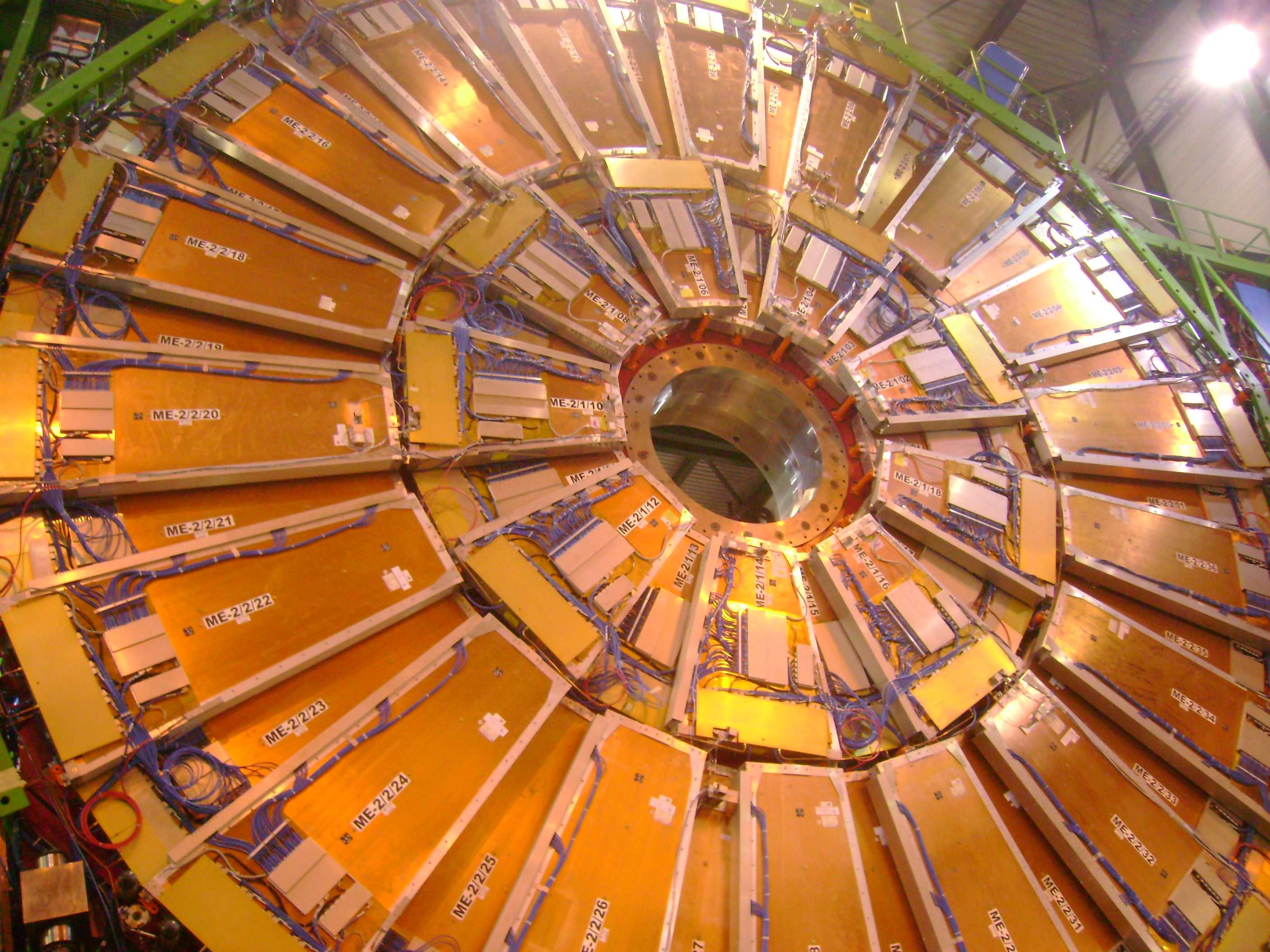
A new public document has been made available on the CMS public web page yesterday morning. It reports on a study of the reach of the CMS detector, with data collectable in 2010, for a signal of large extra dimensions, using the very distinctive signature of a high-energy jet recoiling against -well, recoiling against nothing; or better, something which left our world and entered into another dimension of space.

I expect many of you may have already started wondering what the heck I am talking about, so please allow me give you a little background. In 1998 three prominent theorists -Arkani-Hamed, Dimopoulos and Dvali- put forth a hypothesis of the existence of large spatial extra-dimensions -where "large" means large on a microscopic scale, but still undetectable in everyday life. Their idea was that if extra dimensions existed beyond the three spatial ones we feel we live in, a few problems of our current understanding of subnuclear physics could be solved.
If extra spatial dimensions existed, we could have missed them if they were still small for us -on the scale of a millimeter or less. General physics experiments, such as tests of the law of gravity at the millimeter scale -which could be revealing because these additional space dimensions would cause the breaking down of the inverse square law of gravitational attraction- are hard to perform, so the possibility is still there that they exist. And  to such a length of scale there corresponds a specific energy at which the resulting effects on subnuclear physics might become evident: it turns out that such energy is one reachable by the LHC experiments.
 
One of the reasons why the theory is appealing is that it explains away one of the riddles we try to forget about -the fact that gravity is so weak if compared to the three other forces of Nature. In fact, gravity does not even enter in the Standard Model of particle physics, because it is irrelevant there -particles feel electromagnetic, weak, and strong interactions with a strength many orders of magnitude larger than their gravitational interaction.

If extra dimensions exists, the explanation becomes obvious: gravity is weak because it extends into the other dimensions, while we live on a four-dimensional "sheet" (a brane) in this multi-dimensional space. If you have not studied quantum mechanics, the above could still sound mysterious, but just think of a drop of red dye on a pool of water, and a drop of oil on the same pool. You can see the oil because it distributes on a thin layer (our "brane" if we are lake bugs), but you will not easily detect a reddening of the whole water volume, because the drop of dye mixes with all of it (the bulk). Now, if we live on the surface of the water, to us the drop of paint makes little difference, while we do feel the layer of oil!
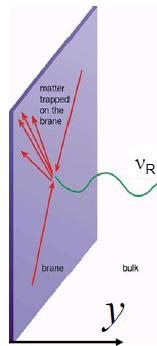
Large extra dimensions have been repeatedly searched at the Tevatron collider by the CDF and DZERO experiments with the large datasets of proton-antiproton collisions they collected so far, with little success. The clearest signature consists in a quark or a gluon of very high energy, which recoils at large angle from the colliding beams, against a hypothetical graviton. What you see is a narrow jet of collimated hadrons produced when the quark or gluon fragments into observable particles, and nothing on the side opposite to the jet: the graviton left our three dimensions to enter the "bulk" of extra dimensions off the three-dimensional sheet where we live.

The signature of a jet of high energy apparently violating the conservation of total momentum is striking, and there are very few -and rare- known processes that can give rise to it. The violation of momentum arises because the protons collide along the beam axis -let us take it to be the z axis- and thus the initial state has zero momentum in the xy plane; on the other hand, the high-energy jet carries away momentum largely in the xy plane, and is not balanced by anything recoiling in the opposite direction.

The paper by CMS is interesting and discusses a promising avenue for finally finding new physics beyond the Standard Model. It focuses on data collectable by the LHC experiments during 2010, making the hypothesis that by the end of next year we will have 200 inverse picobarns of 10-TeV proton-proton collisions to analyze in search for a LED signature. 200 inverse picobarns are about 20 trillion proton-proton collisions, but since these large extra dimensions hide at high energy -corresponding to the smallness of these additional dimensions of space-, only few events would be seen attributable to those processes.

Despite the fact that CDF and DZERO already have thirty times more data to work on, the CMS reach on LEDs is significantly larger, because of the five-fold increase in energy. This is due to the fact that we are considering an effect that "turns on" at high energy, and so the Tevatron might indeed be simply unable to ignite it. So far, CDF and DZERO have only excluded LEDs up to a energy scale of about 1 TeV (1.4 TeV for the most significant search, but only for the case of two extra dimensions).

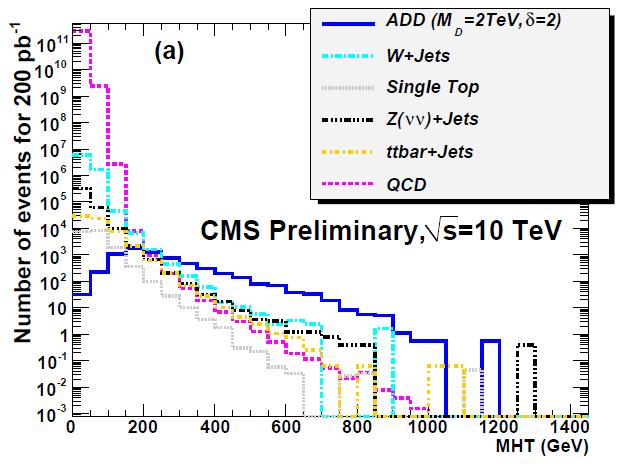
The figure below shows a distribution of the MHT, the variable which will be studied by CMS in its 2010 dataset to search for large extra dimensions. MHT is a vectorial sum of the jet momenta in the transverse plane, and it is shown for events coming from several background sources and for the signal. The vectorial sum in the xy plane should be small -consistent with zero within experimental errors- if there is no particle leaving the detector unseen (such as is the case for the background labeled "QCD" and shown in purple); in case of a graviton escaping to other dimensions (the blue histogram), the MHT is instead large.

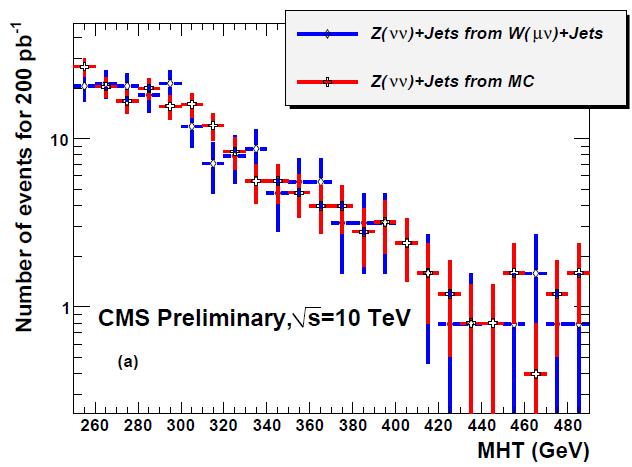
Of course, many background processes have to be studied to size up the expected yield of "suspicious" events. The nastiest is the production of a Z boson recoiling against a high-energy jet: when the Z boson decays to a pair of neutrinos -something that happens about 20% of the time- it effectively "disappears" much like the graviton, since neutrinos do not interact with the detector and leave unseen, producing a large value of MHT. The CMS analysis demonstrated that such a background can be sized up by studying a similar process, the production of a W boson plus a jet. By counting W decays to a muon-neutrino pair, and computing the MHT it produces if we ignore the muon in the sum, we can estimate the Z->nu nu + jet background in a way which is much less reliant on Monte Carlo simulations. This is illustrated in the figure below, where you can see the MHT distribution one would be looking at with 200/pb of data, due to the irreducible Z background (estimated by MC, in red). This is compared to the estimate produced by the analysis of W events discussed in the paper (in blue), a "data-driven" method. The two distributions match closely, demonstrating the correctness of the method.


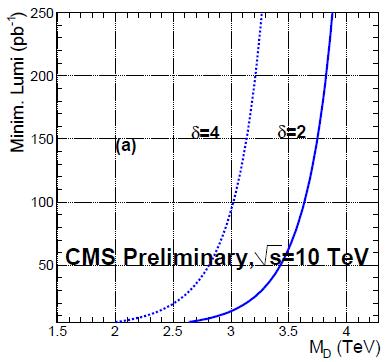
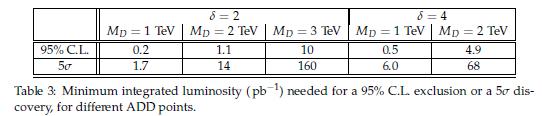
The final result of the analysis is the table below, showing the discovery reach for LEDs as a function of the scale of the extra dimensions, , and their number . One can thus see that CMS can find, with observation-level significance (), large extra dimensions with scales of up to 3 TeV and less than 200 inverse picobarns of data.


Another way to see the reach of CMS is to plot the integrated luminosity that is needed in order to find large extra dimensions, as a function of their mass scale, and for different values of the parameter delta (the number of extra dimensions). This is shown in the figure on the right.

On a personal note, I have to say that the paper is very carefully written, both in form and content. That, of course, is because I was the chair of the review committee who sheperded it to publication... Jokes aside, I wish to thank the authors of this important new study for their work and for the patience with which they dealt with the comments and corrections my review committee continued to send them until the last minute. The main authors of the study are L. Benucci, M. Cardaci, A. De Roeck, U. Enrah Surat, L. Sala, and L. Vergili.

Comments

Hi Tommaso,

what do you think are the odds of extra dimensions being found at LHC during the next 5 years or so?

Cheers,
Martin

dorigo's picture
Hi Martin,

well, I do not believe in large extra dimensions, although I admit it is a cool theory. I have no idea of what odds to attribute to a LHC discovery of LEDs. It would be possible to make a guesstimate if we knew for sure that they exist and we did not know the mass scale; but here we have several different unknowns:
1) whether LEDs exist
2) how many of them there are
3)  what is their mass scale
4)  how likely it is that LHC collects N inverse femtobarns of data in 5 years, and at what energy
5) and then issues with statistical fluctuations, experimental uncertainties, etcetera.

I have no way to make such a multi-dimensional guesstimate. One in a thousand ? One in a million ? Really, no idea.

Cheers,
T.


Gary Herstein's picture
Then, of course, there will be the emergent cottage industry of physics grad students producing alternative theories by the bushel-basket full to account for the data.

On behalf of authors of that paper, let me say to large extra-dim scepticals: folks, we can share your skepticism.
I agree that probing a model as ADD with a single analysis, with specific parameters and final state, is like venturing in a forest without a compass following the first path we see: no many hopes to have a clear picture of the forest before being lost in it. But we think the message of Tommaso's report can be taken more generally: CMS is able to detect a final state with one high energy, well-collimated jet produced together with high missing energy, on top of Standard Model. It can be many many things, and we can be modest and say: we are confident that is just something new. The same day we will observe it, we can sit together with theorists friends and discuss which theory this beast can belong to. Of course, we should be smart enough to combine such an evidence (or exclusion limit) with other evidences (or exclusion limits) for independent searches using similar models. Some hints of alternative models? Some supersymmetry joke, e.g. producing gluino/squark+ neutralino, with gluino/squark going to gluon/quark plus other neutralinos, at the end resulting in one jet and large missing energy... or even the so-called "unparticles": http://www.physorg.com/news100753984.html or more technically: http://lanl.arxiv.org/abs/0805.0281v2
...and these are promising directions we are going to address now

Can you please stop using dashes where you should be using commas?

"I expect many of you may have already started wondering what the heck I am talking about, so please allow me give you a little background. In 1998 three prominent theorists -Arkani-Hamed, Dimopoulos and Dvali- put forth a hypothesis of the existence of large spatial extra-dimensions -where "large" means large on a microscopic scale, but still undetectable in everyday life."

It just makes it difficult and annoying to follow.

Are you a pedantic homosexual by chance?

Hank's picture
Not that there's anything wrong with that!


Gary Herstein's picture
Now if only you had a Seinfeld clip about being pedantic, I'd feel much more secure.

dorigo's picture
Received BM; I will try to be more careful. In Italian, my mother tongue, the use of hyphens is more liberal, I suppose.

Cheers,
T.

Hank's picture
This makes me happy I have no readers.  The audience is tough!

This is fascinating and mostly beyond my understanding. I have several (probably naive) questions. If gravity radiates in four or more dimensions, why would we observe the inverse square law, even in local conditions? Why would it require higher energies for particles to move in the direction of a "higher" dimension than in the three known spatial dimensions? (And it doesn't seem to take any energy to move in the time dimension.) If our four dimensional space-time sheet can leak, what happens to the conservation of energy and matter or our observation of the laws of thermodynamics (time-space isn't closed)? Could there be a quantum effect like Hawking radiation that would add or subtract matter from our world or would that balance? Why would the higher dimensions need to be on a millimeter scale if I can't look in that direction anyway?

dorigo's picture
Hi Steven,

never be afraid of asking naive questions -who asks them is silly for five minutes; who does not, is silly for the rest of his or her life.

Besides, your questions are not silly at all. The additional dimensions are expected to have a small extension. So for large radii, they do not change appreciably the inverse square law -or so I think! I must confess I have not studied the detail of the LED model: most of the maths is above my head (or let's say, to be more accurate: it is above my head given my limited capability to invest time studying it).

Matter -quarks and leptons, as well as gauge bosons- is confined to lie in our brane, that is why it cannot leak outside. The need for these extra dimensions to be small is both due to the absence of any detected effect in cavendish-like experiments (tests of gravity), and because the "dimension" of these additional directions is inversely proportional to the energy at which the relevant quantum effects become apparent.

I hope some of our theorist friends is capable of answering you more appropriately...

Cheers,
T.

Are you saying that we know the additional dimensions must be small because most of our physical measurements suggest three spatial dimensions, but we suspect the additional dimensions are non-zero in extent because some physical measurements (gravity) are better explained that way? That's interesting. I know it's too early to speculate, but I wonder why three dimensions grew to billions of light years while other dimensions might have stopped after the end of inflation. Or maybe they grew and then collapsed under the force of gravity (stronger in those directions) overpowering dark energy (weaker in those directions).

LEDs are one possible framework that can be used to explain (depending on the specific model) the weakness of the gravitational force, the hierarchy problem (it can bring down the Planck scale), dark matter, etc. It's not that it explains better some physical measurements; the point is that it provides a framework where you get some facts explained naturally, without a need for fine tuning constants and etc.

Also, notice that "our" three dimensions are intrinsically different to the extra ones: the brane where the standard model particles live is orthogonal to the extra dimensions. Therefore, if inflation had anything to do with the standard model, it should affect the three "normal" dimensions and not the extra ones. That alone would explain naturally the size difference.

My understanding of the expansion of the universe is that it is more than matter and energy moving apart from an original point; it is space itself. What used to baffle me about inflation was that it seemed to require particles to move faster than the speed of light. I read recently that it was space expanding faster than light and now I can nod my head and say, "Oh yeah, that's more reasonable" as if I had any actual experience of space expanding, at any speed.

I broght up inflation - and it is probably a red herring - just because our host was explaining that the extent of any new dimensions was constrained by the physics we've already measured in our familiar three dimensions. It just hit me that range of sizes was roughly like the size of the three dimensions at the end of the inflationary period. It's a silly connection; just because there are two things that I don't understand that are the same size doesn't mean there's any relation between them.

If we do discover an additional spatial dimension, I hope that someday we'll understand why (as well as how) it behaves differently than the first three. Why is it smaller? Why don't particles move in that direction? Why is gravity the only force that radiates in that direction? (Maybe the last two questions answer each other.)

It's an interesting coincidence, but it doesn't mean much. Remember that the Universe grew to that size prior to inflation, and it keeps growing after it; even without inflation. Any dimension that had an order of nanometers after inflation would be very macroscopic by now.

Assuming that this dimension exists and that one could control an access point, would it be possible for this access to absorb a destructive force?

dorigo's picture
Steve, there is no "access point". Think again at the lake bug living on the surface of the water. It does not "know" that there is a whole volume of water underneath it. In any case, as the post above describes, in some sense this additional dimensions are indeed capable of absorbing energy, in the form of high-energy gravitons.

Cheers,
T.

What would be the characteristics of something (a particle say) or a force that could "travel" or "have an effect" in a larger dimension and either not have an effect in a smaller dimension or have less effect (like you suggest gravity might).

Would it be a relationship between the "frequency" of the partial and the dimension/size of the larger dimension?

Would there be a observable fractional or periodic "beat" relationship that might be more observable if the frequency was at non fractional multiples.

For example if the particle had a "vibrational" frequency of x and the larger dimension was 4 x would it be more noticable than if the dimension size was 3.5x?

Would that basically act as a fourth dimensional comb filter filtering particles which didn't have a non fractional mulitple? (like a hair comb on the surface of water which slows water surface waves without a non factional frequency equal to the distance between the comb fingers.)

dorigo's picture
George, I am unqualified to answer, I am an experimental particle physicist and these theories are quite speculative (they do not belong to textbooks -yet). However, I believe there are no frequency relations like those you suggest in the most credited theories of LEDs.
Perhaps if you are interested in a readable discussion of these ideas, you could try with Lisa Randall's "Warped Passages", a really well-written account.

Cheers,
T.

But you do discuss this.

From the article you wrote:
"the explanation becomes obvious: gravity is weak because it extends into the other dimensions, while we live on a four-dimensional "sheet" (a brane) in this multi-dimensional space."

So why does gravity extend into the fourth dimension while the other strong forces do not?
What makes gravity different?

dorigo's picture
Hi George,
I am not a particle theorist, and worse, I am close enough to being one that I have to be careful not to discuss about theories I do not fully know, to protect my reputation.

That said, the Arkani-Dimopoulos-Dvali model is just one of the many alternatives that have been put forth. One observes that the picture of electroweak and strong forces acting on fermions, with all of them playing on the same brane, works well -we have a lagrangian formulation which works wonders without the need of even an extra U(1) group describing one extra compactified dimension. We observe also that gravity is much weaker. This leaves us with a theoretical problem (the "hierarchy problem"). The ADD model is a potential solution.
There in fact exist other LED models where particles have wavefunctions which do extend in the bulk. This allows their mass to be different, because of their different location and amount of extension.
So, I think there is no fundamental answer to your question. But I am very happy to be proven wrong by one of our theorist friends who visit this site, as long as I learn something in the process...

Cheers,
T.

Comment inspired by George Watson's question and apologies for interfering the discussion. Without being a specialist I would bravely speculate that in brane models gravity is extended to higher dimensions "orthogonal" to the brane. Gravitation is assumed to be mediated by strings connecting different branes and presumably also points of same brane in order to give rise to gravitational force inside brane whereeas other interactions are purely local and occur inside the branes.

By the way, extra dimensions in the proposed sense is not the only explanation for apparent non-conservation of quantum numbers. Creation of dark matter could serve also as a signature. For standard prejudices about dark matter the rate for this is very low but in my own theoretical scenario (TGD) for dark matter 8-D imbedding space containing space-time as surface has book like structure and the leakage between pages of this "book" would transform matter to dark matter and would mean apparent non-conservation of quantum numbers.

In TGD framework the holography reduces to something rather boring: everything occurs at space-time level. 3-D light-like surfaces are analogs of branes and represent also particles as generalizations of string orbit and allowing generalization of conformal invariance if space-time is 4-D. 4-D space-time surface is the counterpart of bulk and gravitation can be said to be mediated by strings connecting branes defined by these light-like 3-surfaces. Spin 2 for gravitons indeed requires that gravitons involve a string connecting two light-like 3-surfaces. For decade or two ago I would have shouted: Heureka, dimension of space-time explained! Now I am ashamed of still considering seriously the possibility that space-time actually is four-dimensional and I have explanation for why this is so!;-)

.

Extra dimensions don't need strings. The graviton is a particle whose momentum has an extra component; and the discussed model doesn't have any "branes" beyond the one where the standard model lives. The absence of extra dimensions would kill string theory, though (until someone gives an ad-hoc explanation, of course)

dorigo's picture
Hi Matti,

I am not sure I understand your point. Of course when some higher-dimensional object intersects a lower-dimensional hypersurface, it will have components orthogonal to it.  But probably I misunderstood what you really meant.

Cheers,
T.

Tommaso,
Am I right to assume this study assumes only gravitons are allowed to get through the bulk, and that the experiment would have an even better reach for theories where other particles can have bulk components?

for example, where the charge of electrons remains hidden in atoms? How is it possible, we cannot feel it at distance?

One answer can be, it spreads in hidden dimensions, formed by atom orbitals...
http://aetherwavetheory.blogspot.com/2009/04/quest-for-hidden-dimensions...

dorigo's picture
Anon, although this is possible, it is not the scenario that was taken in consideration by the study I reported on. I am unable to answer your question meaningfully...

Cheers,
T.

Just keep up the great work! The truth will be revealed soon enough!

Yes, but ... why is Gravity considered "feeble"?

In Frank Wilczek's excellent lecture at http://mitworld.mit.edu/video/204/ the question "why is Gravity feeble" is restated simply as "why is the proton so light" (at 53:30 into the lecture), for which he gives a (to my ears) quite reasonable explanation - it is light because the energy of the bound quark state is not particularly high (by nature of QCD) and the quark rest mass is only a sliver away from zero (the sliver being explained away by interactions with the Higgs field).

So, gravity just looks feeble because we are slumming it far away from any serious energy density in a near-perfect vacuum. Nobody asks why the pressure is low in a near-perfect vacuum. It's just the nature of the vacuum, right?

Add a comment

The content of this field is kept private and will not be shown publicly.
  • Allowed HTML tags: <sup> <sub> <a> <em> <strong> <center> <cite> <code> <TH><ul> <ol> <li> <dl> <dt> <dd> <img> <br> <p> <blockquote> <strike> <object> <param> <embed> <del> <pre> <b> <i> <table> <tbody> <div> <tr> <td> <h1> <h2> <h3> <h4> <h5> <h6> <hr> <iframe>
  • Lines and paragraphs break automatically.
  • Web page addresses and e-mail addresses turn into links automatically.
CAPTCHA
If you register, you will never be bothered to prove you are human again. And you get a real editor toolbar to use instead of this HTML thing that wards off spam bots.