

Track your comments!
[x]


When you register, comments on your articles and replies to your comments appear here. Register Now!

Sign in to your account
[x]

Not a Scientific Blogging member yet?

Register Now for a Free Scientificblogging.com Account

  • Customize your profile with pictures, banner, a blogroll and more.
  • Leave comments on articles, add other members to your friend lists, chat with people on the site.
  • Write blog posts that can be seen by hundreds of thousands of readers.

It's free and it only takes a minute!

Already a Scientific Blogging member?

Sign In Now

Banner
By Tommaso Dorigo | June 22nd 2009 01:22 PM | 62 comments | Print | E-mail | Track Comments
About Tommaso

I am an experimental particle physicist working with the CMS experiment at CERN and the CDF experiment at Fermilab. In my spare time I play chess...

View Tommaso's Profile
Prologue

Some of you might remember the ripples caused in the blogosphere by the two-standard-deviation excess found by the CDF collaboration in their data in January 2007, while searching for a Higgs boson of the Minimal Supersymmetric extension of the Standard Model (MSSM). The search, led by my colleague physicist and blogger John Conway, had focused on the Higgs decay to a pair of tau leptons. To Conway's bewilderment, a small but nagging bump had indeed appeared in the invariant mass of two tau candidates in the data, corresponding to a Higgs mass of 160 GeV (right, in yellow).

The story has been told several times: while commenting Conway's intriguing result, I made the point that if the bump were really due to a supersymmetric Higgs boson -a fact enormously less likely than the alternative hypothesis of being due to a statistical fluctuation-, then a similar signal should have been present in a plot I had recently produced, again with CDF data but in a different distribution: events containing pairs of b-quark jets.
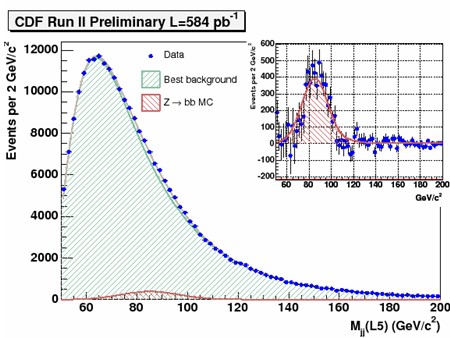
The purpose of my study of the dijet mass distribution had been to extract a signal of the very un-exotic Z boson decay to b-quark jet pairs (see picture, left -the Z signal is in red), but since Z decays to b-quark pairs are quite similar to Higgs decays to b-quark pairs, indeed if the bump found by Conway and collaborators was due to a few Higgses decaying to tau leptons, my own plot would by necessity contain quite a few more decaying to b-quarks: that is because if a MSSM Higgs exists and if it produces a signal in the tau-tau final state, it does decay to b-quark pairs, too. The b-quark is in fact as similar to the tau lepton as a quark can be: both are third-generation fermions, and both have negative weak hypercharge, and both have a mass of a few GeV. If the MSSM Higgs decays to taus, it also decays to b's- unless you introduce complicated perversions in your SUSY theory.
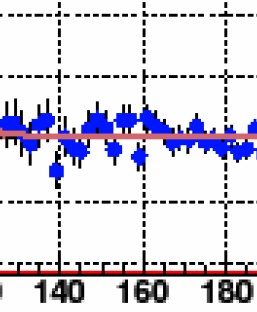
My own mass distribution of b-quark jet pairs was in good agreement with background predictions, but as I commented the results found by John and his colleagues, I noted that the background in my plot could easily hide the excess one would expect at 160 GeV from Higgs production: a few hundred Higgs decays could be there, hard to spot, but potentially awaiting to provide a confirmation of the MSSM Higgs discovery (see on the right an enlargement of the inset in the previous plot).

I was writing these comments tongue-in-cheek, since it was clear to me that what had emerged from the tau-tau mass distribution was just a fluctuation of backgrounds. See, I do not believe in supersymmetry! Regardless of what I believed, however, my posts drew the attention of a New Scientist reporter, who had already contacted John Conway to gather information for his article. He now wanted to add my side of the story to spice things up.

Despite my attempts during our phone conversations at dumping his excitement, the NS reporter ended up producing an article which contained a few inaccuracies, and which put too much emphasis in what I had specifically explained to be, for sure, just a statistical fluctuation. His piece then got picked up by the Economist, which added some additional misrepresentations. The final result was a mediatic bubble which was quite upsetting for a few of my colleagues within CDF. So much so that I, despite having done nothing wrong, apologized with my collaborators for having caused a stir in the media.

Two years later...

More than two years later, we are in the situation of giving a look at a fresh new analysis produced by the DZERO collaboration, which used a larger data sample of proton-antiproton collisions than the one available to Conway in 2007, to further investigate on the existence of a MSSM Higgs boson, by combining searches involving pairs of b-quarks and pairs of tau leptons.

The result, of course, is that there is no such thing: a MSSM Higgs has been excluded by DZERO in the range of theory parameters which was indicated by the 2007 result; this is something which also an update of the analysis by CDF has clarified. So if you only care for exciting news, you can stop reading now. However, we might learn a thing or two by looking at the DZERO analysis in some detail. That is what I offer to do for you in the following; but first, let me give you in my usual inaccurate fashion a very quick and dirty introduction on the Minimal Supersymmetric extension of the Standard Model, and on the few basic facts you need to know about the Higgs boson predicted within that framework.

The Higgs boson in the MSSM

The Minimal Supersymmetric extension of the Standard Model is a subset of a class of theories -generically called supersymmetric- which build on the Standard Model of electroweak interactions to mend a very nagging shortcoming of the SM, called the problem of fine tuning.

In two words, in the SM the Higgs boson mass is unnaturally small, since its value receives very large positive and negative contributions from virtual diagrams. As Michelangelo Mangano aptly puts it, it is as if you asked each of ten friends to give you a irrational positive or negative number of order unity, and upon adding the ten numbers, you found a result equal to 0.000000000000000000000000000000001 or so: you would guess that your friends played you some trick! They must have conjured to nullify the sum of their ten numbers.
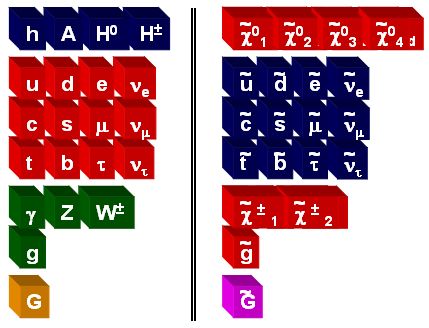
Supersymmetric theories solve that problem -the unnatural smallness of the sum of many different large contributions from virtual processes to the Higgs mass- quite elegantly. There, the Higgs boson mass is protected from those large contributions by the existence of a full class of additional particles, copies of the Standard Model quarks, leptons, and gauge bosons, but endowed with different values of spin. The figure on the right shows on the left side the SM particles (with
five Higgs bosons, whose explanation is given below), and their
corresponding s-particles on the right side.

Bosons will be fermions in the SUSY world, and fermions will be bosons: a really beautiful symmetry, but one which unfortunately is not realized fully in nature. No, it cannot work as is: because all these additional particles have never been seen in Nature. So we need to "break the symmetry" between SM and SUSY, and hypothesize that some mechanism is at work to make the SUSY particle masses much larger than our present detection reach.

So, in order to solve the problem of fine tuning of the SM, we have to assume that there exist more than twenty so-far-unseen elementary particles, and that these particles all have masses above our detection limits, but not too much so (lest their mending effect on the fine-tuning becomes more complicated to keep intact). Together with those additional particles, there are at least 105 new unknown parameters to buy in the package, which the theory does not explain: not just the particle masses, but their couplings, mixings, etcetera. A whole new world to explore.

To be fair, SUSY theories do not just give us a solution to the problem of fine tuning, in exchange for these 105 free parameters and score of new particles they load the theory with. They have the benefit of making more straightforward the unification of forces at very high energy -a very appealing feature for theorists.

To understand this point, you need to know that electromagnetic and weak interactions "unify" at the electroweak scale: for energies larger than the mass of the weak vector bosons -say above 100 GeV, or 100 proton masses- the two interactions have similar strength, and they are in fact described in a unified way. Physicists believe that the same unification happens at a much higher energy scale -one directly unreachable by our experiments- between the three fundamental gauge couplings of the Standard Model. However, in the absence of supersymetry, the three gauge couplings do not seem to converge to a single point. In supersymmetric theories, the evolution of interaction strengths at high energy is varied from the SM, and the three interactions do "meet" at the same energy scale. This is sketched in the figure above.

Now, let me go back to the spectrum of particles predicted by SUSY theories. As far as the Higgs boson is concerned, in the MSSM (which is a minimal version of the many different SUSY theories that can be formulated) there is not just one such particle, but five different ones; the three electrically neutral ones are called h,H, and A; and then there are a and a . The lightest neutral Higgs among these five particles does behave similarly to the Higgs boson of the Standard Model, so search techniques are pretty similar.

A value significantly different from 1 of a unknown parameter called allows the lightest neutral Higgs to be produced much more frequently by our colliders, such that we have sensitivity for that particle even with the data already available at the Tevatron: cross sections are larger by a factor , and these MSSM Higgs bosons might already be extractable from the data. In fact, present searches have started to exclude significant portions of the parameter space of supersymmetric theories, by not finding a signal of SUSY Higgs bosons.

Let us then have a look at the analysis that DZERO recently produced: it allows to peek inside the techniques which are used to extract a potential signal; the techniques rely on the known properties of the Higgs boson, in particular, its expected decays. As mentioned above, these are dominated by tau lepton pairs and b-quark pairs.


The combined DZERO search for MSSM Higgs bosons


The result published by DZERO is a combination of three separate searches for MSSM Higgs bosons, by allowing the Higgs to decay to either tau lepton pairs of b-quark pairs. Why three and not two searches ? Because DZERO considered two different ways of producing the Higgs; in one case, only the tau-lepton final state could be searched, in the other, both final states are possible. Let me explain in more detail this fact.
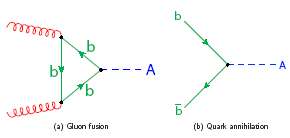
In proton-antiproton collisions the Higgs can be produced by a multitude of different processes, but most of them are irrelevant for practical detection purposes. The two considered by DZERO in their searches are direct production -through quark-antiquark annihilation or gluon-gluon fusion diagrams such as those shown on the left- and Higgs radiation off a b-quark -the process called Higgs-strahlung, originated by diagrams such as those shown in the Feynman graphs below. The two classes of processes are quite different in their phenomenology: in direct production the Higgs is the only object which appears in the final state of the collision, if we ignore the debris due to the remnants of the two projectiles, which leaves the interaction point along the beam line; in Higgs-strahlung processes, instead, it recoils against a b-quark jet.
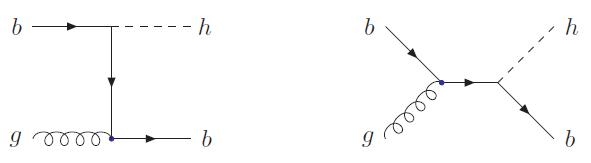

When directly produced,  only a Higgs decay to two tau leptons can be identified because tau leptons provide a clean signature in the detector, and backgrounds are relatively small; for b-quark pairs, the signal would instead be buried in a huge background coming from quantum chromodynamical (QCD) processes: strong interactions which produce pairs of b-quarks with large rate.

If instead it is produced by Higgs-strahlung, the Higgs signal can be searched even in the decay, because the presence in the event of a third b-quark -the one from which the Higgs boson got radiated- causes a strong decrease of QCD backgrounds: QCD produces quark-antiquark pairs, and the third odd b-quark forces backgrounds to have four of them.

Three search channels

The search makes use of the variegated phenomenology of tau lepton decays. In a sizable fraction of their disintegrations, tau leptons just produce an electron and a pair of neutrinos, or a muon and a pair of neutrinos; they thus appear as an energetic electron or muon. In the rest of their decays, they yield narrow hadronic jets containing few particles -typically one or three charged pions, plus a few neutral pions.
From an experimental standpoint, there are thus three different possibilities to select Higgs decays to tau lepton pairs: the event will contain an electron and a narrow jet, or a muon and a narrow jet, or an electron and a muon; dielectrons or dimuons, which would suffer from large backgrounds from electroweak processes, are not considered by DZERO.

In the search for the Higgs-strahlung process, the topology always includes a muon from tau decay, a narrow jet, and a b-tagged jet. The muon is needed because it is through its presence that the event is collected by the online trigger system.

Finally, in the Higgs-strahlung process, at least three b-tagged jets are selected by a neural-network b-quark jet identification. The events are collected by a three-jet trigger, but they may contain from three to five hadronic jets; the large backgrounds are handled by using two separate likelihood discriminants, one optimized for Higgs bosons of mass below 140 GeV, and the other for larger masses.

Results

The data in each of the three searches are compared with the sum of backgrounds, finding good agreement and no hint of a signal for any Higgs boson mass hypothesis in the studied range. To combine the many different search channels into which the three main topologies are divided (depending on the kind of lepton is identified from tau decay, or the number of jets in the event for the three-b-quark search), the data are combined into bins of similar signal to noise ratio: in this way, the sensitivity of the combination is maximized. One thus obtains a plot where the observed data is shown as a function of the logarithm of the ratio between number expected signal events and background events.
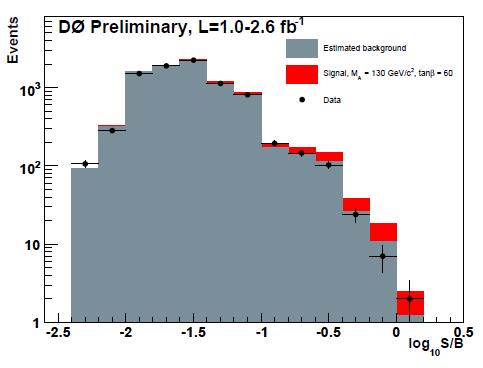


Above you can see the case of a Higgs boson search: here, a value has been assumed to draw the expected amount of signal in red in each bin. The grey histogram shows the background distribution expected from the many contributing sources (mainly coming from top-quark pair production and QCD processes, plus decays), and the black points with error bars show the DZERO data. A good agreement with the background hypothesis is indeed observed.

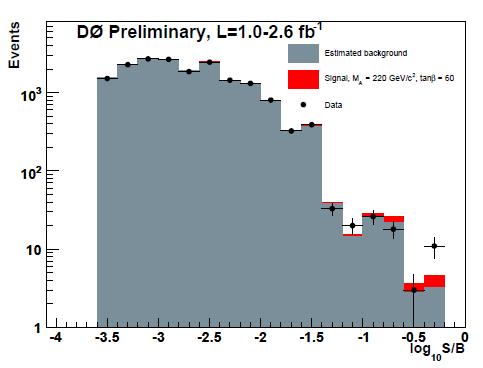
Below is instead the case for a 220 GeV Higgs boson, at the same value of . It is evident that for such a high mass of the Higgs boson, the expected signal in the data becomes much smaller, due to the fact that the production cross section decreases quickly with the particle mass. Again, a good agreement between data points and the grey histogram is observed.


From histograms such as the ones shown above, upper limits on the Higgs production cross section can be derived for a variety of values of the parameters describing the MSSM parameter space. Whenever the upper limit on the signal cross section is smaller than the cross section predicted by theory, the corresponding point of the parameter space is excluded. The result is usually displayed in a plot of versus the mass of the A boson (regardless of whether A was searched or another Higgs neutral scalar of the trio; two of the three neutral Higgs bosons are usually degenerate in mass for much of the parameter space).
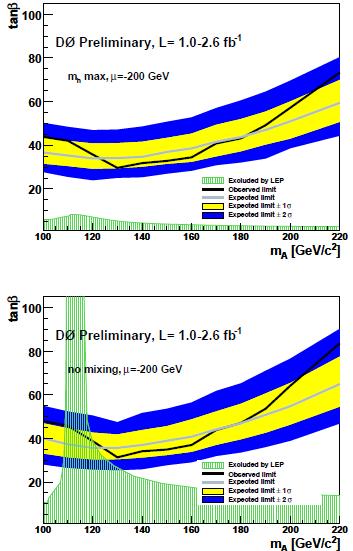
On the left I provide a couple of such exclusion plots. They correspond to two different choices for the value of other parameters of the MSSM scenario considered, the so-called "Mh max" and the "no mixing" cases. I will not make this piece more technical that it needs be, so the explanation of what those cases refer to is waived. Let me just mention what the differently coloured areas mean: the green area has been excluded by the LEP experiments; the yellow and blue bands instead show the ranges -within one and two standard deviations, respectively- where DZERO expected to obtain its exclusion limit, giving their analysis method and data sample size. The black curve shows the actual limit: it needs to be interpreted as an upper limit on the allowed values of for any given mass of the A boson, such that all the area above the black curve is excluded.

The area excluded includes the region once favoured by the 2-standard-deviations Higgs boson signal seen by CDF in January 2007. This is no big news: in fact, a more recent result by CDF had already excluded the former signal, toward the end of that same year. What I think is more relevant is that the present search puts together two very different production processes, and exploits two complementary decay channels. To do better than DZERO, CDF will probably need to use the same technique. Besides, this is what has been used by both experiments for a while now, for SM Higgs searches: the combination of many insignificant results allows to obtain significant advancements. The logic of the ant at work in HEP!

In conclusion...

The Tevatron searches for Supersymmetry have already removed a large chunk of parameter space to these models. The allowed range of some of the parameters has shrunk considerably in the last few years, and yet the faith in SUSY of many colleagues, both theorists and experimentalists, is unshaken. Whenever I talk to one of them, and they show amazement when I declare I do not believe in SUSY, I am left with mixed feelings. Does not the continuously shrinking parameter space get my colleagues thinking that maybe -just maybe- SUSY is a beautiful, deep, erroneous theory of Nature ?

Or maybe I am the one who does not understand that really, naturalness of the Higgs mass and grand unification of the three gauge couplings at a single scale are priceless, and 105 unknown parameters are still a modest price to pay ?

Unfortunately, it will take a long time to find out. Or maybe not: experiments at the LHC, which is starting up this fall at 4 or 5 TeV per beam, might just see cascades of supersymmetric particles from day one after startup.... Let me doubt about that. I would be very, very happy to be proven wrong, but I just do not buy it...

Comments

I understand your dislike of SUSY given the absence of clear evidence for it and Occam razor. But we know that there is dark matter, which has to consist from not-SM particles. Do you think that SUSY is just too complicated theory for incorporating one additional not-SM particle and solving the fine-tuning problem ? If so, what are the simpler alternatives to SUSY ?

dorigo's picture
Hi Sergey,  who said DM is made of elementary particles ? I believe it is made of something else.
A good possibility is primordial black holes, for instance...
As for fine tuning, I do not see it as one of the most pressing issues. In my opinion, there is much more left to understand than fine tuning. Quantum gravity, for instance... Until we have a theory that really can explain everything together, fine tuning is a false problem to me. It might have a anthropic explanation!

Cheers,
T.

Thank you for your reply Tommaso.
From your answer I see that you don't believe in Hawking radiation :) I agree that if you think that the BHs don't evaporate, they can constitute the cold DM (although I have no idea whether the theory is able to produce so many stable BHs (25% of the mass of the Universe) in the early stages of the Universe).
Cheers,
S.

dorigo's picture
Well, who knows. It is just the first non-elementary particle physics explanation I could think of. However, be careful with percentages - DM is believed to make up for 80% of the mass of the universe, or 25% of the whole mass-energy budget. But you certainly know that.
There exist other possible explanations. Supersymmetry is nice because it gives more or less the right cross section -that is, until we will have ruled out particle masses up to a TeV, when this will stop being a strong argument...

Cheers,
T.

Tommaso,
you cite your Fig. 1 as a point in favor of supersymmetry,
because "... in the absence of supersymetry,
the three gauge couplings do not seem to converge to a single point ...".

However,
why would it not be just as nice and useful for two of them to meet first,
and
then the combination of the first two to meet with the third,
especially
if the first two were naturally unified ElectroWeak
and the third were the Color Force
with
unification of all three at around 10^14.5 GeV
and
total unification (including Gravity) occurring at the Planck scale ??

Tony Smith

PS - Here is a link to an image modified from your Fig. 1
to illustrate my question:

http://www.tony5m17h.net/SM12uni3.jpg

I tried to post it as

but it did not show up correctly on Preview.

dorigo's picture
Hi Tony,

sure, of course two couplings might merge and then join the third. This is not much worse than the eye-pleasing convergence of the three couplings together. I do not think we can be guided by such qualitative arguments, so I do not consider too compelling the "built-in" coupling unification feature. But people who understand theory better than me do find this a rather important point in favor of SUSY...

Cheers,
T.

I wonder if Italian Nobel Prizewinner Cabibbo will comment on this in his public talk in Roma in connection with the big Strings conference? By the way, here he is on Youtube:

http://www.youtube.com/watch?v=wo4A7vyAL-k

I can't comment on his physics but his taste in women is impeccable. Those are the nicest legs I have ever seen.

Yes, Tony,  I've wondered about the same as Tony Smith. Or it could something crazy like the water phase diagram:

http://upload.wikimedia.org/wikipedia/commons/d/de/WaterPhaseDiagram.png

Where some or the branches disapear, spontaneously appear, or unite.

BTW, Tommaso, I've been thinking of Dark Matter, and maybe it doesn't need any new physics. It is just the classical interaction graviton-graviton

http://arxiv.org/abs/0901.4005

Now, I just have to see if these scattering conspire to make gravitational solitons AND/ Or it might be that  gravitational solitons are just remains of the beginings irregularities of the inflations in the begining universe. I guess it is better than think about black holes zooming around...

Marcos Fraca indicated the works of Beliski, a specialist in gravitational solitons, and this guy was also his professor.

It is called "demagogy" if you take some specific hunch of John Conway about SUSY Higgs at 160 GeV - that almost no one else has ever believed - and call it "supersymmetry". On the other hand, SUSY is reasonably likely to be there, at accessible energies, with the Higgs comfortably around 120 GeV, and nothing has changed about it now. We'll see.

dorigo's picture
Well, Lubos -if Conway's signal had turned out to be a new particle, it would have been SUSY for sure. Believing a 2-sigma evidence is another matter, of course. What is constantly changing is that SUSY particle masses get pushed further up by the experimental searches... This of course might prove meaningless, if one day we do find it. Or, in the other case, prove that some ideas in Science never get abandoned, and die when their supporters do.

Cheers,
T.

Come on, Tommaso, one such a measurement couldn't prove "SUSY for sure". Equally importantly, if one particular realization of "SUSY for sure" is ruled out, it doesn't mean that "SUSY more likely than not, with other parameters" is also ruled out.

dorigo's picture
I agree to both your observations... See, sometimes, when you behave, one can easily concur with you!
Cheers,
T.

The fact that you don't like supersymmetry just goes to show your lack of taste. The arguments you use to explain how ugly it is are repeated over and over again without thinking. Take for instance this "we have to assume that there exist more than twenty so-far-unseen elementary particles" is a total misrepresentation of SUSY which simply embeds all particles in SUSY multiplets roughly enlarging the particle content by a factor 2. Now, it's not the same to say that your theory requires adding more than 20 additional particles (in fact is much more than that) than saying you have to double the spectrum as any known particle must have supersymmetric "shadows" along quantum dimensions.

dorigo's picture
Your supersymmetric shadows are real particles, Armonyous, with masses quite different from the SM ones, and different spin and decay properties. Each and every one of the introduced new states, in fact, adds richness to the phenomenology. So do not hide behind factors of two, which are the real deception. These are 23 new states (or 35, if you count squarks of different color -but there, really, we would be cheating). What do you mean by "much more than that" ?

Our disagreement depends, I think, largely on the fact that you think as a theorist, and I think as an experimentalist. From a theory point of view, sure, add SUSY, and the spectrum doubles -no big deal, and we win on many tables: naturalness, GUT-readiness, DM candidates. From an experimental point of view, however, you are putting on the market a large stock of new states of which no evidence has ever been seen. And you add as a footnote that the beautiful symmetry is broken "otherwise we'd have seen these particles already". Sorry, but a perfect SUSY symmetry would have been beautiful, such a badly broken one is ugly. If you claim it's a matter of taste, well... I think an elegant theory has few god-given parameters, not 130.

Cheers,
T.

Dear Tommaso, you are indeed talking as an experimenter. The problem is that you are talking as an experimenter but about theoretical issues, which is why you are talking as a moron, too.

The comment that a broken SUSY is "ugly" reveals your complete lack of sense of "beauty" in physics. In theoretical physics, this sense is actually not a subjective, ill-defined aesthetic criterion but a result of a good judgment and summary of many similar situations in which the number of elementary concepts has been reduced.

For example, you could have said the very same thing about the electroweak symmetry. A perfect electroweak symmetry would be beautiful (with massless electrons and all stuff like that) while a broken one is ugly, isn't it? Well, it's not. At the fundamental level, a broken electroweak symmetry is as beautiful as an unbroken one. It is actually the very same theory in the UV. Whether or not it manifests itself in the broken form or the unbroken form depends on the low-energy dynamics, Higgs potentials, and similar stuff. A Higgs potential with a sphere of minima rather than a unique minimum at h=0 is not "more ugly", it's actually equally symmetric and equally beautiful: it's just dynamically different.

So I would recommend you to refrain from your judgments based on parts of your knowledge that is completely missing in your brain, otherwise you look like a moron, and it may be more than just a perception.

Needless to say, the situation with SUSY is analogous. Much like the electroweak symmetry, SUSY is broken at low energies but preserved at the very high energies. It is highly conceivable that a restored SUSY in the UV is as necessary for the consistency (of the full theory, including quantum gravity) as a restored electroweak symmetry is needed for the consistency of weak interactions. So the only question might be where it is broken and how - both in the electroweak and SUSY case.

At any rate, your aesthetic criteria are completely unrefined and they may only matter for people who are as unrefined as you are when it comes to judging physical theories.

130 is not a number of God-given parameters. There are 0 God-given parameters in the full theory which is called string theory. 130 is just the number of phenomenological parameters of an effective low-energy theory. All of them are calculable from the fundamental theory once the right vacuum and matter content breaking and communicating SUSY breaking is known. See e.g. the papers by Intriligator, Shih, Seiberg and their followups to see how the true origin of SUSY breaking is dynamically calculated in specific models, and please view this lesson as a good reason to shut up about things that you have no idea about, such as the comparisons of the theoretical strength of theories in theoretical physics.

dorigo's picture
Lubos, to insist in my mistake of talking about things I should be forbidden to discuss, which of the 10^500 versions of string theory are you referring to when you say it has no parameters ?  ;-)
Cheers,
T

Dear Tommaso, as the duality revolution has shown, there are no "different versions of string theory". There is only one string theory, and like any sensible realistic theory of anything, it has many solutions. The journalistic figure 10^{500} is a finite figure, counting a finite set (a subset of a countable set of stabilized vacua). If there were parameters in string theory, the number would be uncountable. There are no parameters in string theory. You shouldn't have read bullshit from crackpots like Peter Woit and Lee Smolin that much.

dorigo's picture
Uuuh, correct me if I am wrong Lubos, but when Weinberg and Salam wrote down the theory of electroweak interactions, there were not many solutions: just one.
Anyway, I admit my knowledge of string theory is based on popularization articles and books, so have it your way...

Cheers,
T.

Dear Tommaso,
I tried to correct some widespread laymen's misconceptions about the symmetries and their beauty and predictivity here:

http://motls.blogspot.com/2009/06/symmetry-and-beauty.html

Field theories have the "non-uniqueness" in their very definition, e.g. in the spectrum and choice of interactions that are included. That's because they're not unifying theories of everything: they only describe possible things given certain phenomenological low-energy field content. In string theory, the different field theories are realized as vacua in a unified theory, so one has many solutions of one theory instead of many theories.

However, your implicit statement that field theories can't have "landscapes of solutions" is also wrong by itself. Multiplicity of solutions is a generic phenomenon in sufficiently complex or comprehensive theories, including field theories. Search through Nima's paper a few years ago. The Salam-Weinberg theory is a theory describing too simple a physical setup, so it can have a limited number of solutions. Still, the Standard Model - and even the Salam-Weinberg theory - has many thermodynamic phases etc. - which is pretty much the same thing.

It doesn't seem that you are too affected by popularizing books written by experts for the lay audience - you rather seem to be influenced by depopularizing, anti-physics vitriolic books written by the crackpots. You should read a popular book about string theory, too, to get at least some basic knowledge about the subject.

Best wishes
Lubos

Thanks Lubosi.

Tommaso, it's not a matter of being a theorist or an experimentalist. What kind of physicist are you that fails to appreciate the beauty of a theory beyond the myriad of masses and couplings to be measured? Why the hell would you want to measure them for?

May Supersymmetry exist and may you spend the rest of your life measuring all those observables without appreciating what they are important for!

Primordial black holes are indeed consistent with WMAP results, according to Spergel, and this is not a trivial test. From the latest results on scattering amplitudes in (eg.) N=4 SYM we know that mathematical supersymmetry is there somewhere in an effective theory, but of course the idea of SUSY partners is ludicrous ... as if an old fashioned local field theory could be the correct way to predict new observables ... what an idea, LOL!

Tommaso, you clearly disfavour SUSY. Do you believe the LHC will find any new physics beyond the SM Higgs? There are tons of theories on the current marketplace for possible SM extensions that would lead to new physics at the LHC scale. Do you believe any of them? Or do you think the LHC will cost billions of euros and see only one new particle?

dorigo's picture
Hi Anon,

yes, you basically have it. I have in fact bet against the LHC finding any new particle besides a SM Higgs. The bet, which is for $1000, has been taken for three-quarters by theorist Jacques Distler, and for the rest by ATLAS experimenter Gordon Watts.

Mind you, it is not so much that I believe LHC will not find new physics. I fear it won't, and so I placed a sort of insurance bet. I am in fact spending the best years of my working life on this machine...

See here for the bet.

Cheers,
T.

Yes, I know about the bet (and sorry, but I must cheer that you lose it). My question is more to the direction of: do you dislike all NP theories equally? Or are you specially against SUSY? Or maybe (as most physicists I know) you have a softer spot for one particular model, or class of models?

dorigo's picture
I confess: theories with large extra dimensions are the most fascinating ones to me. However, I do not believe those either :)
As you see, I am really a die-hard sceptic. My scepticism is not scientifically consistent -I know the SM is just an effective theory, and it must break down somewhere. I just cannot see it happening any time soon...

Cheers,
T.

Hi Tommaso,

Thank you for the interesting post. One comment- it's not really the case that the lightest neutral Higgs has \tan\beta enhanced production, because it depends on m_A. For large m_A all the couplings of the lightest Higgs become SM-like, and it is the heavier Higgs that has enhanced production through bottom loops. However, the cross section is still small as you point out because of the mass suppression. This is why the exclusion plots you reproduced above only extend to relatively moderate values of m_A. Only for low m_A < m_h_max (the maximum lightest Higgs mass in the scenario) is it the lightest Higgs that has any enhancement, and this parameter range is already somewhat constrained by LEP.

My collaborators and I recently did a theoretical study of the Tevatron reach for the neutral Higgs sector of the MSSM (arXiv:0905.4721), which you might find of some interest.

Best,

Patrick

What happens when I post a comment with the address of someone who hates spam, and is quick to call a lawyer?

Oh wow. Test@test.com must be PISSED. What an annoyance.

dorigo's picture
Hi Patrick,

thanks for the clarification. In the post I totally avoided the issue of which higgs we are looking for, whether it is degenerate with a second one, whether the width effects at large tan(beta) make the result meaningful or not, etcetera. I know a little about the effects you mention, because I did ran some simulations of MSSM higgs production at generator level a few years ago -and I had to struggle to understand the results at first.

In a sense, writing here is relaxing, because I know I can be inaccurate without a problem: what remains after one forgets the details is culture, and that I think I am capable of distributing, suitably filtered :)

And, thank you also for your link. Your paper is very interesting. Would you be willing to write a popularization of its main results for this site ? I used to have a series called "guest posts" at my old site (Ben Allanach contributed with a piece on the MSSM a while ago), you would be the first one here. Let me know...
The rules are: one to five-six pages, at least a few well-explained figures or graphs, and availability to answer comments for a few days after the posting. A few thousand readers are guaranteed.

Cheers,
T.

Hi Tommaso,

I understand- sorry to nitpick! Thank you very much for the invitation, I'd be happy to do a guest-post. Can you send me an email (pdraper[at]uchicago[dot]edu) so that I have your address? Also, what format should I send you- latex, PDF, html, etc?

Thanks,
Patrick

The SI standard of mass is a physical artifact, Newton's G cannot be calculated, the Standard Model arrives massless. Supersymmetry's partners refuse to appear, protons do not decay, the Higgs mechanism does not reveal its vector boson. Supergravity, lattice and loop quantum gravity, and above all string and M-theory predict nothing. Meanwhile...

The Nordtvedt effect is not observed. Polarized electron spin and orbital angular momentum test masses validate the Equivalence Principle (EP). Generall Relativity exactly describes 1.74 solar-mass pulsar PSR J1903+0327 in a 95.17-day 0.437-eccentricity orbit with its 1.05 solar-mass star companion. 27% vs. 1.4x10^(-4)% gravitational binding energy, 1.8x10^(11) vs. ~30 surface gees, 2x10^(8) gauss vs. ~5 gauss magnetic field, superconductive compressed neutrons and exotica vs. proton-electron plasma; pulsar equatorial spin >11% lightspeed validate the EP within observational error. Einsteins's elevator is definitive if the vacuum is isotropic. Meanwhile...

All protein L-amino acids and natural D-sugars (e,g, cellulose) - biological homochirality. Yang and Lee demonstrated the Weak Interaction (weak interactions overall - look for yourself) are not parity-conserving. If the vacuum is not massed-sector achiral isotropic all of physics goes for a Burton without contradiction of prior observation: DO LEFT AND RIGHT SHOES VACUUM FREE FALL DIFFERENTLY? Do macroscopically and chemically identical, opposite parity atomic mass distributions violate the EP? Anisotropic vacuum plus Noether's theorems do not enforce conservation of angular momentum. Noether's theorems require continuous symmetry - invalid given external (coupled to rotation and translation) discontinuous symmetry parity.

Reduction to practice: Some enantiomorphic crystallographic space groups contain no conflicting or racemic screw axes: P3(1)21 and P3(2)21, P3(1) and P3(2), [3(1) is a right-handed threefold screw axis, 3(2) is left-handed]. The first pair is right and left-handed single crystal quartz commercially grown to high purity and structural perfection. The second pair is right and left-handed single crystal glycine gamma-polymorph, easily grown from acidified water. Load parity Eotvos experiments opposing solid spherical single crystals of right- and left-handed quartz or, separately, glycine. The proper test of spacetime geomery is atomic mass distribution geometry. If there is a net non-zero signal output...

The Big Bang launched with an intense massed sector chiral pseudoscalar vacuum background. Its dilution powered cosmic inflation; the Weak interaction froze out left-handed; matter dominated antimatter as broken symmetry forced baryon number and other conservation violations during false vacuum decay. Biological homochirality was universally biased by residual chiral anisotropic vacuum background long thereafter. Quantized gravitation theories require supplementing Einstein-Hilbert action with a parity-violating Chern-Simons term.

Then rewrite contemporary physics so it works: teleparallel gravitation into quantized gravitation; SUSY rebuilt.

dorigo's picture
Uncle Al, that's hilarious. Have you ever thought of becoming a live reporter of sports events ? "Tardelli crosses the midfield line. Serves Cabrini. Cabrini advances. He sees Rossi. Rossi gets the ball. He turns around. Rossi is trying to kick. Rossi... Goal!!!!"

Cheers,
T.

A handful of pre-meds could overturn quantum mechanics at the founding postulate level as assuredly as Euclid's parallel postuate proved to be weak. If the vacuum is chiral anisiotorpic in the massed sector, Einstein's elevator has a trivial empirical exception: left and right shoes. Noether's theorems fail for chiral anisotropic vacuum. Left and right shoes, opposite parity atomic mass distributions, macroscopically identical crystals of left and right-handed quartz... will not conserve angular momentum and QM is then incomplete. Funny strange but not funny ha-ha.

It is not humor given the experiment. The massless seclor is achiral by observation. Nobody in physics or anywhere else has tested the massed sector. Billion lightyear paths show no optical refraction, dispersion, dichroism, or gyrotropy (certainly after the dilute intergalactic medium is subtracted). Nobody has tested opposite parity atomic mass distributions - that's chemistry, and physics knows nothing about constructing it. Yang and Lee illustrated the folly of letting theorists talk without beng held responsible for their predictions.

Nobody has performed a parity Eotvos experiment opposing enantiomorphic space groups P3(1)21 and P3(2)21 quartz (or cinnaabor, or berlinite, or tellurium..). If you want denser atomic packing and lower symmetry still, then single crystals of the gamma-polymorph of glycine, enantiomorphic space groups P3(1) and P3(2), respectively 0.01256 nm^3/atom and 0.007869 nm^3/atom,

Eur. J. Mineralogy 2 63 (1990)
J. Solid State Chem. 36 371 (1981)
Acta Crystallogr. B36 115 (1980)

If you do not like $2 million apparatus, it can be done in an undergrad lab via calorimetry with enantiomorphic space groups P3(1)21 and P3(2)21 single crystal benzil. Cutting edge 5x10^(-14) difference/average sensitivty mass/mass in an Eotvos experiment over 90 days is a 4% net signal vs. 0.1% precision in a set of differential scanning calorimeter differential enthalpy of fusion experiments over 48 hours,

http://www.mazepath.com/uncleal/shoes.png
differential vacuum insertion energy
http://www.mazepath.com/uncleal/orbit.png
differential parity Eotovs signal, energy/mass
http://www.mazepath.com/uncleal/lajos.htm#b4
5x10^(-14 ) relatlve not 10^(-13). Adelbeger's group improved.

Explanations of biological homochirality are loathsome. The weak interaction is strictly left-handed. Parity violating energy eifference (PVED) experiments seek a measurable energy divergence between left-handed and right-handed molecules from weak interaction Z^0 neutral current exchange between nucleus and electrons. Optimistic PVED is 8·10^(-12) eV. Room temperature energy background kT = 0.0257 eV. Carbon-carbon bond strength is 3.6 eV.

Mendeleev Commun. 13(3) 129 (2003)
Angew. Chem. Int. Ed. 41(24) 4618 (2002)
Angew. Chem. Int. Ed. 41(7) 1139 (2002)
Angew. Chem. Int. Ed. 39(22) 4033 (2000)
Chem. Phys. Chem. 2(7) 409 (2001)
Phys. Rev. Lett. 84(17) 3811 (2000)

Theorists boast promiscuity while empiricists pay child support. Somebody should look.

In my opinion Higgs boson was observed already as a bare top quark event. End of story.

Biological homochirality is explained here, if someone is interested... http://aetherwavetheory.blogspot.com/2008/11/cp-invariance-violation-and...

>which is why you are talking as a moron, too.
[...]
>There are 0 God-given parameters in the full theory which is called string theory.

Who's talking like a moron?

You're surely one of them but the original comment meant Tommaso Dorigo if you haven't caught this not-so-subtle point.

String theory is a beautiful mathematical construction. Too bad it has nothing to do with physics ;-)

What is this?????????????????????????????????????????????????????????????

>if you haven't caught this not-so-subtle point.

My ever-so-subtle point was that anyone who believes in a zero-parameter theory is a moron...

"My ever-so-subtle point was that anyone who believes in a zero-parameter theory is a moron..."

I think one can believe in a zero-parameter theory and not be a moron (QCD with massless quarks has just one discrete parameter, the number of colors, which is pretty close to no parameters). But what's pretty amazing is those people who believe in a zero-parameter theory of everything that can't predict anything at all....

You're not just a moron, you're human garbage, W*it, and your constant lies about "predictions" are just a small part of the reason why.

The number of parameters in string theory is the very same as the number of parameters in pure QCD - it is zero. Everyone who is not a moron has understood the reason and the experts have understood it for 30+ years.

Lubos, please... :-\

Every theory based on special relativity contains light speed as a free parameter, every theory based on quantum mechanics uses Planck constants as a free parameter, etc..

String theory is based on Lorentz symmetry and assumption of hidden dimensions (between many others).
When hidden dimensions would manifest itself by violation of Lorentz symmetry (and I don't see any reason, why they shouldn't), they would render string theory inconsistent from its very beginning. Any ideas?

Come on, Lubos, all that rap about string theory being parameter-free is more than 30 years old. It's even older than the SM. Remember the good old days when ST fans promised a dynamical computation of the electron mass? And what do you have to show to support your claims? Even Ludwig Plutonium has done better in the last 3 decades.............................

It's more than 30 years old and it's true and important, too. The people who realized it in the mid 1970s were not idiots, unlike most visitors of Dorigo's blog who haven't been able to understand these basic points, even after those years.

I don't have any magic enchantment that can teach basic physics to low-quality human material like you - quite on the contrary, it has been established that it is impossible. Return to school.

For those with IQ above 100, string theory has no non-dynamical adjustable parameters because every potential deformation of its rules is a marginal operator, or its nonperturbative generalization, and every such operator can be extended to a massless field by adding exp(ik.X) with any momentum, and all such massless scalar fields are stabilized in all realistic vacua without new long-range forces. This was a fact in 1979, it is a fact now, and in fact, it was a fact 13.7 billion years ago, long before people learned it.

I have never promised anyone any timeframe for a dynamical calculation of the electron mass even though I think it will become reality on on one day.

Dear Lubos,

String theory has many very nice and appealing features, I admit. I just don't understand why should we be so arrogant to call it the final theory? Why it isn't possible that it will get a place in the final picture, either literally or through the ideas we learn from it, without being IDENTICAL to the "final theory"? I mean, couldn't string theorists be just a little bit more open-minded? I tend to believe that if they learned somehow that the IDENTITY does not hold, some of them would commit suicide as it seems to be like a religion for them...

One statement by Veltman recently caught by eyes:

"In supersymmetry one inevitably has more than one Higgs system, so a priori that ruins the prediction of zero photon mass of the simplest Higgs model."

Winning a nobel price does not prevent you from basic misunderstandings.

Perhaps the difference between believers of the Saint String and the non-believers is that the formers feel that they have the right to call other people who don't kneel down before their words "low-quality human material". Well, Lubos, irrespective to whether you're right or wrong, on a human/moral level we already know your qualities. If we have IQ<100 than you have EQ<8.

Lubos, why should Tommaso, as an experimenter, think that a huge moduli for string theory is qualitatively any better than theories with lots of free parameters? I mean, I think in his mind, choosing a vacua that fits better experiment over another is worse than determining many parameters because for him, it implies having to live with phenomena with so high enegy levels that they won't be likely be probed within many centuries.

Anyway, I am not really sure if it is that what he thinks. Is it really that, Tommaso?

Dear Daniel, none of the semirealistic vacua in string theory has any moduli whatsoever. By the very definition, they're stabilized so they have no moduli. You shouldn't be using words that you have manifestly no clue about, and neither should Tommaso.

I am not saying that Tommaso should think something or something else as an experimenter. He has the freedom to act the way he wants. What I am saying is that by emitting this nonsense, all of you are showing that you are crackpots when it comes to physics beyond the Standard Model.

Finally.

Indeed, discrete degeneracy plays a similar role for certain practical purposes as a continuous degeneracy - that's what you probably wanted to say. And what? That's how the world works and has to work. The degeneracy of solutions is an established fact of physics, and even outside string theory, it is arguably impossible to derive a complex matter content of the Standard Model (or beyond) from any hypothetical theory with no significant degeneracy of vacua or multiplicity.

At any rate, no such theory exists today. You are talking about non-existent nonsense, wishful thinking, religious lunacy. I am talking about physics and in physics, the answers are diametrically different from your laymen's opinions tainted by too frequent a reading of other crackpots who have as vanishing clue about the subject as you do.

Lubos, but I said  that moduli -> vaccua, not vaccua -> moduli as you say.
" no such theory exists today" , you mean, standard model was not perfectly  found insided string theory?

dorigo's picture
Daniel, what I really think is that it is quite useless to argue with a taliban like Lubos on this matter. He manages to behave when we discuss other topics here, and he actually contributes positively then. So I prefer to keep it that way and avoid having to argue. Besides, I objectively am incompetent on the matter at hand, i.e. string theory. I can still recognize a fundamentalist when I see one, but that's another matter.

Cheers,
T.

Dear morons, instead of arguing using your empty skulls, you may want to learn at least some basics of the subject that defines the cutting edge of a discipline you claim to be interested in - physics - in the last 25+ years.

Tommaso, the popular line about 105 new parameters is somewhat misleading. If SUSY really is part of nature, and broken at around 1 TeV, there will be a specific theory describing this breaking, and it will have far fewer than 105 parameters.

dorigo's picture
Sorry, Rhys, but these kinds of handwaving theoretical arguments are unconvincing to me. It is always a promise of future enlightenment, much like string theory. I am maybe obtuse if I see the trees and not the forest, but that is the view from the vantage point we are sitting on right now.

Cheers,
T.

Yes, QCD with massless quarks is parameter-free, and that's fascinating.
It's also interesting that in the real world, since QCD was discovered until today, many billion dollars have been spent just to find out what the value of the strong coupling constant is in Nature. At the Z peak and in MSbar scheme at NNLO and NLL it is about 0.1 That's a pretty expensive parameter for a parameter-free theory.

Quite a few years ago I attended a seminar E.Witten gave to a mixed audience of theorists and experimentalists about physics beyond the SM. Needles to say, string theory and susy featured prominently in his talk. At the questions session an experimentalist asked a rather obvious question, what if susy is not observed at the LHC? Witten's answer is one of the following two, guess which one,

(a) Only a moron with a terribly ugly bad taste for physics would ask such a question. The problem with experimentalists is that they are all idiots. Even a mentally retarded infant would know by now that susy IS going to be observed by the LHC, just because string theory is a parameter-free theory of Nature all the way up to the Planck scale.

(b) In that case further development will have to be experiment driven.

So be it....

dorigo's picture
 Ah anon, but Lubos cannot be blamed for not being on par with Witten. We would all be to blame in that case...
Cheers,
T.

Witten is actually being hypocritical up to dishonest in many of these situations, and I think that he is a part of the problem. Still, he has done enough for me to forgive him these sins.

"Witten is actually being hypocritical up to dishonest in many of these situations, and I think that he is a part of the problem. Still, he has done enough for me to forgive him these sins."

That's what blogs are for, to get the inside scoop that you won't get from more formal channels.

I had no idea Witten is dishonest and hypocritical, and that he is a problem for string theory. I wonder, how far is Humanity going to go in its degeneration ?

Thank God we have Lubos to enlighten us on these issues. I feel relieved that he forgives him, though.

What I wrote is no secret or a blog-level material. The fact that e.g. hateful crackpot W*oit can abuse the name of Witten against string theory in the way he does would surely be impossible without this particular attitude of Witten himself.

Add a comment

The content of this field is kept private and will not be shown publicly.
  • Allowed HTML tags: <sup> <sub> <a> <em> <strong> <center> <cite> <code> <TH><ul> <ol> <li> <dl> <dt> <dd> <img> <br> <p> <blockquote> <strike> <object> <param> <embed> <del> <pre> <b> <i> <table> <tbody> <div> <tr> <td> <h1> <h2> <h3> <h4> <h5> <h6> <hr> <iframe>
  • Lines and paragraphs break automatically.
  • Web page addresses and e-mail addresses turn into links automatically.
CAPTCHA
If you register, you will never be bothered to prove you are human again. And you get a real editor toolbar to use instead of this HTML thing that wards off spam bots.