




Suzaku ("red bird of the south") was launched on July 10, 2005. The observatory was developed at the Japanese Institute of Space and Astronautical Science (ISAS), which is part of the Japan Aerospace Exploration Agency (JAXA), in collaboration with NASA and other Japanese and U.S. institutions.
The team trained Suzaku's X-ray telescopes on the cluster PKS 0745-191, which lies 1.3 billion light-years away in the southern constellation Puppis. Between May 11 and 14, 2007, Suzaku acquired five images of the million-degree gas that permeates the cluster.
By looking at a cluster in X-rays, astronomers can measure the temperature and density of the gas, which provides clues about the gas pressure and total mass of the cluster. Astronomers expect that the gas in the inner part of a galaxy cluster has settled into a "relaxed" state in equilibrium with the cluster's gravity. This means that the hottest, densest gas lies near the cluster's center, and temperatures and densities steadily decline at greater distances.
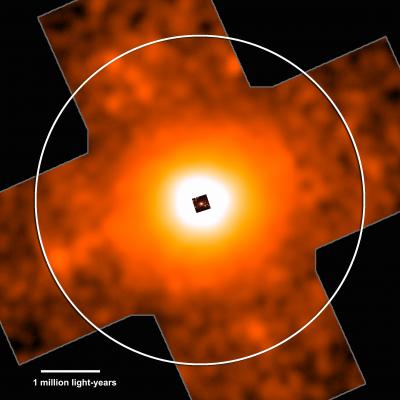
This Suzaku image shows X-ray emission from hot gas throughout the galaxy cluster PKS 0745-191. Brighter colors indicate greater X-ray emission. The circle is 11.2 million light-years across and marks the region where cold gas is now entering the cluster. Inset: A Hubble optical image of the cluster's central galaxies is shown at the correct scale. Credit: NASA/ISAS/Suzaku/M. George, et al.
"These Suzaku observations are exciting because we can finally see how these structures, the largest bound objects in the universe, grow even more massive," said Matt George, the study's lead author at the University of California, Berkeley.
In the cluster's outer regions, though, the gas is no longer in an orderly state because matter is still falling inward. "Clusters are the most massive, relaxed objects in the universe, and they are continuing to form now," said team member Andy Fabian at the Cambridge Institute of Astronomy in the UK. The distance where order turns to chaos is referred to as the cluster's "virial radius."
For the first time, this study shows the X-ray emission and gas density and temperature out to -- and even beyond -- the virial radius, where the cluster continues to form. "It gives us the first complete X-ray view of a cluster of galaxies," Fabian said.
In PKS 0745-191, the gas temperature peaks at 164 million degrees Fahrenheit (91 million C) about 1.1 million light-years from the cluster's center. Then, the temperature declines smoothly with distance, dropping to 45 million F (25 million C) more than 5.6 million light-years from the center.

The massive radio galaxy PKS 0745-191, for which the cluster is named, appears at the center of this Hubble Space Telescope image. The picture forms the inset in the Suzaku image above. Credit: NASA/STScI/Fabian, et al.
To discern the cluster's outermost X-ray emission requires detectors with exceptionally low background noise. Suzaku's advanced X-ray detectors, coupled with a low-altitude orbit, give the observatory much lower background noise than other X-ray satellites. The low orbit means that Suzaku is largely protected by Earth's magnetic field, which deflects energetic particles from the sun and beyond.
"With more Suzaku observations in the outskirts of other galaxy clusters, we'll get a better picture of how these massive structures evolve," added George.
The findings appeared in Monthly Notices of the Royal Astronomical Society.



Comments